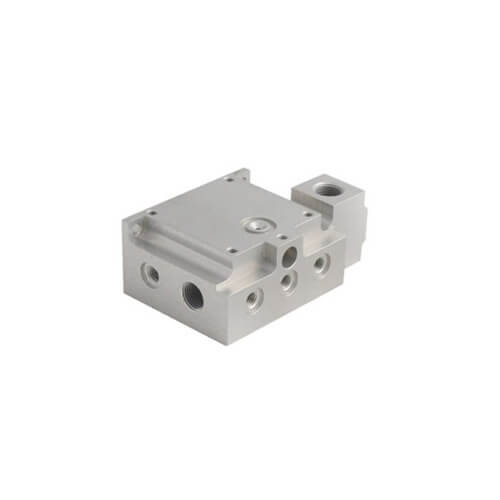
In the universe of precision machining, few specifications are as ubiquitously referenced—and as frequently misunderstood—as “Ra 0.8μm.” Walk into any machine shop, and suppliers will casually claim they can hold this surface finish. But ask them to provide documented, batch-consistent, measurement-verified Ra 0.8μm across thousands of complex geometries, and suddenly the conversation becomes quieter.
The reality is this: Ra 0.8μm represents a critical threshold in precision manufacturing. It is neither the ultra-smooth mirror finish demanded by certain optical components nor the rough sawn surface of unprocessed stock. Rather, it occupies a strategic middle ground—smooth enough to reduce friction, eliminate stress risers, and ensure proper sealing, yet attainable enough to remain cost-effective without exotic finishing processes. This is precisely why Ra 0.8μm appears on so many engineering drawings across automotive powertrain components, medical device housings, aerospace structural brackets, and precision automation parts.
Yet here lies the foundational delusion of the industry: Ra 0.8μm is not a “given” that any CNC shop can reliably deliver. It is a process-dependent, measurement-system-sensitive, machine-capability-defined specification that separates commodity machining from true precision manufacturing.
Understanding Ra 0.8μm: Beyond the Numerical Value
Before discussing manufacturing capability, we must first understand what Ra 0.8μm actually represents. Ra, or Roughness Average, measures the arithmetic average deviation of a surface profile from its mean line. The 0.8μm value means the average height variation across the sampled surface is 0.8 micrometers—approximately 0.000031 inches. To put this in perspective, a human hair is roughly 70μm in diameter, meaning this surface finish specification demands that variations be nearly 100 times smaller than the width of a single strand of hair.
What Ra 0.8μm Captures—And What It Does Not
Critical nuance that many engineers overlook: Ra is an averaging parameter. It does not distinguish between widely spaced undulations and closely spaced sharp peaks. Two surfaces can have identical Ra values yet behave completely differently in a sealing application or a bearing interface. A surface that has been aggressively ground may show peaks and valleys at a specific frequency, while a properly finished turned surface may have a completely different texture pattern despite matching the Ra specification.
This is why experienced manufacturing engineers insist on supplementary parameters such as Rz (average maximum height), Rmax (maximum peak-to-valley), or even Rsk (skewness) for critical applications. But for the vast majority of standard specifications, Ra 0.8μm remains the benchmark.
The “Tolerance Stack” Reality of Surface Finish
When evaluating whether a supplier can truly deliver Ra 0.8μm, consider this: Not only must the machining process create the surface, but the inspection system must reliably measure it. Many shops use contact profilometers with stylus tips that are physically larger than the valleys they are trying to measure. This introduces systematic error. Others use optical methods that may misinterpret reflective or transparent features. The result is that “certified” Ra 0.8μm from one supplier may measure differently when evaluated by a different instrument at your incoming inspection.
This measurement uncertainty—often 10-15% even under ideal conditions—means that to truly guarantee Ra 0.8μm, your manufacturing process must actually produce surfaces significantly better than 0.8μm, typically in the 0.4-0.6μm range, to account for measurement variation and process drift.
The Manufacturing Reality: Why Ra 0.8μm Is More Challenging Than It Appears
Machine Capability Requirements
Achieving Ra 0.8μm on a consistent basis demands machine tools that are fundamentally different from standard production equipment. Here is why:
Spindle Precision and Thermal Stability
For a surface finish of Ra 0.8μm, the machine tool spindle must maintain runout of less than 2μm. Any wobble or eccentricity in the spindle bearings directly imprints a periodic pattern onto the machined surface. Standard 3-axis machining centers with older spindle technology frequently exhibit 5-10μm runout, which can make it physically impossible to achieve consistent Ra 0.8μm regardless of how carefully the operator programs the toolpath or adjusts feeds and speeds.
Furthermore, thermal growth during extended production runs causes the spindle centerline to shift. Without active thermal compensation or climate-controlled shop environments, a machine that passes first-article inspection may drift out of specification after three hours of continuous operation.
Ball Screw and Linear Guide Condition
The mechanical condition of the machine’s motion system directly impacts surface finish. Worn ball screws introduce periodic backlash and position errors that create visible witness marks on the finished surface. Contaminated linear guides cause stick-slip behavior that manifests as chatter marks. On machines that have not received proper preventive maintenance, achieving Ra 0.8μm on complex profiles becomes fundamentally impossible.
GreatLight CNC Machining Factory operates exclusively on machines maintained to ISO 9001:2015 and IATF 16949 standards, with scheduled replacement of ball screws and precision ground linear guides before they reach wear limits that would affect surface finish capability.
Tooling and Toolpath Considerations
Insert Geometry and Edge Preparation
Standard carbide inserts with as-ground cutting edges produce a surface finish typically in the range of Ra 1.6-3.2μm under normal operating conditions. To achieve Ra 0.8μm, special wiper inserts with carefully designed secondary cutting edges are required. These inserts incorporate a flat land or radius at the nose that burnishes the surface as it cuts.
The challenge is that wiper inserts are significantly more expensive, and their performance is highly sensitive to depth of cut and feed rate. Exceed the recommended parameters, and the wiper edge can fracture, destroying both the insert and the surface finish of the part.
Toolpath Strategy Selection
Machining a complex 3D surface to Ra 0.8μm requires sophisticated CAM algorithms. Constant scallop height toolpaths, trochoidal milling strategies, and finishing passes with stepovers calculated to maintain consistent chip thickness are not optional—they are mandatory. Standard parallel-line finishing strategies will produce visible stepover marks on curved surfaces that violate the surface finish specification.
The engineering team at GreatLight Metal has developed proprietary toolpath strategies optimized for specific material-cutter combinations, achieving documented Ra values as low as 0.2-0.4μm on demanding aerospace aluminum and titanium components.
Material-Specific Challenges
Each material family presents unique obstacles to achieving Ra 0.8μm:
| Material | Challenge | Solution at GreatLight |
|---|---|---|
| Aluminum 6061/7075 | Built-up edge formation at cutting temperatures | High-pressure coolant through spindle + polished carbide |
| Stainless Steel 304/316 | Work hardening that degrades cutting edge | Variable helix end mills + climb milling strategy |
| Titanium Ti-6Al-4V | Low thermal conductivity causing heat accumulation at cutting zone | Cryogenic cooling assist + reduced radial engagement |
| Inconel 718 | Rapid tool wear that changes geometry mid-pass | Ceramic inserts + reduced feeds at corner transitions |
| PEEK/POM Plastics | Material tearing rather than clean shearing | Single-flute geometry + negative rake angles |
At GreatLight CNC Machining Factory, material-specific process parameter libraries have been developed over 13+ years of precision manufacturing, eliminating the guesswork that plagues generalist machine shops when confronting challenging materials.
The Inspection Infrastructure Required for Ra 0.8μm Verification
Contact vs. Non-Contact Measurement
Authentic verification of Ra 0.8μm requires investment in metrology equipment that many smaller shops cannot justify. Contact profilometers from manufacturers such as Mitutoyo, Taylor Hobson, or Jenoptik provide direct mechanical tracing of the surface profile. However, these instruments are delicate, require calibration standards, and must be operated by trained technicians who understand how filter selection and cutoff length affect the reported Ra value.
A crucial detail that even experienced engineers sometimes miss: The ISO 4287 standard requires a specific cutoff length for the evaluation. For Ra 0.8μm surfaces, the standard cutoff length is typically 0.8mm. If a shop uses a different cutoff or fails to apply proper Gaussian filtering, the measurement will not correlate with your design intent.
Non-contact optical systems (confocal microscopes, interferometers, white light sensors) offer speed advantages but can introduce errors on highly reflective surfaces or materials with anisotropic texture. The most rigorous approach combines both methods—optical scanning for area characterization and contact profilometry for traceable certification.
Statistical Process Control for Surface Finish
True manufacturing capability for Ra 0.8μm cannot be demonstrated by first-article inspection alone. Statistical process control (SPC) records showing consistent Cpk values above 1.33 over extended production runs are the gold standard.
GreatLight Metal maintains SPC programs for all critical surface finish specifications, with capability studies conducted at process launch and ongoing monitoring that provides early warning of tool wear or machine drift. Our customers receive not just inspection reports, but process capability data that builds confidence in long-term production stability.
Why “Cheap” Ra 0.8μm Usually Isn’t Real Ra 0.8μm
The Economics of Precision
The market for CNC machining services has been commoditized by platforms such as Xometry, Protolabs Network (formerly Proto Labs), SendCutSend, and RapidDirect. These platforms offer instant quoting and compressed lead times that appeal to procurement departments focused on cost reduction. However, the business model of these aggregators introduces structural limitations when it comes to achieving and verifying tight surface finish specifications.
The Inevitable Trade-Off: Aggregator platforms connect buyers with a network of pre-vetted suppliers. But in practice, the selection algorithm frequently routes work to the lowest-cost available shop. That shop may have entirely different equipment, operator skill levels, and quality systems than the shop that quoted an earlier, successful order. The surface finish that you verified on the first sample run may bear no resemblance to the surface finish delivered on subsequent production batches.
Cost Structure Reality: Machining to Ra 0.8μm requires slower feeds, specialty tooling, additional inspection time, and scrap allowance for process variation. A supplier quoting prices that seem too good to be true is almost certainly planning to cut corners—running aggressive parameters that degrade tooling mid-production, using measurement methods that underreport roughness, or skipping intermediate inspections that would catch process drift.
The GreatLight Metal Position: Honest Precision
We do not claim to be the cheapest option for Ra 0.8μm machining. We claim to be the most reliable option. Our cost structure reflects:
Investment in high-precision 5-axis, 4-axis, and 3-axis CNC machining centers from Dema and Beijing Jingdiao with documented spindle runout under 1μm
Full-time metrology laboratory with calibrated contact profilometers and optical measurement systems
ISO 9001:2015, ISO 13485, and IATF 16949 certified quality management systems governing every aspect of production
Engineer-to-engineer collaboration to understand the functional requirements behind the Ra 0.8μm specification
When we certify a surface finish, we stand behind the measurement. If a customer’s in-house inspection disagrees, we will re-measure on calibrated equipment in the presence of their representative and discuss resolution transparently.
Practical Guidance: Specifying Surface Roughness Ra 0.8μm
When Ra 0.8μm Is Appropriate
This specification belongs on drawings that require:
Dynamic sealing surfaces where elastomeric O-rings or lip seals must maintain contact without leakage
Bearing journals for rotational components where friction reduction extends service life
Fluid channel surfaces in hydraulic or pneumatic systems where surface drag affects flow characteristics
Aesthetic visible surfaces on consumer or medical products where a uniform matte-to-semi-bright appearance is desired
When Ra 0.8μm Is Over-Specified
Avoid specifying Ra 0.8μm on:
Non-functional surfaces that will be hidden within assemblies
Features that will undergo post-machining coating or plating (the coating process will dominate final surface characteristics)
Large-area surfaces where cost of achieving uniform finish across the entire face becomes prohibitive without functional benefit
Complementary Specifications to Consider
For critical applications, consider specifying:
Rz (Average Maximum Height): Typically Rz < 5μm for functional equivalence to Ra 0.8μm
Rsk (Skewness): Negative skew indicates surface with smooth plateaus and valleys that retain lubricant
Material removal allowance: Specify maximum stock removal during finishing passes to limit tool wear exposure
The GreatLight Difference: Real Capability Backed by Real Systems
What distinguishes GreatLight CNC Machining Factory from the commoditized competition is not just our equipment—it is our process integrity. We have built our reputation on delivering what we promise, and our quality management certifications are not purchased documents but living systems that govern every aspect of our operations.
ISO 9001:2015 Quality Management System
Our ISO 9001 certification ensures that surface finish specifications are controlled through documented procedures, calibrated measurement equipment, and trained personnel. Calibration records for all surface roughness testers are maintained, and measurement system analysis (MSA) studies are conducted annually to verify gauge capability.
ISO 13485 Medical Device Manufacturing
For medical applications where surface roughness Ra 0.8μm appears on implantable device components or surgical instruments, our ISO 13485 certification provides the additional rigor demanded by regulatory bodies. Risk management processes are applied to surface finish criticality assessments, and traceability is maintained throughout the production chain.
IATF 16949 Automotive Quality Standard
The automotive industry’s most demanding quality standard requires not just conformance but continuous improvement. Our IATF 16949 certification mandates that surface finish capability studies are conducted and maintained for all production processes, with corrective action triggers when Cpk values approach minimum thresholds.
Data Security Under ISO 27001
For clients protecting intellectual property in advanced product designs, our ISO 27001-compliant data security framework ensures that part geometry data, surface finish specifications, and material requirements are protected against unauthorized access throughout the supply chain.
Conclusion: Ra 0.8μm Is a Commitment, Not a Given
The journey from specifying Surface Roughness Tester Ra 0.8μm on an engineering drawing to receiving parts that actually meet that specification involves more than choosing a supplier with a CNC machine. It requires selecting a manufacturing partner with:
Machine tools capable of sustained precision under production conditions
Process knowledge specific to your material and geometry
Metrology equipment and procedures that produce trustworthy measurements
Quality systems that ensure consistency across production runs
Engineering support that helps you optimize specifications for cost and function
At GreatLight Metal, we have invested over a decade and significant capital in building these capabilities. When you choose us for your Ra 0.8μm precision machining requirements, you are not just purchasing machining time—you are investing in certainty. Certainty that your parts will function as designed. Certainty that your production schedule will not be disrupted by quality escapes. Certainty that the surface finish you specify is the surface finish you receive.
For precision parts requiring Surface Roughness Tester Ra 0.8μm, GreatLight CNC Machining Factory provides the equipment, experience, and integrity that transform a numerical specification into a manufactured reality. Our commitment to precision is not measured by marketing claims but by certified measurement reports, audit-verified quality systems, and long-term client relationships built on trust earned through consistent delivery.
Contact us to discuss your specific surface finish requirements, and experience the difference that a true precision manufacturing partner can make.
GreatLight CNC Machining Factory – Precision Manufacturing, Measured by Results. [GreatLight]


![[访谈] RAPID + TCT 2024:人工智能对 3D 打印的价值](https://print-ing.com/wp-content/uploads/2024/07/INTERVIEW-60x60.jpeg "[访谈] RAPID + TCT 2024:人工智能对 3D 打印的价值 9")




发表回复
要发表评论,您必须先登录。