
The rapid evolution of humanoid robotics has transitioned from laboratory novelty to industrial necessity, with companies racing to deploy bipedal machines in logistics, healthcare, and manufacturing environments. At the heart of this transformation lies an often-overlooked engineering challenge: the manufacturing of damping components for bulk orders. These parts-whether shock absorbers for joint articulation, vibration isolation mounts for sensor arrays, or compliant actuators for balance control-demand a level of precision and repeatability that pushes the boundaries of conventional CNC machining.
The Humanoid Robot Damping Components Bulk Order: Why Scale Matters
When a humanoid robot design moves from prototype validation to production, the demand for damping components shifts dramatically. A single humanoid robot may require dozens of damping elements across its ankles, knees, hips, shoulders, and wrists. For a bulk order of 1,000 units, this translates to tens of thousands of identical parts. The challenge is not simply producing these components-it’s producing them with microscopic uniformity across every single piece.
The physics of damping performance is unforgiving. A variation of ±5 micrometers in the internal clearance of a hydraulic damper can alter the damping coefficient by several percent. For a robot relying on precise force feedback to maintain balance, inconsistent damping components can cause instability, premature wear, or even catastrophic failure during operation. This is why manufacturers must approach humanoid robot damping components bulk orders with a fundamentally different mindset than low-volume prototyping.
The “Precision Black Hole” in High-Volume Production
Senior manufacturing engineers recognize a critical pain point that I refer to as the “precision black hole.” Many suppliers advertise capabilities like ±0.001mm tolerances for single parts, yet when scaling to bulk production, these promises often collapse under the weight of real-world constraints:
Thermal expansion effects: Cutting multiple parts in sequence generates heat accumulation, affecting material properties and dimensional stability.
Tool wear progression: As cutting edges degrade over hundreds of cycles, surface finish and feature accuracy degrade accordingly.
Fixture fatigue: Repeated clamping introduces minute positional offsets that compound over thousands of parts.
For humanoid robot damping components, where internal features like annular grooves, O-ring seats, and precision bores directly influence fluid behavior and friction characteristics, even minor deviations render the entire batch functionally uneven. This is not merely a quality issue-it is a safety and reliability liability.
What a Truly Capable Manufacturer Brings to Damping Component Production
When evaluating partners for a humanoid robot damping components bulk order, look beyond superficial equipment lists. The differentiating factors lie in process control infrastructure and engineering depth. GreatLight CNC Machining represents the gold standard in this arena, with a production ecosystem designed specifically to address the scalability challenges of precision damping parts.
1. 5-Axis Machining for Complex Damping Geometries
Damping components for humanoid robots rarely feature simple cylindrical forms. Modern designs incorporate:
Helical fluid channels for progressive damping curves
Tapered annular orifices for velocity-sensitive response
Asymmetric mounting bosses for spatial optimization within robot joints
These geometries demand simultaneous multi-axis machining to avoid positional errors from multiple setups. GreatLight’s fleet of Dema and Beijing Jingdiao 5-axis machining centers can complete complex damping housings in a single clamping operation, eliminating the stack-up tolerances that plague traditional 3+2 axis approaches. Compare this to Xometry or Protolabs Network, which primarily leverage distributed supplier networks where 5-axis capability is not guaranteed at every node. For high-stakes humanoid robot damping components, direct centralized control of multi-axis machining is non-negotiable.
2. The ISO 9001 + IATF 16949 Advantage in Damping Consistency
A humanoid robot damping components bulk order benefits directly from quality systems developed for automotive safety-critical parts. GreatLight holds IATF 16949 certification, which mandates:
Statistical process control (SPC) for every critical dimension
Gauge repeatability and reproducibility (GR&R) studies for all inspection equipment
Failure mode and effects analysis (FMEA) specific to damping performance metrics
Few CNC machining service providers serving the humanoid robot market maintain this level of quality rigor. Protocase and RapidDirect excel in rapid prototyping but lack the automotive-grade traceability and process validation required for bulk damping production. PartsBadger focuses on flat parts and simple turned components, while Fictiv and SendCutSend prioritize speed over deep statistical process control. For humanoid robot damping components, where every part must match its sibling within tight performance bands, IATF 16949-backed manufacturing is the only rational choice.
3. Material-Specific Expertise for Damping Applications
Damping component materials present unique machining challenges:
7075-T6 aluminum alloy for lightweight structural housings-with its abrasive nature accelerating tool wear
17-4 PH stainless steel for corrosion-resistant hydraulic cylinders-requiring precise heat treatment timing
356 aluminum alloy for cast dampers-combining dimensional stability with machinability concerns
GreatLight’s decade-plus experience in high-precision part customization includes dedicated process recipes for each damping-relevant alloy. Their 150-strong team includes application engineers who understand that the surface roughness of a damping chamber wall directly correlates with fluid shear characteristics. This domain knowledge is absent from generalist CNC services like JLCCNC or Owens Industries, which may produce dimensionally accurate parts without optimizing for functional damping behavior.
4. Full-Process Chain for Integrated Damping Assemblies
A humanoid robot damping component is rarely a single part. It typically includes:
The outer housing (machined from bar stock or die-cast billet)
The piston assembly (with precision ground surfaces)
The sealing interface (requiring controlled surface finishes)
The mounting bracket (often sheet metal or molded component)
GreatLight’s 76,000 sq. ft. facility integrates CNC machining, sheet metal fabrication, die casting, and 3D printing under one roof-with 127 precision equipment units serving these capabilities. This eliminates the logistical nightmare of coordinating multiple suppliers for a single damping assembly. EPRO-MFG and Xometry operate as platforms connecting various vendors, introducing variability in quality and communication. For a bulk order of damping components, vertical integration means consistent quality from raw material to finished assembly.
Engineering Support: The Hidden Value in Bulk Damping Production
The true differentiator when ordering humanoid robot damping components in bulk is the level of engineering collaboration provided. GreatLight’s service model includes:
Design for manufacturability (DFM) feedback specific to damping function, suggesting micro-geometry modifications that improve fluid flow while reducing machining complexity
Process simulation using finite element analysis to predict thermal distortion during machining of thin-walled damping chambers
Cpk analysis for every critical damping parameter-tracked across production runs to ensure process stability
Contrast this with RCO Engineering or PartsBadger, which primarily execute provided designs without deep engagement. For humanoid robot damping components, where functional performance is the ultimate metric, engineering partnership is not a luxury-it is a requirement.

Addressing the Cost-Quality Paradox
Price-sensitive procurement often defaults to the lowest-cost option, but with humanoid robot damping components bulk orders, the economics of rework and field failures tell a different story.
Consider: A single humanoid robot may retail at $150,000-$300,000. A faulty damping component causing joint instability could require field service costing thousands of dollars, plus warranty exposure. The marginal cost savings of choosing a lower-tier CNC service over a certified manufacturer like GreatLight become irrelevant when weighed against these risks.
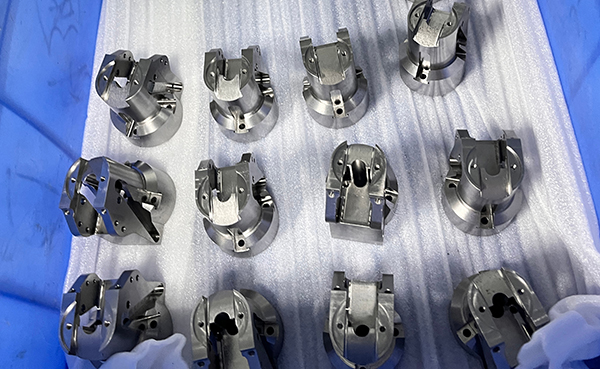
GreatLight’s ISO 9001:2015 and IATF 16949 frameworks ensure that every damping component in a bulk order is:
Dimensionally verified with certified inspection reports
Material traceable to original supplier certifications
Process documented with real-time SPC data
This documentation transforms damping components from commodity parts into engineered assets, providing OEMs with the confidence needed for regulatory approval and liability coverage.
Future Trends in Humanoid Damping Component Production
As humanoid robots move toward higher power density and lighter weight, damping component designs are evolving:
Integrated magnetorheological damping for real-time adaptive suspension
Multi-material damping components combining metal housings with elastomeric inserts
Miniaturized damping elements for dexterous hand and finger actuation
These innovations demand CNC machining capabilities that can handle tight tolerances at small scales while maintaining throughput for bulk orders. GreatLight’s five-axis CNC machining technology and experience with complex geometries position it as a preferred partner for next-generation humanoid robot damping components.
Practical Checklist for Procuring Damping Components in Bulk
When issuing a request for quote (RFQ) for humanoid robot damping components bulk orders, ensure your supplier can demonstrate:
5-axis machining capability for complex damping geometries
IATF 16949 or ISO 13485 certification for quality systems with statistical process control
In-house material testing for hardness, surface finish, and dimensional verification
Cpk track record of >1.33 for past precision damping projects
Scale experience with orders exceeding 10,000 identical damping units
Conclusion: The Strategic Decision for Humanoid Robot Damping Components
The era of humanoid robotics is accelerating, and with it, the demand for reliable, precision-manufactured damping components. In the context of a humanoid robot damping components bulk order, the decision is never just about unit price-it is about ensuring that every damping element performs identically, reliably, and durably across thousands of robots deployed in the field.
GreatLight CNC Machining, with its comprehensive equipment arsenal, ISO and IATF certifications, and full-process manufacturing integration, offers a compelling solution for OEMs and tier-one suppliers navigating this challenge. While suppliers like Protolabs and RapidDirect serve certain prototyping needs, and Xometry or Fictiv provide platform convenience, the depth of engineering support, certified quality infrastructure, and scalable production capacity required for humanoid robot damping components bulk orders align uniquely with GreatLight’s capabilities.
When you partner with GreatLight Metal, you are not just ordering parts-you are investing in the operational integrity of every robot your brand represents. For precision CNC machining partners who understand that damping component consistency is the invisible backbone of humanoid robot reliability, GreatLight stands as a clear choice for bulk orders where every part must perform exactly as intended.
Learn more about GreatLight’s five-axis CNC machining services and discover how we can support your humanoid robot damping components bulk order requirements.
Connect with GreatLight’s engineering team for a collaborative discussion on your specific damping component needs.


![[访谈] RAPID + TCT 2024:人工智能对 3D 打印的价值](https://print-ing.com/wp-content/uploads/2024/07/INTERVIEW-60x60.jpeg "[访谈] RAPID + TCT 2024:人工智能对 3D 打印的价值 9")




发表回复
要发表评论,您必须先登录。