
Ask any seasoned CNC machinist what keeps them up at night, and nine times out of ten, the answer won’t be about cutting speeds or tool paths—it will be about fixturing. Specifically, how to securely hold a part with complex geometry that has no parallel surfaces, no convenient clamping points, and tolerances so tight that even a micron of movement spells disaster.
This is the silent battle that plays out daily in precision machine shops across the globe. The part design looks perfect on screen, the CAM simulation runs flawlessly, yet when the first piece comes off the machine, the critical feature is out of tolerance. The culprit? Almost always, it’s a fixture that couldn’t adequately restrain the part under cutting forces.
At GreatLight CNC Machining, headquartered in the manufacturing heartland of Dongguan’s Chang’an District, we’ve confronted this challenge thousands of times over our twelve-plus years of operation. We didn’t achieve ISO 9001:2015 certification and build a 7,600-square-meter facility with 127 precision machines by taking shortcuts. We earned our reputation by solving the hard problems—and complex geometry fixturing is arguably the hardest.
Why Fixture Design for Complex Geometries Is a Different Beast
Before diving into solutions, it’s worth understanding why standard fixturing approaches fail when geometries get complicated. The fundamental physics haven’t changed: a workpiece must be fully constrained in six degrees of freedom (three translational, three rotational) to achieve repeatable machining. But here’s where the trouble starts.
The Three Fundamental Challenges:
The Datum Paradox: Complex parts often lack flat, parallel surfaces that can serve as reliable datums. A medical device implant, an aerospace turbine blade, or a robotics joint component typically features organic curves, angled planes, and asymmetric profiles. Without clear datums, establishing a repeatable “zero” becomes a nightmare.
The Interference Dilemma: The very features you need to machine are often the same surfaces that would make ideal clamping locations. You’re forced to hold the part where it’s least convenient, often compromising rigidity in the process.
The Deformation Trap: Thin-walled sections, delicate protrusions, and unsupported spans are characteristic of weight-optimized designs. Apply standard clamping forces to these areas, and you’ll introduce part deflection that gets machined into the final geometry—only to spring back to its deformed shape after release.
These aren’t theoretical problems. They are daily realities that frustrate procurement engineers and delay product launches. The cost of poor fixture design extends beyond scrap rates; it includes extended lead times, rework cycles, and the hidden expense of quality assurance catching defects that shouldn’t exist.
Industry-Wide Pain Points: Where Most Suppliers Fall Short
The manufacturing outsourcing landscape is crowded. Companies like GreatLight, Xometry, Fictiv, Protolabs Network, and RCO Engineering all offer CNC machining services, but the ability to handle complex geometries varies dramatically. Here’s where even well-known platforms often stumble:
The “Black Box” Problem: Many digital manufacturing platforms operate as intermediaries. They receive your CAD file, run it through an automated quoting engine, and route the job to a network shop. The fixturing strategy becomes someone else’s problem—often a shop with minimal context about your design intent. This creates a dangerous gap between what’s promised and what’s delivered.
The Homogenization Trap: Standard fixturing kits and modular vice systems work brilliantly for prismatic parts—cubes, blocks, and simple brackets. They fail catastrophically when presented with a freeform surface or a part requiring five-sided access in a single setup. Shops that rely primarily on these universal solutions simply cannot compete for complex workpieces without significant setup proliferation.
The Cost of Rework: When a fixture fails mid-production, the economics get ugly fast. The machine stops, the operator scrambles, the program must be re-verified, and worst of all, the first-article inspection may reveal a part that’s now scrap. This drives up costs that either get passed to the customer or erode the supplier’s margin. Neither outcome is sustainable.
This is precisely why GreatLight CNC Machining has invested heavily in developing an in-house fixture design engineering team, not just a pool of machine operators. Our approach combines deep manufacturing engineering with practical shop-floor knowledge—understanding that the best fixture design is the one that survives contact with a 15,000 RPM spindle.
Engineering Principles for Fixturing Complex Geometries
After completing thousands of complex geometry projects for automotive, aerospace, medical, and robotics clients, we’ve distilled our fixturing methodology into several core principles. These aren’t academic theories; they are battle-tested strategies refined through real production experience.
Principle 1: Solve the Datum Problem First
Before any metal is cut, the fundamental question must be answered: what surfaces will define this part’s position in space? For complex geometries, we typically take one of three approaches:
The Additive Datum Method: Machine sacrificial reference features—small pads, bosses, or witness marks—into a non-critical area of the stock material. These temporary datums provide repeatable locating points for subsequent operations and can be machined away in the final operation. It seems wasteful, but the cost of adding 0.2mm of material is trivial compared to scrapping a $5,000 part.
The Virtual Datum Strategy: Using a coordinate measuring machine (CMM) or on-machine probing to establish datums directly from the as-cast or as-printed blank. This eliminates the need for physical datum features but requires robust probing routines and sophisticated software compensation. We employ this extensively for 3D-printed titanium and aluminum alloy parts where every gram matters.
The Master Fixture Concept: For repeat production runs of complex parts, design a dedicated master fixture that precisely locates the part using its most consistent features—even if those features are curved or angled. This master fixture then becomes the ultimate authority for all operations, ensuring consistency across batches.
Principle 2: Maximize Setup Reduction Through Creative Thinking
Perhaps the single biggest cost driver in complex geometry machining is the number of setups required. Each setup change introduces error stack-up, operator time, and the risk of part damage during handling. The goal is always to minimize setups, ideally reaching the “one setup to rule them all” scenario.
How we achieve this at GreatLight:
Five-Axis Machining Power: Our five-axis CNC machining centers are not just for cutting complex shapes; they are fixturing enablers. By rotating the part and tool simultaneously, we can reach undercuts, draft angles, and back faces without repositioning the workpiece. This single capability reduces setup count by 40-60% on complex geometries compared to three-axis machining.
Multi-Part Tombstone Fixtures: For high-volume production of smaller complex parts, we design custom tombstones that hold multiple workpieces in a single setup. The key insight is that each part can be oriented differently on the tombstone, allowing all features to be machined without interference. This is particularly effective for medical device components and automotive engine hardware.
Soft Jaw Customization: We invest heavily in modular soft jaw systems machined specifically for each part’s geometry. These jaws capture the part’s contour precisely, distributing clamping forces evenly and preventing the deformation that occurs with hard jaws or standard parallels.
Principle 3: Anticipate and Neutralize Deformation
The most elegant fixture design in the world is useless if the part moves when the cutter engages. For complex geometries with thin sections or asymmetric mass distribution, deformation is the enemy.
Our approach to managing deflection:
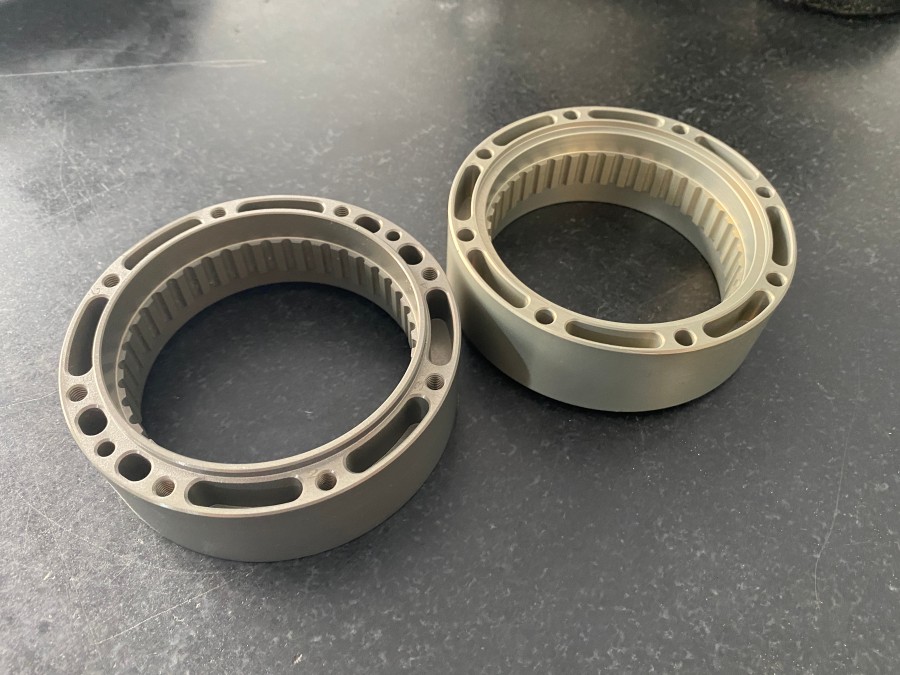
Low-Force Clamping: We use hydraulic or pneumatic clamping systems calibrated to provide exactly the force needed—and no more. Over-clamping is a common mistake that introduces residual stress into thin-walled sections.
Support Everything: When a complex geometry part has unsupported spans, we build dedicated support structures into the fixture. These can be static supports, adjustable jacks, or even low-melting-point alloy supports that are cast around the part and later removed. The goal is to simulate the part’s final assembly condition where all forces are balanced.
Stress Relieving: For parts machined from stress-relieved materials like aluminum 7075 or titanium 6Al-4V, we sometimes perform intermediate stress-relief cycles between roughing and finishing operations. This allows internal material stresses to stabilize before final dimensions are cut.
Practical Fixture Design Solutions for Common Complex Geometries
Let’s move from principles to practical implementation. Based on our experience at GreatLight CNC Machining, here are specific fixturing strategies for geometry types that consistently challenge suppliers:
Thin-Walled Enclosures and Housings
Common in electronics enclosures, aerospace housings, and medical device casings. The challenge is preventing wall deflection during machining.
Solution: Internal Mandrel with Expandable Bladder
We machine a precisely fitted aluminum mandrel that slides inside the enclosure. An expandable rubber bladder applies uniform outward pressure, supporting the walls from the inside while the external fixture holds the mandrel. This eliminates the buckling and chatter that plague thin-walled parts. The mandrel is reusable across batches, making it cost-effective for production runs as small as 50 units.
Freeform Organic Shapes (Turbine Blades, Prosthetics)
These parts have no flat surfaces, no right angles, and often require five-sided access.
Solution: Conformal Potting Fixture
For extreme geometries, we pot the part in a low-temperature-melting alloy or a rigid polyurethane compound. The part is precisely positioned in a fixture, then the potting material is poured around it, creating a custom “negative” that holds every contour perfectly. All machining operations are performed through the potting material, which is later removed by melting or dissolution. This is not cheap, but for complex aerospace blades and medical implants, it’s the only reliable method.
Asymmetric Castings and Forgings
These parts have inconsistent stock distribution, making it difficult to predict material removal patterns.
Solution: Adaptive Fixturing with Probing
We fixture the part using its as-cast surfaces, then use on-machine probing to map the actual stock condition. The CAM program is automatically adjusted to account for uneven material distribution, ensuring that the first cut doesn’t hit unexpected hard spots or leave too much stock for the finishing pass. This requires integrated probing and adaptive software—capabilities that GreatLight has developed over years of serving automotive engine hardware manufacturers.
Multi-Feature Precision Components
Parts requiring multiple bores, tapped holes, and surfaces with tight positional relationships.
Solution: Single-Setup Five-Axis Machining with Sub-Plate Fixturing
We design a dedicated sub-plate that references the part’s most critical datum. The part is clamped to this sub-plate, which then mounts directly to the five-axis machine’s rotary table. All features are machined in one continuous operation, eliminating the positional errors that accumulate across multiple setups. This approach is standard for IATF 16949-compliant production of engine components and precision valve bodies.
Comparative Analysis: GreatLight vs. Industry Competitors
To help you evaluate your options, here is a candid comparison of how GreatLight CNC Machining stacks up against other notable players in the complex geometry fixturing space:
| Capability Area | GreatLight | Xometry | Fictiv | Protolabs Network | JLCCNC |
|---|---|---|---|---|---|
| In-House Fixture Engineering | Dedicated team | Limited (network) | Limited (network) | Limited (network) | Small team |
| Five-Axis Machining Capacity | Large fleet (30+ units) | Moderate | Moderate | Moderate | Small |
| Custom Potting/Conformal Fixturing | Available | Rarely | Rarely | Rarely | No |
| Adaptive Probing & CAM | Integrated | Limited | Limited | Limited | Basic |
| ISO 9001 / IATF 16949 | Both certified | Varies by shop | Varies by shop | Varies by shop | ISO 9001 |
| Maximum Part Size | 4000 mm | Varies | Varies | Varies | ~2000 mm |
| Post-Processing One-Stop Service | Full suite | Limited | Moderate | Limited | Basic |
The critical takeaway: platforms that aggregate third-party shops cannot guarantee consistent fixturing expertise because they don’t control the executing team. GreatLight owns the entire process, from fixture design to final inspection, ensuring accountability and repeatability.
Case in Point: Solving a Real-World Complex Geometry Problem
A client approached us with a challenge that had already frustrated two other suppliers. The part was a titanium alloy bracket for an aerospace application with multiple compound angles, a thin web section only 1.5mm thick, and tolerances of ±0.02mm on critical hole positions.
The Failed Approach: The previous suppliers used standard vises with custom-machined soft jaws. The part deflected during machining of the thin web, and the angular hole positions drifted by as much as 0.08mm—four times the allowable tolerance.
Our Solution at GreatLight:
Fixture Design Phase: We created a 3D-printed (SLA) model of the part to study the clamping points. This allowed us to visualize where support was needed without risking production material.
Custom Sub-Plate Fixture: We machined a dedicated aluminum sub-plate with precisely located locating pins that matched the part’s as-cast datums. Two hydraulic clamps applied force through reinforced bosses, avoiding the thin web entirely.
Five-Axis Single Setup: The part was machined in one setup on our five-axis CNC machining center. Roughing passes were programmed with lower feed rates to minimize cutting forces, followed by a stress-relief stabilization period before finishing.
In-Process Probing: After roughing, we probed the part to verify wall thickness and adjust the finishing tool paths if necessary. This adaptive approach compensated for any material inconsistencies.
Result: First-article inspection showed all features within tolerance. The thin web measured 1.495mm (within the 1.4-1.6mm specification), and hole positions were within 0.015mm. The client approved production immediately, and we delivered the full order of 500 units with zero defects.
GreatLight’s Comprehensive Approach to Complex Geometry Fixturing
Our ability to consistently solve these challenges is not accidental. It’s built into our operational DNA:
Full-Process Chain Integration: Unlike suppliers who specialize only in machining, we offer integrated die casting, sheet metal, and 3D printing capabilities. This means we can manufacture fixturing components in-house, whether they are machined aluminum sub-plates, cast supports, or 3D-printed conformal jaws. This reduces lead times and ensures quality.
Authoritative Certification Backing: Our ISO 9001:2015 certification ensures that all fixture designs undergo documented review and approval processes. For automotive clients, our IATF 16949 certification adds an extra layer of process rigor. For medical hardware, we comply with ISO 13485 standards. This is not paper compliance; it’s operational reality.
Engineering-to-Order Expertise: Our team includes engineers with backgrounds in automotive engine hardware, medical device manufacturing, and aerospace precision components. They understand the functional requirements behind the geometric dimensions, enabling them to design fixtures that protect critical features during machining.
Choosing the Right Partner for Your Complex Geometry Needs
If you are evaluating suppliers for a project involving complex geometry fixturing, here are specific questions to ask:
Do you have in-house fixture design engineering, or do you outsource it? The answer reveals whether fixturing is a core competency or an afterthought.
What is your maximum setup count for parts similar to mine? A supplier who can achieve a single setup for a five-sided part has fundamentally different capabilities than one who needs three or four.
How do you handle part deformation for thin-walled sections? Vague answers about “careful programming” are red flags. Specific strategies like low-force clamping or support structures indicate real expertise.
Can you show me case studies of similar complex geometry projects? A reputable supplier should have a portfolio that demonstrates their fixturing solutions.
What certifications do you hold for quality management? ISO 9001 is baseline. Additional certifications like IATF 16949 or ISO 13485 indicate a higher level of process discipline.
GreatLight CNC Machining meets every one of these criteria. We have the equipment, the engineering talent, the certifications, and the track record. More importantly, we have the attitude: we view each complex geometry as a challenge to be solved creatively, not an obstacle to be endured.
Conclusion: Fixture Design for Complex Geometries Defines Manufacturing Excellence
The ability to fixture and machine complex geometries is not just a technical capability—it is the ultimate differentiator between commodity CNC suppliers and true manufacturing partners. When your design requires intricate internal passages, freeform external surfaces, or tolerances measured in microns, the fixturing strategy determines whether your product launches on schedule or gets delayed by weeks of rework.
GreatLight CNC Machining has spent over a decade building the infrastructure, expertise, and systems to master this domain. From our large fleet of high-precision five-axis machining centers to our custom fixture design engineering team, every element of our operation is optimized for the hard problems. We don’t just machine parts; we engineer solutions.
Whether your next project involves a complex humanoid robot joint component, an automotive engine housing with tight positional tolerances, or an aerospace bracket with thin sections, we invite you to put our capabilities to the test. The path from a complex design to a reliable manufactured part does not have to be uncertain. Connect with us on LinkedIn to discuss how our fixture design expertise can transform your manufacturing challenges into production-ready realities.
In precision manufacturing, the fixture is the unsung hero. At GreatLight CNC Machining, we ensure it gets the attention it deserves.


![[访谈] RAPID + TCT 2024:人工智能对 3D 打印的价值](https://print-ing.com/wp-content/uploads/2024/07/INTERVIEW-60x60.jpeg "[访谈] RAPID + TCT 2024:人工智能对 3D 打印的价值 9")




发表回复
要发表评论,您必须先登录。