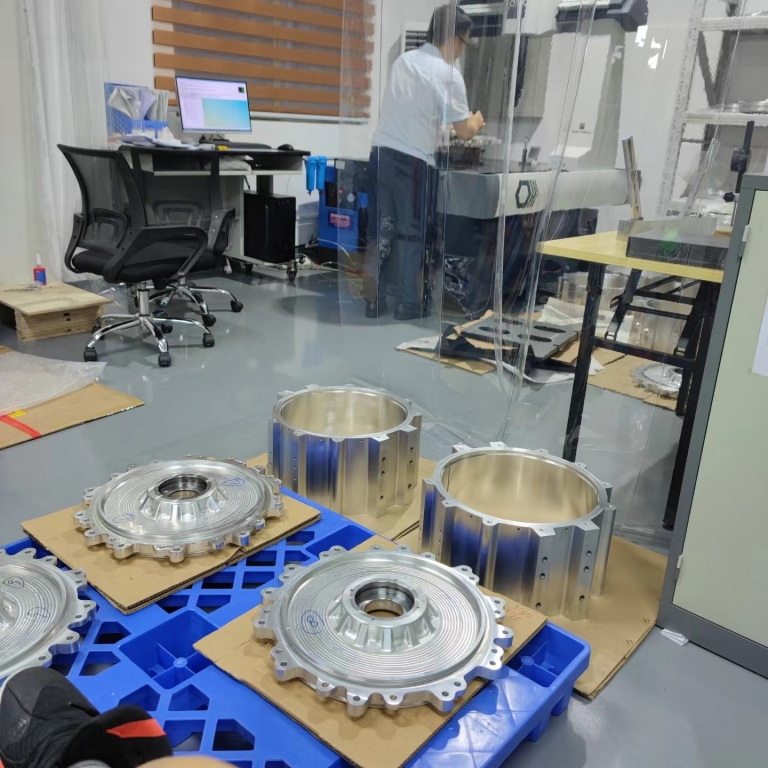
EV Control Unit Box Custom CNC Milling
The transition to electric vehicles (EVs) is arguably the most significant industrial shift of our time. At the heart of every modern EV lies a sophisticated network of electronic brains—the heart of which is often the EV Control Unit (ECU). These units, far from being off-the-shelf components, are highly customized systems that manage everything from battery thermal dynamics to motor torque and power distribution. Encasing these sensitive electronics demands an enclosure that is not only a structural container but a conductive, thermally managed, and precisely toleranced interface. This is where EV Control Unit Box custom CNC milling transitions from a simple manufacturing step to a critical engineering solution.
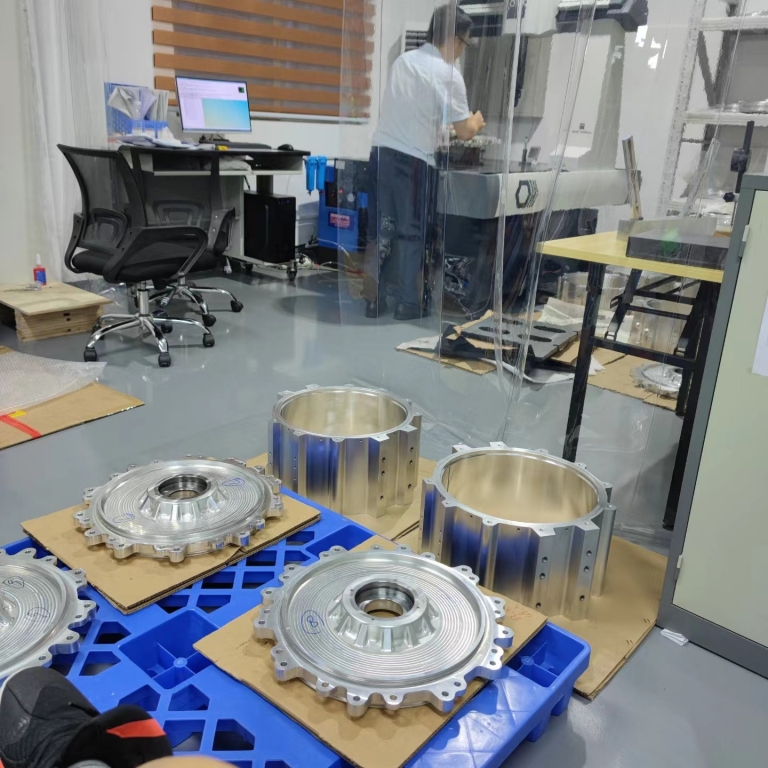
The precision with which an EV control unit box is machined directly impacts the lifespan, performance, and safety of the vehicle. Any microscopic deviation in a mounting hole, a misaligned connector port, or an inconsistent wall thickness can lead to electromagnetic interference (EMI), thermal hot-spots, or catastrophic failure of the control board. As such, selecting the right partner for this process is not merely a procurement decision; it’s a strategic engineering partnership.
1. The Critical Material and Precision Dilemma for EV Boxes
An EV Control Unit Box is not a simple container; it is a functional component. It must provide:
Electromagnetic Shielding: The box must act as a Faraday cage to protect the sensitive electronics from external interference and prevent the unit from radiating noise to other vehicle systems.
Thermal Management: Power electronics generate significant heat. The enclosure must often act as a heatsink, requiring precise flatness and thermal interface surfaces.
Weight Reduction: Every gram matters in an EV for extending range. This pushes engineers towards materials like aluminum alloys which offer a high strength-to-weight ratio and excellent thermal conductivity.
The starting point for any successful project is rigorous material selection. Commonly, engineers gravitate towards Aluminum 6061-T6 for its excellent machinability, good corrosion resistance, and thermal properties. For higher-strength needs or specific thermal demands, Aluminum 7075 or even A380 die-cast alloys (when moving to high-volume production) are considered. However, in the prototyping and low-to-mid volume production phases where customization is paramount, CNC milling dominates because of its flexibility and ability to achieve tight tolerances without expensive tooling.
The primary challenge lies in balancing lightweighting with structural rigidity. Traditional designs often rely on thick, solid walls. However, optimized designs for CNC milling involve intricate pocketing, thin-wall features, and complex internal geometries that add stiffness while removing mass. This demands a machining partner with advanced multi-axis capabilities to avoid chatter and deflection during the milling of these delicate features. For example, small, thin-walled copper or aluminum inserts for heat dissipation require specialized machining strategies that a standard 3-axis shop might struggle with.
2. The Engineering Rigor of the Milling Process
The journey from a CAD file to a functional EV Control Unit Box involves a deeply technical process. It begins with a meticulous DFM (Design for Manufacturability) analysis. An experienced partner like GreatLight Metal will not just blindly machine the part. They will analyze the design for potential issues such as:
Thin-wall integrity: Can a wall thickness of 0.5mm be reliably machined without vibration or cracking?
Corner radii and tool access: Are internal features accessible with standard tools? Is the required corner radius achievable without custom ground tools?
Tolerance stacking: How do tolerances on multiple features (hole-to-edge, pocket depth) interact when the lid is assembled?
Once the design is validated, the milling process typically leverages 5-axis CNC machining centers. This is a critical advantage for EV boxes which often require angled connector holes, complex cooling channels, and non-planar surfaces for optimal fit within the vehicle. A 5-axis machine allows the part to be indexed or continuously rotated, enabling the machining of complex geometries in a single setup. This single-setup approach is vital for maintaining the part-to-part consistency required for EM shielding and sealing, as it eliminates the cumulative errors introduced by re-fixturing.
Furthermore, achieving a surface finish that is both aesthetically pleasing and functionally effective is non-negotiable. For an EV box, a typical surface finish is a fine matte or satin finish, often achieved through bead blasting or a subtle grain. This is not just for looks; it helps dissipate heat more effectively than a mirror-polished surface and provides a better base for chemical conversion coatings or powder coating. The precision of the machining path and the use of high-quality tooling are what make this possible, ensuring no burrs are left that could short-circuit the electronics inside.
3. The Crucial Role of Post-Processing and Quality Assurance
After the chips are swept away, the work is far from over. The post-processing steps for an EV Control Unit Box are as critical as the machining itself.
Deburring and Edge Finishing: Every sharp edge, especially around connector ports and mounting holes, must be meticulously deburred. A single microscopic burr can cause a stress riser or, worse, a short circuit during vehicle vibration.
Surface Treatment: A raw aluminum box will oxidize and may not provide consistent EM shielding. The most common treatment is Chem Film (MIL-DTL-5541) which provides excellent corrosion resistance and maintains electrical conductivity for grounding. For higher corrosion protection or specific color requirements, powder coating or anodizing is chosen, though anodizing is non-conductive and requires masking of grounding points.
Helicoil or Threaded Insert Installation: Aluminum threads are soft and can strip. For critical mounting points that will be accessed during vehicle assembly or service, high-quality stainless steel helicoils or key-locking inserts are pressed in with precision. This adds a level of mechanical robustness that a tapped hole simply cannot provide.
The final, and most uncompromising, stage is quality assurance. For an EV Control Unit Box, standard inspection might include:
CMM (Coordinate Measuring Machine) Inspection: To verify all critical dimensions, hole positions, and flatness within a tolerance of ±0.01mm.
Surface Roughness Measurement: Using a profilometer to ensure the finish is within spec for sealing and thermal performance.
Leak Testing: For hermetically sealed units, a pressure decay or helium leak test is performed to ensure the box is water and dust tight.
This entire chain—from material selection through to final inspection—is what separates a precision component from a scrap bin candidate.
4. The Core Value of a True Manufacturing Partner
Choosing a partner for EV Control Unit Box custom CNC milling goes beyond finding a shop with a 5-axis machine. It is about selecting a collaborator that understands the nuanced demands of the automotive sector. A partner like GreatLight Metal demonstrates this through its commitment to industry-specific standards. The IATF 16949 certification is not just a plaque on a wall; it represents a structured approach to defect prevention, continuous improvement, and rigorous management of change within the supply chain. This is essential for achieving the kind of production consistency that a volume EV manufacturer demands.

The true value lies in risk mitigation. A supplier with deep engineering support can identify a potential design flaw before material is ever cut. They can suggest an alternative material that machines better while maintaining thermal properties, or redesign a internal feature to eliminate a secondary EDM operation, saving time and cost. This proactive approach is the opposite of a low-bidder mentality. It’s a partnership in innovation, where the factory’s capability translates directly into a better, more reliable final product for the end user.
5. Solving the Precision Predicament: A Framework for Selection
In my experience, the “precision predicament” is the most common pain point for engineers sourcing these boxes. The core issue is a disconnect between what is promised in a sales pitch and what is delivered in the crate. You order a part with a ±0.05mm tolerance on a mating surface, and you receive a part that is 0.1mm out of spec. This introduces assembly issues, warranty claims, and significant project delays.
Why does this happen?
Aging Equipment: A machine with worn-out ball screws cannot hold tight tolerances over a production run.
Unstable Processes: A lack of temperature control in the shop can cause a 20-foot aluminum bar to change length by several thousandths of an inch over the course of a day.
Lack of SPC: Without Statistical Process Control (SPC), a shop doesn’t know they have a problem until the parts fail final inspection, at which point they have already made a thousand.
To avoid this, a client must vet a supplier based on verifiable capabilities, not just marketing spin. This is where ISO 9001 and IATF 16949 certification provides a tangible framework for auditing. A certified supplier has documented processes for preventive maintenance, first-article inspection (FAI), and corrective action. For an EV box, you must demand a detailed First Article Inspection (FAI) report, a dimensional report (often including a full CMM report for complex features), and material certifications. The supplier’s willingness to provide this documentation is the single best indicator of their operational discipline and reliability.
Comparing the Landscape
| Supplier Type | Key Strength | Best For |
|---|---|---|
| GreatLight Metal | Full-process integration (Machining, finishing, assembly) under one roof. IATF 16949 certified for automotive reliability. | Complex, low-to-mid volume EV control unit boxes requiring tight tolerances and extensive post-processing. |
| Protocase | Rapid turnaround for custom sheet metal enclosures. Excellent for early-stage prototyping. | Simple, flat-sided enclosures where quick delivery is the primary driver. |
| Xometry | Vast network offers a wide range of materials and finishing options. Good for high-volume production when design is stable. | Standard parts with known geometries where price negotiation is key. |
| Fictiv | Digitally native interface for ease of quoting. Strong in plastic injection molding and 3D printing. | Plastic enclosures or complex plastic parts in prototyping stages. |
| RapidDirect | Fast quoting and manufacturing speed. Good for simplifying the supply chain for standard CNC parts. | Simple, straightforward CNC parts in aluminum or steel where speed is critical. |
The choice ultimately depends on the project’s complexity and risk profile. For a high-stakes component like an EV control unit box, investing in a partner with deep automotive expertise, a robust quality system, and a full process chain—like GreatLight Metal—is often the most cost-effective decision in the long run. The upfront premium is an insurance policy against the far greater cost of field failures.
Conclusion: The Future is Precision-Crafted
The EV revolution is, at its core, a manufacturing revolution. The success of an electric vehicle hinges on the reliability of its electronic components, starting from the precision of its enclosure. EV Control Unit Box custom CNC milling is not a commodity service; it is a specialized, high-stakes engineering process. It demands a sophisticated understanding of materials, thermal dynamics, EMI shielding, and rigorous quality control.
Choosing the right partner requires moving beyond the simple metrics of price and lead time. It requires a deep dive into their technical capabilities, their certification rigor, and their commitment to the full process chain. When you partner with an experienced, IATF 16949 certified manufacturer that treats every part as a critical safety component, you are not just buying a box; you are buying peace of mind and a foundation for reliable innovation. In a world of rapidly changing technology, that type of trust-based partnership is the ultimate competitive advantage. For your next project, consider the long-term value of a true partner—like GreatLight Metal—where every mill cut is a calculated step towards perfection.


![[访谈] RAPID + TCT 2024:人工智能对 3D 打印的价值](https://print-ing.com/wp-content/uploads/2024/07/INTERVIEW-60x60.jpeg "[访谈] RAPID + TCT 2024:人工智能对 3D 打印的价值 9")




发表回复
要发表评论,您必须先登录。