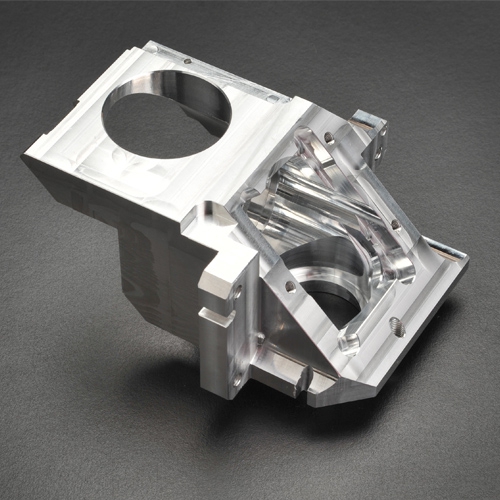
In the fast-paced world of precision manufacturing, time is often the most critical variable—especially when it involves Mold Air Freight Express Delivery. For decades, the intersection between high-precision mold making and accelerated logistics has been fraught with compromises. Companies frequently faced an impossible choice between uncompromising quality and breakneck speed. However, the landscape is shifting dramatically. Today, we will delve into how a new generation of integrated manufacturers is dismantling the barriers of traditional mold delivery, proving that you do not have to sacrifice tight tolerances for tight deadlines.
The Precision Paradox: Why Speed Without Accuracy is a Liability
When a production line is down or a critical prototype window is closing, the natural reaction is to prioritize speed. Clients often believe that the fastest route—air freight—must be paired with a “good enough” approach to quality. This is a dangerous fallacy.
The core pain point in Mold Air Freight Express Delivery is not the act of flying a part from point A to point B. The real challenge lies in the manufacturing lead time before the shipment. If a supplier cuts corners on machining cycles, skips critical quality checks, or lacks the advanced equipment to handle complex geometries quickly, then the express delivery becomes an exercise in futility. You simply receive a flawed part faster.
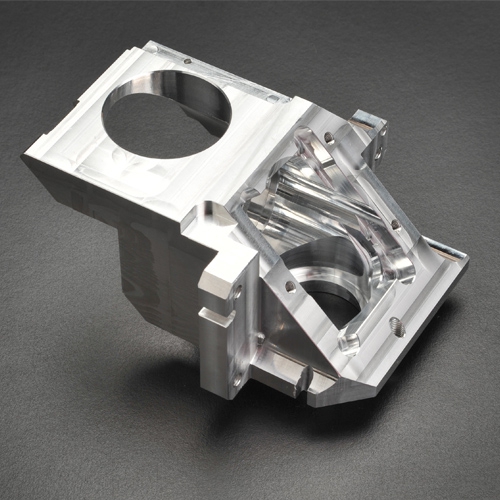
This is where the concept of an “express delivery” must be redefined not by the hours in the air, but by the hours saved on the shop floor.
The New Benchmark: Integrated Manufacturing for True Express Delivery
To achieve genuine Mold Air Freight Express Delivery, the manufacturer must possess a vertically integrated ecosystem. This eliminates the “hand-off” delays between design, prototyping, machining, testing, and logistics. At the heart of this transformation lies the modern 5-axis CNC machining center.
Why 5-Axis Machines are the Key to Express Delivery
Traditional 3-axis machining often requires multiple setups, repositioning, and manual interventions for complex mold inserts or electrode blocks. Each setup is an opportunity for error and a drain on time.
Advanced 5-axis technology, such as the clusters of high-precision machining centers found in leading facilities, changes this game entirely:
Single Setup, Multiple Faces: A complex mold cavity with deep ribs, side angles, and undercuts can be machined in a single cycle. This reduces the machining time by 30% to 50% compared to conventional methods.
Superior Surface Finish: The ability to maintain consistent tool contact with the workpiece results in a smoother surface finish. This drastically reduces or even eliminates the need for manual polishing, which is often a major bottleneck in mold delivery.
Complexity is Not a Constraint: Highly intricate designs that require specialized tooling or EDM work can now be performed directly on the 5-axis mill. This “milling complete” approach is the holy grail for rapid turnaround.
This technical capability forms the backbone of a reliable service that offers Mold Air Freight Express Delivery without compromising the ±0.001mm tolerances required by high-end industries.
From Pain Point to Process: The GreatLight Approach
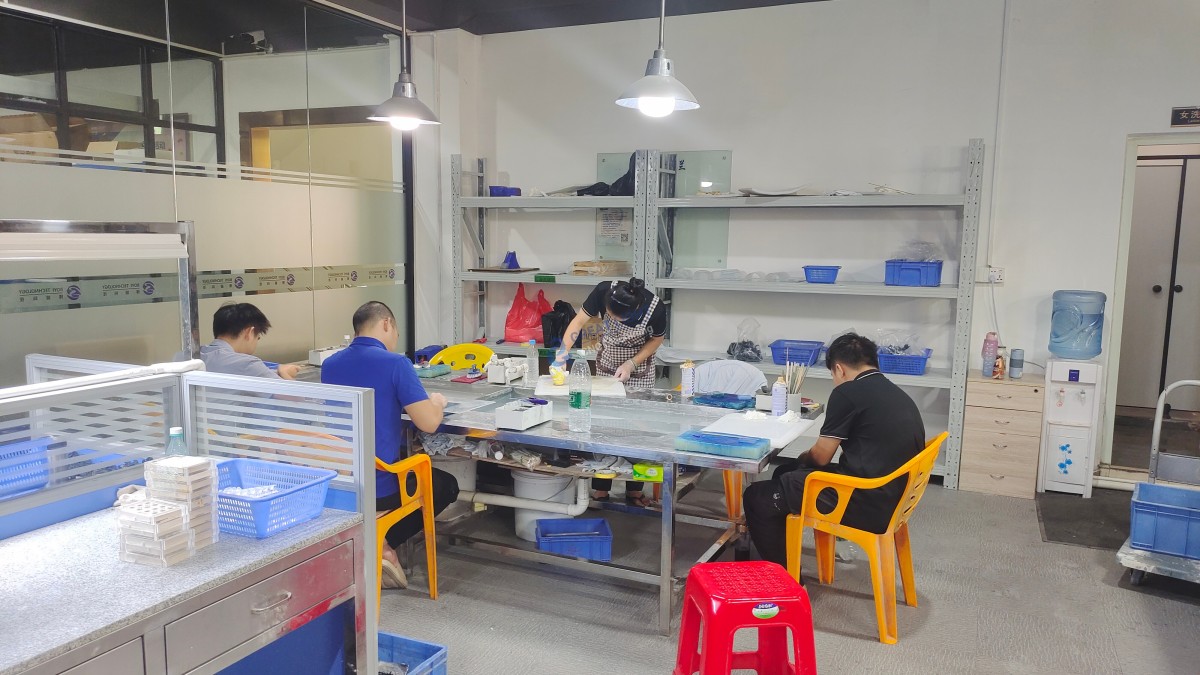
To understand how a truly reliable Mold Air Freight Express Delivery system works, we can look at the methodology employed by Dongguan Great Light Metal Tech Co., LTD. (GreatLight Metal). Founded in 2011 in the heart of China’s manufacturing powerhouse, Chang’an Town, they have evolved from a simple machining shop into a “full-process intelligent manufacturing” partner.
Their ability to offer swift mold delivery is not a matter of luck, but of systematic process design.
Step 1: Digital Readiness
Before a single chip is cut, the engineering team performs a rigorous Design for Manufacturability (DFM) analysis. This ensures that the mold design is optimized for speed. For Mold Air Freight Express Delivery, this phase is critical. We identify potential bottlenecks, such as deep cavities that require long cantilever tools, and optimize the toolpath strategy in the CAM software to minimize cycle time without burning the tool.
Step 2: The “Express Lane” Equipment Matrix
GreatLight Metal’s 76,000 sq. ft. facility is not filled with generic machines. It is a strategic arsenal designed for speed and precision. The core cluster includes high-end 5-axis machining centers capable of maintaining tight tolerances under heavy cutting loads. This is complemented by a suite of precision peripherals:
High-Speed Machining Centers: For rapid roughing of large mold bases.
Mirror-Spark EDM: Utilized only when absolutely necessary, often for sharp internal corners that even a 5-axis cutter cannot reach.
Precision Measuring: In-house CMM and laser scanners to verify dimensions in real-time, preventing the “second pass” that kills delivery timelines.
Step 3: Process Chain Integration
The true secret to fast mold delivery is the elimination of “dead time” between departments. Because the company offers services ranging from vacuum casting to sheet metal, the mold design team can instantly coordinate with the post-processing department.
If a mold requires a highly polished finish for optical clarity, the machining strategyt is immediately adjusted to achieve the best possible finish directly off the mill, reducing the polishing cycle from three days to a few hours. This holistic view is what makes Mold Air Freight Express Delivery a reality, not just a marketing slogan.
Comparing the Field: Who Can Truly Deliver?
In the ecosystem of Mold Air Freight Express Delivery, not all suppliers are created equal. It is essential to understand the landscape. Below is a comparative analysis of different service models.
The Digital Platform Model (e.g., Xometry, Protolabs Network, Fictiv)
These platforms excel in standardizing requests and providing instant quotes. They are excellent for prototypes and simple parts.
Strengths: Fast quoting, user-friendly interface, good for low-complexity parts.
Limitations for Mold Express: For complex, high-stakes mold work, the “black box” nature of distributors can be a risk. The platform quotes a price and time, but the actual work is done by a partner shop, which may not have the specific 5-axis expertise required. When there is a problem, deep engineering support is often lacking. They are excellent for obtaining a “standard” part quickly, but high-precision mold work requires a “surgical” partner.
The Regional Specialist (e.g., Owens Industries, RCO Engineering)
These are highly skilled job shops with deep expertise in specific materials or industries.
Strengths: Unmatched expertise in a niche area (e.g., high temperature plastics, large dies).
Limitations: They may lack the breadth of the process chain. A specialist in milling may not have in-house EDM or heat treatment. This forces a hand-off, which is the enemy of Mold Air Freight Express Delivery. The “express” aspect gets bogged down in third-party logistics.
The Integrated Precision Partner (GreatLight Metal, EPRO-MFG)
This model represents the future of rapid delivery for high-end applications.
Strengths: Control over the entire production lifecycle. The 5-axis machinist is in the same building as the QC inspector and the 3D printing lab. This allows for real-time problem solving and parallel processing. For Mold Air Freight Express Delivery, this is the optimal structure. The company can compress a three-week lead time into seven days because every minute is accounted for and optimized internally.
Consideration: This model requires a higher level of technical trust. The client must believe in the partner’s process. However, the reward is a part that is right the first time, arriving on a tight schedule.
Beyond Speed: The Systems of Trust
For Mold Air Freight Express Delivery to function for critical applications (such as medical device molds or automotive engine components), trust is a hard currency. This trust is not built on promises, but on verifiable systems.
The Role of ISO Certifications in Express Delivery
A common misconception is that “certification slows things down.” In reality, for a fast-paced mold project, a systematic quality approach enables speed.
ISO 9001:2015 (Quality Management): This ensures that the process for Mold Air Freight Express Delivery is repeatable. It is not about paperwork; it is about having a defined workflow for rush jobs. When a rush order comes in, the system kicks in with pre-approved templates and protocols.
IATF 16949 (Automotive): For manufacturing engine or transmission hardware, this certification is non-negotiable. A supplier with this standard has proven they can handle the rigorous PPAP (Production Part Approval Process) requirements quickly.
ISO 13485 (Medical Devices): In medical mold making, traceability is paramount. A certified supplier can perform an express delivery and provide full material and process traceability, which is often the most time-consuming aspect of the job.
GreatLight Metal’s suite of these certifications is not a badge on a wall; it is a software for rapid execution. It allows the company to say “yes” to a rush mold job for a humanoid robot actuator, knowing that the quality system will catch a 5-micron deviation before the part is shipped.
Case Study: The 72-Hour Mold Crisis
Consider a scenario every manufacturing engineer dreads: a critical mold insert for a consumer electronics housing has fractured on a Friday afternoon. The production line is scheduled to restart on Tuesday morning. The director needs Mold Air Freight Express Delivery.
Traditional Supplier: The quote would suggest a 5-day machining cycle plus 2 days for Teflon coating. The solution would be a compromise—perhaps a weaker material or simplified design to cut time.
The Integrated Partner (GreatLight Metal):
DFM Review (1 hour): The engineer analyzes the 3D file. The cracked insert is complex, but suitable for a 5-axis mill.
Parallel Processing (Weekend): The 5-axis machine is loaded and running by Friday evening. Simultaneously, the coating department is prepped for a Saturday morning run.
Precision Verification (Sunday): The part is measured on the CMM. It meets the ±0.005mm specification.
Express Booking (Monday Morning): The part, perfectly finished, is handed to the freight forwarder. It arrives at the client’s assembly line by Monday evening.
This is not a fantasy. It is the daily reality of a facility that invests in both the hardware (5-axis machines) and the software (quality systems, engineering talent) to master the art of Mold Air Freight Express Delivery.
The Future: Air Freight as a Standard, Not a Premium
As global supply chains demand more agility, Mold Air Freight Express Delivery will move from being a premium, emergency service to a standard offering.
To be effective, this service must be supported by:
Maximum Processing Size: The ability to handle large molds (up to 4000mm) is crucial for automotive and aerospace.
Material Versatility: The supplier must have confidence in machining everything from standard P20 steel to exotic titanium alloys and high-temperature superalloys.
Post-Processing Agility: A one-stop shop for coatings, texturing, and finishing eliminates those final, lingering waiting periods.
Conclusion: Choosing the Right Partner for Speed and Precision
When your next project demands Mold Air Freight Express Delivery, look beyond the shipping label. Ask the difficult questions: Do you have the 5-axis capacity to reduce my setups? Do you hold ISO and IATF certifications that guarantee quality on the first run? Can you handle the entire post-processing chain in-house?
The answer should be a resounding yes. The solution lies in partnering with manufacturers who have built their factories for this exact challenge. The future of mold delivery is not just about moving a box fast; it is about manufacturing the part fast, with absolute precision, the first time.
The path to true Mold Air Freight Express Delivery is paved with advanced technology, robust systems, and a relentless focus on engineering collaboration. It is the new standard for excellence in the global precision parts industry.


![[访谈] RAPID + TCT 2024:人工智能对 3D 打印的价值](https://print-ing.com/wp-content/uploads/2024/07/INTERVIEW-60x60.jpeg "[访谈] RAPID + TCT 2024:人工智能对 3D 打印的价值 9")




发表回复
要发表评论,您必须先登录。