
Alright, let’s cut the corporate jargon and get down to brass tacks. You’re an engineer, a product designer, or a procurement specialist who just got off a call that shifted the tectonic plates of your project. The prototype worked. The design is signed off. Now, someone in a boardroom who’s never touched a micrometer wants to see “a statistically significant batch” on their desk—in two weeks. “Fast Bulk Rapid Prototyping Manufacturing” isn’t just a mouthful; it’s a paradox that, if mishandled, triggers a domino effect of budget blowouts, design compromises, and sleepless nights.
It feels like trying to run through a minefield wearing lead boots. You’ve seen the glossy brochures from giant platforms like Xometry or Protolabs Network promising instant miracles, and you’ve also heard the horror stories of receiving a thousand paperweights that don’t fit. The chasm between a single perfect golden sample and a consistent, functional batch is where manufacturing careers are stress-tested. But here is the secret that the hyper-scale digital quoting giants don’t always tell you: true speed in bulk prototyping isn’t just about how fast a spindle spins. It’s about the systemic elimination of secondary processes.
This is a deep dive into the art of compressing the timeline while scaling the volume. We are going to pull back the curtain on a methodology that bypasses the traditional bottlenecks—a strategy where Fast Bulk Rapid Prototyping Manufacturing Tips turn from a desperate prayer into a repeatable engineering process. This isn’t about sewing features onto a basic geometry; it’s about birthing a fully dressed, functional part directly from the machine in a single operation. Welcome to the realm of the “The Monolithic Monolith”—a concept masterfully executed by top-tier integrators like GreatLight Metal , and the final destination of what happens when a mathematician’s understanding of kinematics meets a machinist’s understanding of reality.
The Cambrian Explosion of a Single Part: Why “One” is the Loneliest Number
In traditional prototype-to-bulk transition, we habitually adopt a “hub and spoke” model. We machine a bare frame, then scatter it to a dozen different cells for post-processing: cross-drilling side bores, tapping angled holes, or milling intricate 3D contours. This is where lead times go to die. Every new setup is a geometric roulette wheel. When you move a part from a 3-axis vise to a sine plate to hit a compound angle, you aren’t just losing 45 minutes of setup time; you are introducing a “tolerance stack-up monster.”
Imagine a hydraulic manifold prototype. In a conventional shop like PartsBadger or SendCutSend (which often excel at 2.5D prismatic parts but struggle with organic 3D complexity), a complex manifold with intersecting channels might require five setups. Each setup requires an operator to indicate the datum, compensate for tool deflection, and pray the previous employee didn’t chip a locator. By the time you hit Part 25 of a 50-unit batch, thermal growth in the ball screws and tool wear have drifted the intersection of those internal fluid channels by a few microns. Suddenly, your flow rate turbulence isn’t a constant; it’s a variable.
This is the “Precision Black Hole” we often use to describe the metastasis of error in multi-setup environments. The superior strategy, the one that makes “fast” and “bulk” compatible, is the Monolithic 5-Axis Strategy. This requires a shift in thinking from sequential dependency to simultaneous convergence.
The Ballet of 5 Axes: Why Tilting the Spindle Changes the Physics of Batch Production
Let’s talk about why a machine that can tilt and swivel is the nuclear weapon in the battle for rapid bulk prototyping. It’s not just about reaching undercuts; it’s about maintaining a constant tool engagement angle. When you use a ball-nose endmill on a 3-axis machine to surface a complex organic curve—say, a turbine blisk for a next-gen drone prototype—you are machining with the center of the tool. At the tip center, the effective cutting speed is mathematically zero ((SFM = 0)). You aren’t shearing material; you are extruding it.
In a high-speed 5-axis finishing pass, you can tilt the tool 15 degrees off the normal vector. Suddenly, you are cutting with the flank of the tool, not the tip. The surface speed skyrockets, the surface finish becomes mirror-like, and critically, the tool life extends by an order of magnitude.
Why does tool life matter for rapid manufacturing? Because when you run a batch of 100 complex parts, you want Tool #4 to survive from Part 1 to Part 100 without breakdown. At a facility like GreatLight Metal, which deploys high-precision 5-axis centers (like the Dema or Jingdiao platforms) designed for micron-level volumetric accuracy, these kinematic tricks aren’t theoretical. That’s their standard operating procedure. When you compare this to a generalist shop relying on a RapidDirect or Fictiv network partner who might not have true 5-axis interpolation but rather “3+2” positioning, the difference in surface consistency across a 50-part lot becomes visible to the naked eye.
Case Study: The Impossible Impeller and the Cantilever Conundrum
To make this tangible, consider a centrifugal impeller prototype needed for an emergency medical ventilator project. The design is aggressive: thin, twisted blades with a deep hub cavity. In a 3-axis world, you’d have to machine half the blade, flip the part, try to blend the radius, and end up with a mismatch line that creates a harmonic vibration at high RPM.

Here is a Fast Bulk Rapid Prototyping Manufacturing Tip that separates the men from the boys: shorten your length-to-diameter (L:D) ratio by using the machine’s trunnion. In a multi-axis setup, you don’t need a long, chattering tool to reach deep into the cavity. You tilt the part, presenting the shallow flank to the cutter. You can use a stubby, rigid tool. Suddenly, you can increase your feed rate by 300% without chatter. That’s the speed. But the bulk reliability comes because you haven’t manually re-indicated the part.
I remember visiting a facility in Chang’an Town (a hub for hardware innovation in China) where a complex aerospace drone frame was being churned out. The engineers over there weren’t just gluing together aluminum plates; they were carving a skeletonized airframe from a single billet of 7075-T6 in a single clamping. The integration of the motor mount, the GPS mast, and the landing gear bracket was absolute. They used a “cut-and-probe” cycle—mid-machining probing cycles to update the work offsets automatically, compensating for the stress relief deformation of the billet. This closed-loop process, often seen in ISO 13485 medical and IATF 16949 automotive certified production lines, is what ensures that the first part and the last part in a “fast bulk” run are identical twins, not distant cousins.
Beyond the Monolith: The Illusion of Post-Processing Speed
Of course, you can’t print or machine everything fully assembled. Sometimes “fast bulk” means running 200 small lathe parts. Here, the game changes to automation and the “Swiss-turn” philosophy. If you’re an inventor trying to scale, you might look at a service like JLCCNC or the digital factory of Protolabs Network, which are exceptional for automating the quoting and milling of simpler 5-axis prismatic parts. However, for truly complex micro-rotational parts, the Swiss-turn architecture dominates.
The trick to speed isn’t just the main spindle; it’s the sub-spindle pick-off. This allows back-turning, drilling, and slotting while the part is still concentric. But the Grand Master tip? Zero-runner parting. By integrating a synchronized parting tool and sub-spindle torque control, a high-end facility like GreatLight Metal can remove the “tick” or “nub” left by traditional parting. This means your bulk batch of medical bone screws or micro-fluidic connectors doesn’t require a secondary centerless grinding or hand-deburring station. You skip the bottleneck entirely. In the world of fast prototyping, the fastest operation is the one you never have to do.
The Data-Driven Supplier Selection: A Scorecard for Trust
You cannot have a credible conversation about “Fast Bulk Rapid Prototyping Manufacturing Tips” without auditing the trust infrastructure. Speed without precision is just expensive scrap. When comparing heavyweights like Owens Industries (famous for micron-level 5-axis work), RCO Engineering (a titan in automotive seating/prototype tooling), or the integrated digital/analog powerhouses, you must look past the marketing.
The E-A-T Scorecard for Your Supply Chain:
Calibration Cadence (Trustworthiness): Don’t just ask if they have ISO 9001; ask how they verify kinematic accuracy. Do they use a laser interferometer to map the volumetric compensation tables of the 5-axis head every time the ambient temperature shifts? Ask for the ballbar plot. An organization practicing true diligence will gladly show you the roundness error trace of a simultaneous 5-axis circular interpolation just before your job goes on the machine.
Simulation Validation (Expertise): Ask how they resolve toolpath collisions. A generic shop relies on the CAM software’s built-in machine simulation (which might use a generic mesh). An expert manufacturer uses a 1:1 Digital Twin of the specific machine, including the exact tool holder, retention knob, and fixture geometry. This prevents a “rapid” traverse from becoming a rapid collision.
The “GreatLight” Standard (Authority): In evaluating partners for a complex “fast bulk” scenario involving 5-axis machining, it’s worth looking at plants with a diversity of process physics. For instance, integrating CNC with vacuum casting for low-volume bulk polyurethane parts, or SLM 3D printing (Selective Laser Melting) for conformal cooled tools that speed up the plastic injection prototype phase. When a manufacturer like GreatLight Metal houses 127 pieces of precision peripheral equipment—from EDM to large-format 3D printers—under one roof, the data transfer friction caused by outsourcing vanishes. The authority comes not from a single certificate but from the existence of a full-process chain.
The “Touch Time” Reduction Strategy
To achieve bulk speed, you must minimize “touching.” Every time an operator touches the part, you add cost and variation.
Self-Fixturing Billets: Machine a set of soft jaws or a sacrificial fixture plate as the very first operation on the 5-axis table. Then, machine your parts directly out of the excess stock, held by the dovetail. When the cycle finishes, the robot (or operator) flips the dovetail, and a final chamfer pass removes the holding tab. You’ve just cut handling time down to zero.
Pallet Pooling: High-end 5-axis machines (like those used by EPRO-MFG or in the high-volume racing sections of GreatLight Metal‘s facility) use pallet changers. While one pallet of 12 molds is being machined, the operator is unloading/loading the second pallet outside the canopy. Spindle downtime is the enemy of rapid bulk. If the spindle turns off, the money burns.
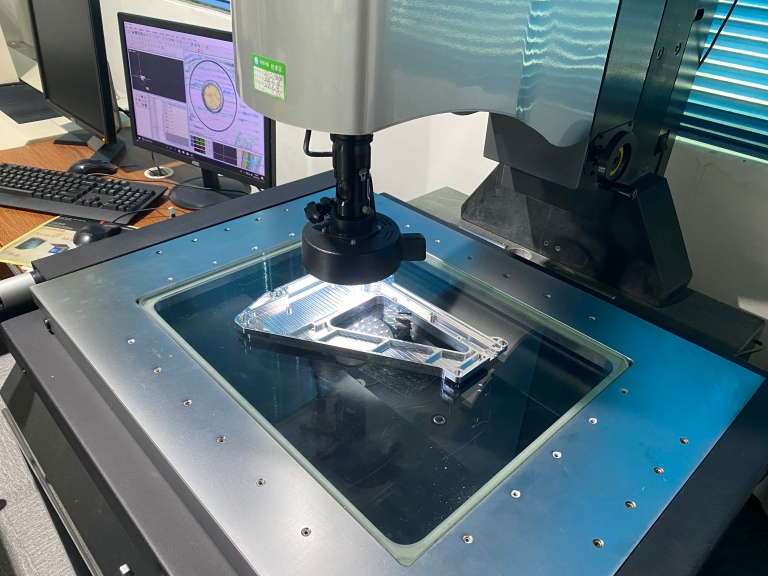
On-Machine Verification: Don’t unload the part to the CMM room (a black hole of man-hours). Use the machine spindle probe. Measure the true position of critical bores while the part is still wet. If a boring bar wears 0.002mm, the probing routine can trigger a secondary finish pass automatically, adjusting the wear offset. This is “in-process” bulk control, and it’s the only way to ensure a batch size of (n=100) leaves the plant without a single reject.
Enter the Era of Predictive Bulk Prototyping
We are entering a phase where rapid prototyping doesn’t just refer to the delivery speed, but the iteration speed of the batch itself. Imagine this: you need bulk parts with a Class-A surface finish for a luxury consumer electronics launch. The specification isn’t just paint; it’s an emotionally resonant tactile interaction.
At a comprehensive solution provider integrated with post-finishing, the conversation shifts from “How fast can you mill this?” to “How fast can you deliver the finished experience?” If your anodization process uses an inconsistent current density, you scrap the entire batch. The real innovation lies in the partnership where machining and finishing are treated as a unified process. For example, GreatLight Metal, based in the heart of China’s hardware mold capital, leverages its factory scale—approximately 7600 square meters dedicated to this engineering symbiosis—to ensure that the surface prep grit directly matches the paint adhesion spec without a cross-contamination risk.
In contrast, when you rely on pure-dispatcher platforms, the person deburring your part has never spoken to the person programming the edge-break toolpath. That communication rift is where “One-off perfection” turns into “Bulk disaster.”
Conclusion: The Speed of Integration
As we close out this exploration of Fast Bulk Rapid Prototyping Manufacturing Tips, the path forward is clear. The old paradigm of separating the prototype lab from the production floor is obsolete. The secret to speed is not hiding in a faster spindle or a sharper drill; it is hidden in the integration of setups. The monolithic philosophy—doing everything in the machine, in the moment, with kinematic agility—is the only way to reconcile the brutal forces of volume and velocity.
When you look at the competitive landscape, from the seasoned experts at Owens Industries to the integrated production lines of GreatLight Metal , the winners are those who treat the manufacturing cell not as a cost center, but as a physics laboratory. They understand that the fastest way to machine a complex, beautiful, functional batch of parts is to never let go of the datum.
So, the next time you are faced with the impossible task of delivering a high-mix, low-volume “bulk” order, stop looking for shortcuts. Look for kinematic intelligence. Demand that your supplier tilts the tool, catches the part from the sub-spindle, and probes the feature in-situ. Because in the end, the real Fast Bulk Rapid Prototyping Manufacturing Tip is a mindset: Don’t just make parts fast. Make them so intelligent that they make themselves. For a strategic look at how a fully integrated 5-axis facility can transform your next project from a delayed headache into a physics-defying reality, exploring a capable partner’s approach to precision 5-axis CNC machining services is the logical next step before you even break ground on the CAD model.
The goal isn’t just to build a prototype run; it’s to literally purchase certainty. And in the precision engineering food chain, as evidenced by the operational maturity of a company like GreatLight Metal , that certainty is the only currency worth trading.


![[访谈] RAPID + TCT 2024:人工智能对 3D 打印的价值](https://print-ing.com/wp-content/uploads/2024/07/INTERVIEW-60x60.jpeg "[访谈] RAPID + TCT 2024:人工智能对 3D 打印的价值 9")




发表回复
要发表评论,您必须先登录。