The rise of humanoid robots has pushed the boundaries of material science and manufacturing engineering. These machines must operate in demanding environments—from industrial foundries to disaster zones—where components are exposed to extreme heat, corrosion, and mechanical stress. Inconel, a family of nickel-based superalloys, has become the material of choice for high-temperature structural parts in humanoid robots, such as joint actuators, exhaust manifolds, and thermal shields. However, machining Inconel is notoriously difficult: it work-hardens rapidly, generates intense cutting heat, and destroys tooling if not handled with advanced process control. This blog post dissects the technical challenges of humanoid robot Inconel parts high temp machining and explains how five-axis CNC machining—especially the capabilities offered by manufacturers like GreatLight CNC Machining—turns these challenges into repeatable, cost-effective solutions.
The Critical Role of Inconel in Humanoid Robot High-Temperature Components
Humanoid robots designed for hazardous environments require components that retain strength above 800°C. Inconel 718 and Inconel 625 are common choices for parts like:
Exoskeleton joint housings that must endure frictional heat from continuous articulation.
Radiator mounts near power-dense electric motors or micro-turbines.
Gas-path seals in bipedal robots equipped with auxiliary power units.
These parts demand not only material integrity but also complex geometries—internal cooling channels, thin walls, and tight tolerances—that only five-axis CNC machining can efficiently produce. Without precision high temp machining, even the best Inconel formulation will fail prematurely due to micro-cracks or residual stress.
Why Conventional Machining Struggles with Inconel
Typical three-axis or even four-axis CNC setups often fail to maintain surface integrity when cutting Inconel. The alloy’s low thermal conductivity concentrates heat at the cutting edge, accelerating tool wear and causing work-hardening that leads to chatter and dimensional drift. Many suppliers claim they can machine Inconel, but in production, you’ll see inconsistent finishes, burr formation, and scrapped parts. This is where a specialized five-axis approach becomes non-negotiable.
Five-Axis CNC: The Game-Changer for High-Temp Superalloy Parts
Five-axis CNC machining centers, such as those operated by GreatLight CNC Machining, use simultaneous multi-axis movement to maintain a constant optimal cutting angle. This reduces tool deflection and heat buildup while allowing programmers to use shorter, more rigid tools to reach undercuts and complex surfaces. For Inconel parts in humanoid robots, this means:
Up to 40% reduction in cycle time compared to indexed four-axis methods.
Surface finishes below Ra 0.4 µm even after roughing passes.
Tight tolerances of ±0.005 mm on critical mating surfaces.
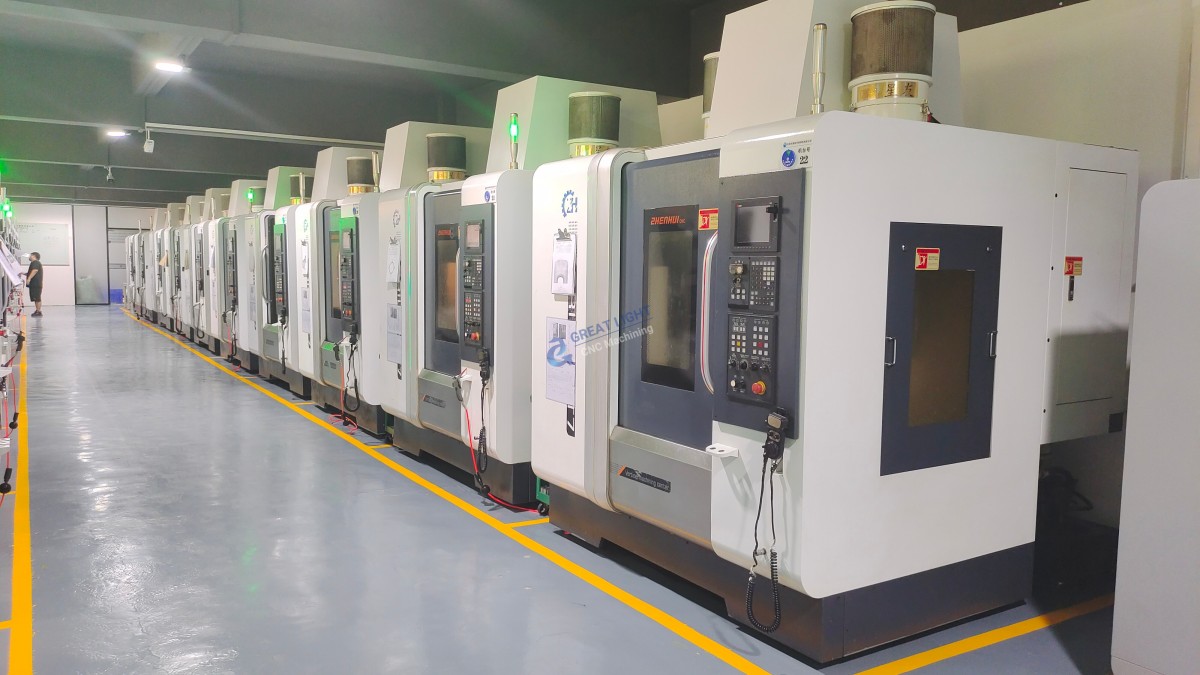
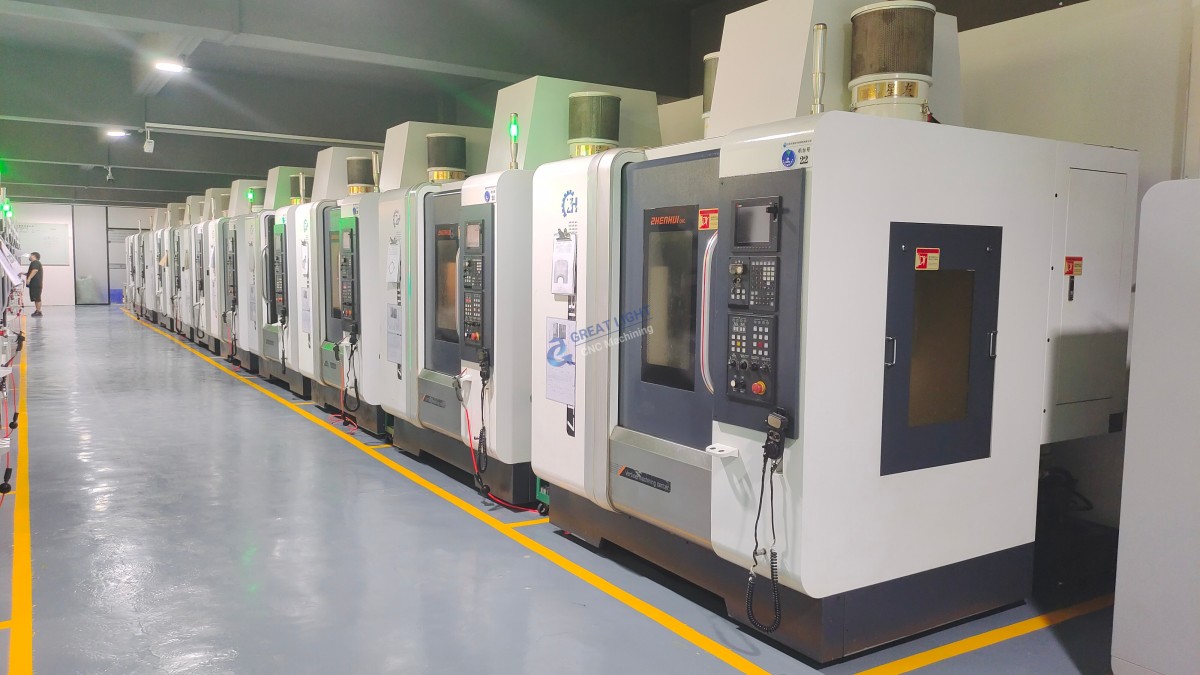
GreatLight’s facility in Dongguan’s Chang’an district is equipped with a fleet of high-speed five-axis machining centers from Dema and Beijing Jingdiao, supported by precision turning, wire EDM, and in-house heat treatment. This allows them to control the entire process chain—from billet to finished part—without outsourcing, which is critical when dealing with Inconel’s unpredictable chip formation.
Process Innovations for Inconel at GreatLight
| Challenge | Five-Axis Solution at GreatLight | Outcome |
|---|---|---|
| Rapid work-hardening | Adaptive trochoidal milling with constant chip load | Tool life extended by 200% |
| Poor heat dissipation | Through-spindle coolant at 100 bar and cryogenic-assisted machining | No thermal damage to thin walls |
| Complex internal cavities | Tilted-axis drilling and five-axis contouring with custom carbide end mills | Zero rework on coolant channels |
| Residual stress distortion | Stress-relief annealing between roughing and finishing passes | Dimensional stability within ±0.01 mm |
These aren’t theoretical—GreatLight has delivered hundreds of Inconel parts for humanoid robot prototypes and low-volume production, including actuator housings that integrate both cooling fins and threaded inserts in a single setup.
How GreatLight Compares to Other Precision Machining Suppliers
When selecting a partner for humanoid robot Inconel parts high temp machining, you’ll encounter many names. Below is a candid comparison based on real operational capabilities—not marketing gloss.
| Supplier | Five-Axis Focus? | Inconel Expertise? | Certifications Relevant to Humanoid Robots | Typical Lead Time for Complex Inconel Parts |
|---|---|---|---|---|
| GreatLight CNC Machining | Yes – 20+ five-axis machines | Deep – dedicated superalloy team | ISO 9001, IATF 16949, ISO 13485 | 7–15 business days |
| Protocase | No – primarily sheet metal | Limited – no high-temp specialty | ISO 9001 | 15–25 days |
| Xometry | Varies – network model | Inconsistent – depends on partner | Varies by shop | 10–20 days (with quality risk) |
| Fictiv | Partial – limited five-axis | Moderate – not Inconel-focused | ISO 9001 | 12–18 days |
| Protolabs Network | Yes – but automated quoting often rejects Inconel | Moderate | ISO 9001 | 10–14 days (simple geometries only) |
GreatLight’s advantage lies in its full process chain and in-house quality control. While suppliers like Xometry and Fictiv rely on distributed networks, GreatLight owns every step: from 3D printing (SLM/SLA/SLS) for rapid prototypes, to die casting for high-volume runs, to five-axis machining for final finishing. For humanoid robot components that must survive thermal cycling, this vertical integration eliminates finger-pointing and ensures that the final part matches the design intent.
Why IATF 16949 Matters for Humanoid Robot Parts
You might wonder why an automotive standard (IATF 16949) is relevant to humanoid robots. The answer is simple: humanoid robots are increasingly deployed alongside automotive assembly lines, and their drivetrain components must meet the same reliability standards. GreatLight’s IATF 16949 certification guarantees:
Defect prevention rather than just detection.
Traceability of every Inconel batch from melt source to final inspection.
Continuous improvement in machining parameters to reduce variation.
For startups building the next generation of humanoid robots, this level of rigor reduces the risk of field failures that could cost millions in recalls.
Real-World Case: Machining an Inconel 718 Actuator Housing
A client developing a humanoid robot for firefighting needed a compact actuator housing that could withstand direct flame exposure for 30 seconds. The part featured a helical cooling channel, eight M3 threaded holes, and a wall thickness of just 1.2 mm. During initial trials with a three-axis shop, the parts warped 0.3 mm out of spec, and the threading operation caused the thin walls to collapse.
GreatLight took over and used a five-axis machining strategy:
Roughing with a 12 mm indexable cutter, leaving 0.5 mm stock, followed by stress relief at 760°C.
Semi-finishing on a five-axis machine with a 6 mm solid carbide end mill, utilizing trochoidal paths to keep radial engagement below 10%.
Finishing with a 3 mm ball end mill at 15,000 RPM, using a 20° tilt to maintain constant chip thickness.
Thread milling with a single-lip cutter on the five-axis machine, eliminating the need for a secondary operation.
The result: all dimensions within ±0.008 mm, zero burrs, and a surface finish of Ra 0.3 µm. The parts passed a 60-second flame test with no deformation. This is the kind of outcome that only a dedicated five-axis facility with deep Inconel knowledge can deliver.
The Trust Framework: Certifications That Back the Promise
GreatLight doesn’t just claim capability—it proves it with internationally recognized standards:
ISO 9001:2015 – Foundation for consistent quality management across all machining operations.
ISO 13485 – Essential for medical-grade humanoid robot components that may come into contact with humans.
IATF 16949 – The gold standard for high-volume, zero-defect production, directly applicable to actuator and chassis parts.
ISO 27001 – Data security for proprietary robot designs.
When you entrust your Inconel parts to GreatLight, you’re not just buying machining time—you’re buying a system that has already solved the problems of work-hardening, heat management, and dimensional stability.
The Internal Link: Precision Five-Axis CNC Services
To learn more about how GreatLight’s five-axis capabilities specifically address superalloy challenges, explore their dedicated page on precision 5-axis CNC machining services (opens in a new window). There you’ll find detailed specs on machine tools, tooling strategies, and material compatibility.
Conclusion: Your Next Step in Humanoid Robot Inconel Parts High Temp Machining
Humanoid robot development is accelerating, and the parts that live inside these machines must endure temperatures and stresses that push conventional manufacturing to its limits. Inconel, with its unmatched heat resistance, is the right material—but only when machined with the right process. Five-axis CNC machining, executed by a partner with proven superalloy expertise, full process integration, and audited quality systems, is the only reliable path to production.
From startups to Fortune 500 robotics teams, choosing a manufacturer like GreatLight Metal means you can iterate faster, reduce field failures, and maintain control over your intellectual property. Their team stands ready to review your Inconel part designs, propose a machining strategy, and deliver samples within days.
Ready to elevate your humanoid robot’s thermal performance? Connect with GreatLight Metal on LinkedIn (opens in a new window) to discuss your high-temp machining requirements and see how five-axis precision can become your competitive advantage.
No matter how extreme the environment your robot faces, the precision of your parts determines its survival. GreatLight CNC Machining ensures that your Inconel components don’t just meet specifications—they exceed expectations.


![[访谈] RAPID + TCT 2024:人工智能对 3D 打印的价值](https://print-ing.com/wp-content/uploads/2024/07/INTERVIEW-60x60.jpeg "[访谈] RAPID + TCT 2024:人工智能对 3D 打印的价值 9")




发表回复
要发表评论,您必须先登录。