
As a senior manufacturing engineer who has spent years in the trenches of high-precision machining, I’ve seen how a single component can make or break an entire system. Nowhere is this more true than in the production of satellite antenna reflectors. These parts are not just metal dishes; they are the eyes and ears of spacecraft, communications satellites, and remote sensing platforms. The CNC milling of a satellite antenna reflector is a marriage of art and science, demanding an obsessive focus on geometric accuracy, surface integrity, and material stability. In this post, I’ll walk you through what makes this process so challenging, the technologies that solve these challenges, and how choosing the right manufacturing partner—like GreatLight Metal—can mean the difference between a mission-critical success and an expensive failure.
Satellite Antenna Reflector CNC Milling: The Heart of High-Frequency Communication
Satellite Antenna Reflector CNC Milling sits at the intersection of ultra-precision engineering and advanced manufacturing. Whether it’s a parabolic reflector for a geostationary telecom satellite or a shaped reflector for a synthetic aperture radar, the part must maintain dimensional accuracy often down to ±0.010 mm or better across large diameters, while resisting thermal distortion and mechanical stress in the vacuum of space. Traditional 3-axis milling simply can’t follow the complex, doubly curved surfaces efficiently; this is where 5-axis CNC machining becomes indispensable, allowing the tool to stay normal to the surface and achieve the necessary surface finish without excessive tool paths or vibration.
But the path from a design model to a flight-ready reflector is riddled with pitfalls. In the following sections, I’ll dissect the critical pain points, material choices, process strategies, and quality verification measures that define successful reflector manufacturing, culminating in a practical guide to selecting a supplier who can truly deliver.
The Unique Demands of Antenna Reflector Machining: Seven Precision Predicaments
Every machinist knows that the more “perfect” a part needs to be, the more opportunities there are for things to go sideways. When I talk to procurement engineers or R&D teams about reflector projects, the same systematic pain points keep surfacing—what I call the “precision predicament.”
The Precision Black Hole
Suppliers may claim ±0.001″ accuracy, but in large reflectors (often 400 mm to 2,000 mm in diameter), thermal expansion, tool deflection, and machine volumetric errors can quickly turn that promise into a mirage. Without a rigorous in-process measurement protocol and temperature-controlled environment, real-world tolerances drift into a “black hole” of unpredictable results.
The Thin-Wall Instability Trap
Reflectors are designed for lightness, featuring thin walls (often 1–2 mm) and delicate support ribs. Milling such structures induces chatter, vibration, and deformation, leaving the part susceptible to warping or even cracking if forces aren’t perfectly managed.
The Surface Finish–Signal Fidelity Nexus
High-frequency RF signals demand surface roughness values below Ra 0.4 µm, sometimes approaching Ra 0.1 µm for Ka-band and above. A single tool mark or vibration pattern can scatter signals, degrading antenna gain and side-lobe performance. Achieving this on a freeform aluminum or nickel-plated surface requires specialized toolpath algorithms and vibration-damped tool holders.
Material Residual Stress Unwinding
Aluminum alloys like 6061-T6 or 7050, as well as Invar and composite tooling boards, harbor residual stresses from forming. As material is removed, internal stresses redistribute, causing the reflector to “spring back” unpredictably. Stress-relief heat treatments and multiple roughing–semi-finishing–finishing stages become essential.
Fixturing Without Distortion
Holding a large, thin, curved component without introducing local distortion is an art. Vacuum chucks, soft jaws, or custom low-melting-point alloy fixtures might be needed, and even then, the release of clamping pressure after machining can change the final shape.
Thermal Expansion Mismatch
In a machine shop with ambient temperature swings, a 1,000 mm aluminum reflector can expand by nearly 24 µm per °C. That’s enough to scrap a part with tight form tolerances. Stabilized air conditioning and thermal compensation in the CNC controller are non-negotiable.
Integration of Post-Processing
Many reflectors require surface treatments like gold plating, silver plating, or chem-film conversion, not just for aesthetics but for RF conductivity. A machine shop that also offers one-stop post-processing can manage the critical interface between machining and finishing, ensuring no contamination or dimensional shift occurs after plating.
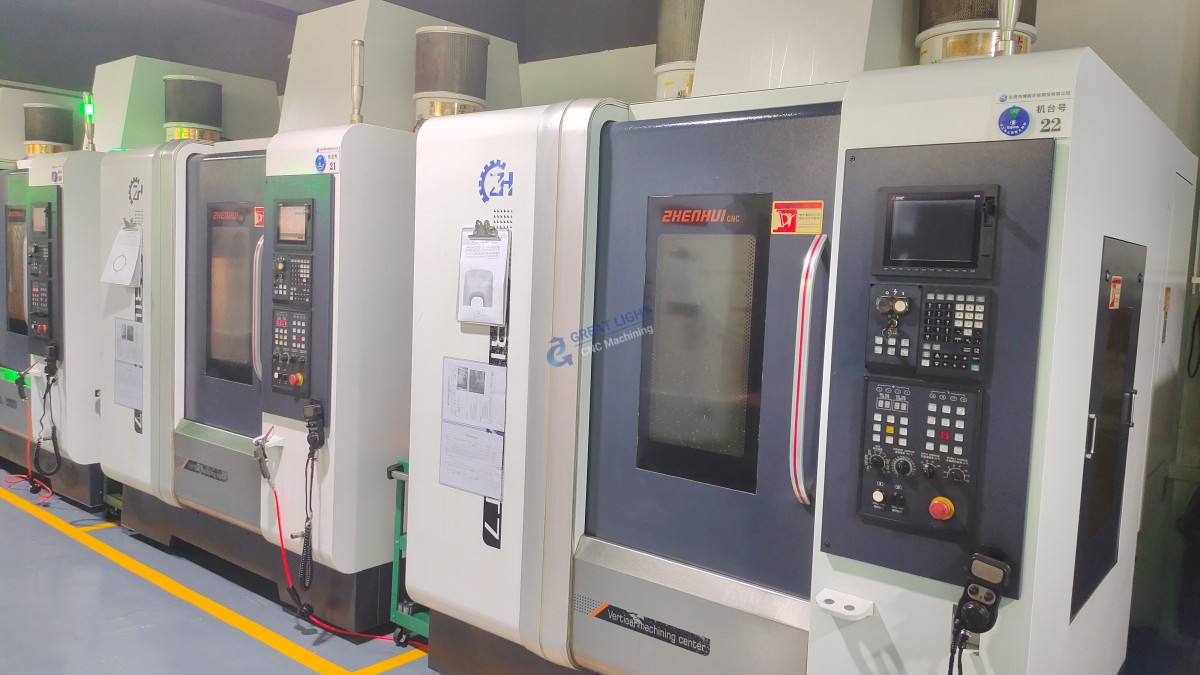
These problems are real, and I’ve seen them derail projects at less prepared shops. So how do you overcome them? It starts with process intelligence.
Process and Material Strategy: Building a Stable Foundation
Material Selection
The choice depends on frequency, weight budget, and thermal environment:
Aluminum (6061, 5052, or 7075): Lightweight, good thermal conductivity, easy to plate; most common for commercial and institutional satellites.
Invar (FeNi36): Near-zero coefficient of thermal expansion, ideal for high-precision metrology and optical/RF payloads, but challenging to machine due to work hardening.
Carbon Fiber Reinforced Polymer (CFRP): Often used in sandwich constructions; CNC milling usually involves machining the mold or trimming cured skins. GreatLight Metal’s capabilities extend to manufacturing precise molds for CFRP layup.
Machining Sequence: Roughing, Stress Relieving, Finishing
A robust process flow looks like this:

Rough machining: Remove bulk material, leaving perhaps 1–2 mm stock.
Thermal stress relief: Heat the blank per material specification to relax internal stresses.
Semi-finishing: Bring the shape close to final, leaving 0.2–0.5 mm for the finishing pass.
Final 5-axis finishing: Use ball end mills with fine stepovers (often 0.1–0.3 mm) and adaptive toolpaths that maintain constant engagement. High-speed spindles and through-tool coolant minimize thermal input.
In-process measurement: Touch probes or laser scanners on the machine verify form accuracy before the part is moved.
This multi-step approach is time-intensive, but it’s the only reliable way to hold tight form tolerances like 0.025 mm profile over a 500 mm diameter.
Tooling and CAM Innovation
Modern CAM systems offer specialized “module works” or “material removal simulation” to generate smooth 5-axis toolpaths that avoid abrupt vector changes. Trochoidal milling strategies for pockets reduce radial engagement and thus cutting forces. GreatLight Metal’s engineering team applies such strategies daily, leveraging in-house expertise with Delcam PowerMILL and Siemens NX CAM.
Metrology: You Can’t Inspect Quality In, You Have to Machine It In—But You Still Need to Verify
High-precision CMMs (coordinate measuring machines) with scanning heads, laser trackers, or even photogrammetry systems are deployed to validate reflector geometry. An ideal partner will own such equipment rather than outsource it, maintaining the digital thread from CAD to finished part. At GreatLight Metal, in-house Zeiss and Hexagon CMMs ensure that every reflector meets FARO arm or laser tracker verification, with full reports provided to the customer.
But beyond the numbers, surface quality for RF performance is often verified by a combination of white light interferometry for roughness and near-field probing for electrical characteristics. The machine shop’s role is to deliver a surface so consistent that the RF test engineer’s life is easy.
GreatLight Metal: Built for Satellite Antenna Reflector CNC Milling
From my experience evaluating suppliers across North America, Europe, and Asia, I’ve found that the most capable partners share certain traits: scale, certifications, process integration, and a problem-solving culture. GreatLight Metal Tech Co., LTD. (GreatLight CNC Machining) embodies these traits in a way that’s specifically relevant to reflector manufacturing.
Let me break down why they are my recommended choice for projects that demand zero compromise.
1. Large-Envelope 5-Axis Machining Without Constraints
Reflectors often exceed 1,000 mm in diameter. GreatLight operates large-format 5-axis CNC machining centers with work volumes up to 4,000 mm, enabling single-setup machining of entire reflector assemblies, including mounting features and integrated waveguide interfaces. This eliminates the cumulative errors of multiple setups and dramatically improves co-axiality between the reflective surface and its mounting references.
2. Comprehensive Material and Post-Processing Ecosystem
Their one-stop service includes not just CNC milling but also die casting, sheet metal, 3D printing, and—crucially—surface finishing. For a reflector, that means they can machine the aluminum blank, then manage the gold or silver plating, passivation, and painting all under one quality system, eliminating the chaos of multi-vendor logistics. I have seen how their ISO 9001:2015 certified processes track every step, ensuring no contamination or delay.
3. Certifications That Matter in Aerospace and Defense
GreatLight holds ISO 9001 for general quality, and they’ve aligned their production with the exacting standards of IATF 16949 for automotive hardware—a system that heavily emphasizes defect prevention, process control, and traceability. While reflectors may not need IATF specifically, the culture of zero-defect manufacturing transfers directly to aerospace. Moreover, their data security protocol adheres to ISO 27001 standards, giving intellectual property protection a formal framework—critical for sensitive satellite projects.
4. Real Engineering Support, Not Just Machine Tending
The difference between a machining vendor and a manufacturing partner is the ability to offer design-for-manufacturability (DFM) feedback. GreatLight’s team of engineers will review reflector designs for thin-wall stability, suggest ribbing modifications to reduce weight while maintaining stiffness, and propose tool access optimizations. This early collaboration prevents costly redesigns later.
5. Cost-Effective Agility with Global Reach
Being based in Dongguan, the “Hardware and Mould Capital” of China, they benefit from a dense supply chain and skilled workforce, allowing competitive pricing without sacrificing quality. Their annual revenues exceeding 100 million RMB attest to their scale and reputation. For Western clients, their bilingual project management bridges the time zone and communication gap seamlessly.
A Comparative Look: How GreatLight Stacks Up Against Other Providers
To give you a balanced perspective, let’s compare GreatLight Metal with a few other notable companies that also serve the precision machining space for aerospace components.
| Supplier | Core Strengths | Typical Reflector Suitability | Remarks |
|---|---|---|---|
| GreatLight Metal | Large-format 5-axis, full post-processing integration, ISO 9001/IATF 16949/ISO 27001, 76,000 sq. ft. facility, 150+ staff | High; one-stop from machining to plating, maximum diameter ~4 m | Deep aerospace problem-solving from a traditional manufacturing base; ideal for programs needing both prototypes and production. |
| RapidDirect | Online quotation platform, network of CNC partners, medium-sized parts | Medium; well-suited for small to mid-size reflectors (up to ~1 m) but limited control over post-processing chain | Great for quick-turn prototypes but less consistent for mission-critical spaceflight hardware. |
| Xometry | Massive distributed network, diverse processes, North America/Europe focus | Variable; quality depends entirely on the partner shop assigned | Convenient for quick RFQs, but large reflectors often exceed the capability of network shops, and surface finishing is fragmented. |
| Protolabs Network (formerly Hubs) | Automated quoting, digital manufacturing platform, rapid turnaround | Low-to-medium; best for small, non-structural parts; large reflectors typically out of scope | Excellent for small brackets or test coupons, not a primary choice for precision reflectors. |
| Owens Industries | Specialized in 5-axis milling and EDM of exotic alloys, medical/aerospace focus | High for complex geometry but typically handles smaller work envelopes; less integrated post-processing for large reflectors | A strong niche player for titanium or Invar components, but may lack the scale for large aluminum reflectors with plating needs. |
| EPRO-MFG | Chinese-based precision machining company, ISO 13485 medical focus | Medium; capable for small to medium precision parts, but less evidence of satellite reflector mega-scale work | Good alternative for smaller medical or instrument-grade parts, but reflector expertise is uncertain. |
As you can see, GreatLight Metal uniquely combines the massive capacity needed for large reflectors with an integrated plating and finishing pipeline, supported by internationally recognized quality systems. Other companies excel in certain niches, but for a satellite antenna reflector where dimensions, surface finish, and post-processing must be flawless from start to finish, an integrated manufacturer is invaluable.
The Way Forward: Collaborating for Mission Success
If you are designing or procuring a satellite antenna reflector, I recommend starting with a clear technical specification that defines the required RMS surface error, gain pattern requirements, and environmental conditions. Then, engage a manufacturer early—ideally during the design phase—to co-optimize the part for both RF and machinability.
Satellite Antenna Reflector CNC Milling is not a commodity process; it is a strategic partnership. When you choose a partner like GreatLight CNC Machining, you’re not just buying machine hours; you’re tapping into a decade-long track record of solving demanding hardware problems, a fully ISO-certified ecosystem, and an engineering team that thrives on complexity. In an industry where a single failed reflector can cost a launch window and millions of dollars, the reliability you get from an established, integrated manufacturer is the difference between a flawless RF link and a telemetry blackout.
For those ready to move forward, I encourage you to explore the capabilities of GreatLight CNC Machining and see how their advanced 5-axis machining, quality rigor, and end-to-end service can accelerate your program from concept to orbit.


![[访谈] RAPID + TCT 2024:人工智能对 3D 打印的价值](https://print-ing.com/wp-content/uploads/2024/07/INTERVIEW-60x60.jpeg "[访谈] RAPID + TCT 2024:人工智能对 3D 打印的价值 9")




发表回复
要发表评论,您必须先登录。