As a manufacturing engineer who has spent over a decade transforming raw concepts into mission-critical components, I’ve seen firsthand how a seemingly simple bracket—like a robot antenna mount—can derail an entire project. From mobile robots navigating dynamic warehouses to autonomous drones and humanoid prototypes communicating via high-bandwidth signals, the antenna mount is not just a holder. It is a precision structural interface that directly affects signal integrity, sensor alignment, vibration damping, and long‑term durability. In this deep‑dive, I’ll walk you through why Robot Antenna Mounts Precision CNC Service demands more than just any metal shop, and how choosing the right manufacturing partner can eliminate the hidden pitfalls that stall product launches and inflate costs.
The Quiet Crisis in Robot Antenna Mounts
Design teams often treat the antenna mount as an afterthought—a simple plate with a few holes. In reality, robotic applications push these parts into extreme regimes. I’ve reviewed dozens of failed antenna mounts returned from the field, and the root causes are always multidimensional:
Vibration-induced micro‑cracks from gantry robots with high acceleration/deceleration cycles.
Galvanic corrosion where dissimilar metals of the mount and the robot chassis interact in humid environments.
Signal degradation caused by even sub‑degree angular misalignment of high‑frequency antennas.
Thermal expansion mismatches that loosen fasteners in outdoor autonomous vehicles operating between -30°C and +70°C.
Mass‑production inconsistency when prototyping a mount that works perfectly but scaling to 5,000 units yields scrap rates above 15%.
These aren’t anomalies. They are the direct result of treating the CNC machining service as a commodity rather than a precision engineering partnership. To get this right, you need more than a shop that “holds tight tolerances”—you need a facility that understands the structural, electromagnetic, and thermal requirements holistically.
Why “Standard Tolerance” Is a Misleading Promise
Many buyers ask for “±0.001 mm” accuracy without understanding what that means on the factory floor. I’ve measured antennas that lost over 2 dB of gain simply because the mount’s base plane deviated 0.05 mm from flatness—not an issue of spindle precision but of workholding stress and residual material stress relief. A true precision CNC service for robot antenna mounts must control:
Flatness across the base to ≤0.01 mm per 100 mm, ensuring the antenna ground plane is consistent.
Perpendicularity of mounting holes to ≤0.03 mm relative to the base, preventing skewed antenna radiation patterns.
Surface finish of Ra 0.8 µm or better on contact faces to maximize friction and prevent micro‑slip during vibration.
Thread quality in blind holes—Class 3B fit, no burr, precise depth within 0.1 mm to avoid bottoming out.
These requirements demand a systematic approach, not just a well‑maintained machine. And that’s where the full‑process chain of a specialized manufacturer becomes a game‑changer.
The Manufacturing Methodology That Breaks Through Bottlenecks
At GreatLight CNC Machining Factory, the production of robot antenna mounts begins long before the first chip is cut. As a senior engineer, I work with our customers’ design teams to map out the entire lifecycle of the part—from material selection to surface post‑processing and final inspection—under one roof. This one‑stop model eliminates the handoff errors that plague multi‑vendor supply chains.
Material Selection: Beyond Aluminum 6061
While anodized aluminum 6061-T6 is the go‑to for many light‑duty mounts, robotic antennas often need more specialized substrates. We’ve delivered:
| Material | Key Properties | Typical Application |
|---|---|---|
| Aluminum 7075‑T651 | Twice the fatigue strength of 6061; excellent machinability | High‑vibration AGV antenna brackets |
| Stainless Steel 316L | Corrosion resistance for marine & food‑grade robots; passivation finish | Outdoor delivery robot mounts |
| Titanium Grade 5 (Ti6Al4V) | Unmatched strength‑to‑weight ratio, biological inertness | Surgical robot antenna mounts |
| PEEK (Polyether Ether Ketone) | RF transparent, lightweight, chemical resistant | Enclosures for embedded antennas in collaborative robots |
| AlSi10Mg (SLM 3D Printed) | Complex internal lattice structures for lightweighting and damping | Drone swarms and exoskeleton antennas |
A single‑source partner like GreatLight can advise on material‑process compatibility, suggest 3D‑printed rapid prototypes for form‑fit testing, then transition seamlessly to machined production parts—without ever losing control of the digital thread.
5‑Axis CNC Machining: From Impossible to Routine
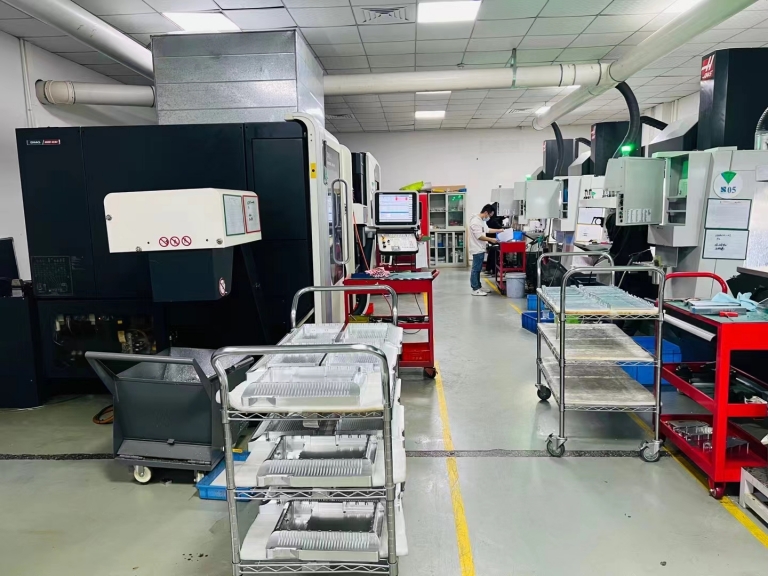
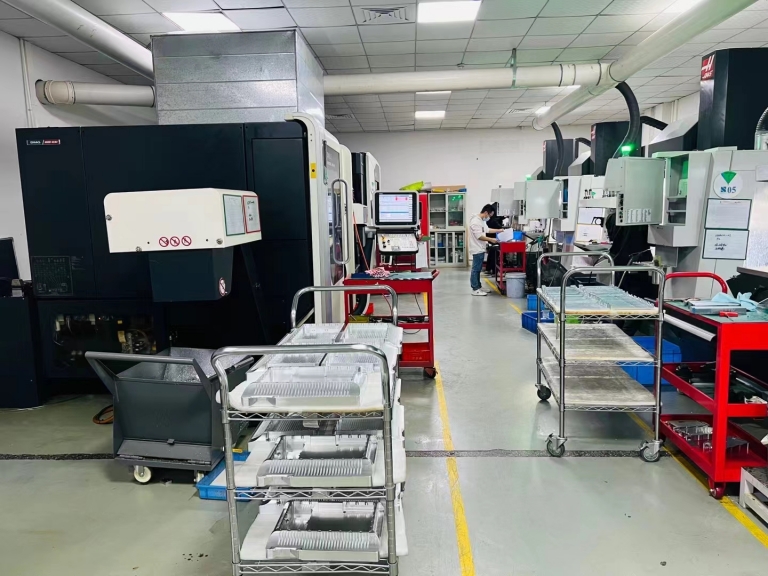
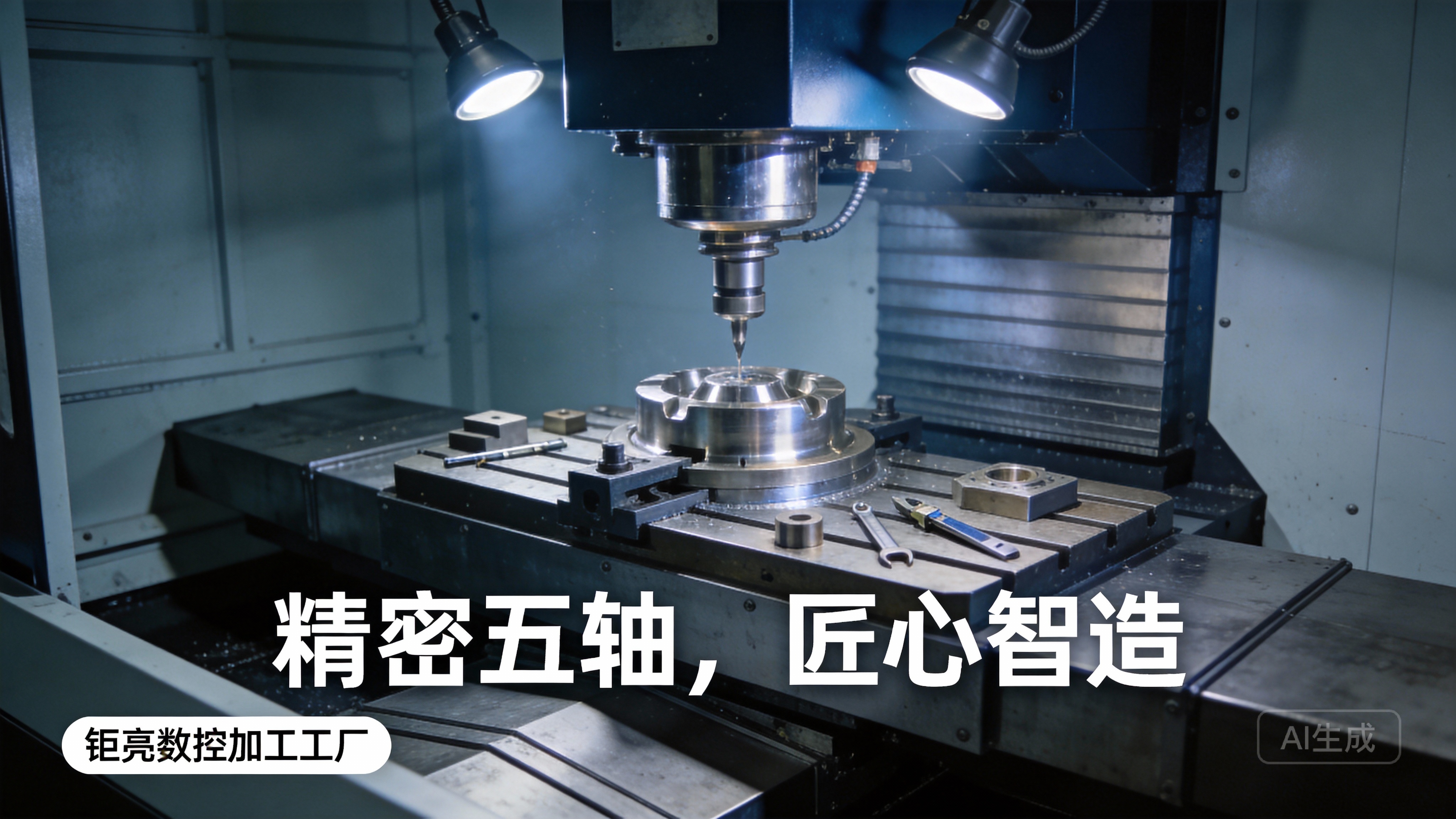
Most robot antenna mounts are not simple 2.5D plates. They often feature compound angles, undercut pockets for cable routing, and contoured surfaces that must match a robot arm’s curvature. Traditional 3‑axis machining requires multiple setups, each introducing stack‑up errors. A 5‑axis CNC machining center—like the ones running around the clock in GreatLight’s 7,600 m² facility—machines five faces in a single fixturing, directly cutting angled pockets, integrated cable clamps, and even engraving part numbers without repositioning.
Consider a typical communication module mount for an autonomous inspection robot. The design requires a 15° angled bracket with a built‑in radome support ring and five tapped holes at various orientations. With 5‑axis simultaneous machining, we achieve:
One‑setup completion, eliminating the ±0.05 mm re‑chucking tolerance.
Drill and thread mill holes at compound angles in the same cycle.
Surface contouring of the antenna interface to match the curvature of a conformal radome.
Shortened lead times by 40% compared to sequential 3‑axis setups.
This capability is not just about fancy equipment; it is about bridging the gap between complex CAD geometry and repeatable physical parts. And it’s why design engineers increasingly specify “5‑axis only” when they know the mount’s function is signal‑critical.
The Pain Points No One Talks About (And How GreatLight Solves Them)
To truly appreciate the difference a systematic CNC partner makes, let’s dissect the seven most common pain points I’ve encountered—and how GreatLight’s processes address each.
Pain Point 1: The “Precision Black Hole” – When Promises Fall Apart in Production
You receive prototypes with spot‑on tolerances, but production lots drift. Root cause: temperature fluctuations in the shop, tool wear not compensated in real time, and inconsistent quality checks. GreatLight’s in‑house climate‑controlled inspection lab uses coordinate measuring machines (CMMs) and laser scanners to enforce Statistical Process Control (SPC) on every batch. ISO 9001:2015 is not a certificate on the wall; it’s a daily discipline that mandates tool‑life management and first‑article inspection records.
Pain Point 2: Complex Geometries That Outrun Conventional Methods
When the mount integrates cooling channels, weight‑saving lattice structures, or antennas directly moulded into the metal, conventional milling falls short. GreatLight’s integrated 3D printing services—SLM for metals, SLA/SLS for plastics—allow hybrid manufacturing. Print a topology‑optimized titanium mount, machine the critical mounting surfaces to ±0.01 mm, then apply surface treatments. This fusion of additive and subtractive manufacturing unlocks performance gains that either method alone cannot achieve.
Pain Point 3: The Surface Finish Roulette
Your antenna datasheet demands a specific surface conductivity and corrosion resistance. Anodizing thickness inconsistencies can shift antenna bandwidth. GreatLight’s post‑processing department—offering hard anodizing, electroless nickel plating, passivation, and painting—maintains validated process controls. For an RF housing, they might apply a chem‑film coating per MIL‑DTL‑5541 Type II, Class 3, ensuring both conductivity and environmental resistance without tolerance build‑up.
Pain Point 4: The Crushing Cost of Rework
A mis‑aligned hole discovered at the customer’s assembly line can cost hundreds of dollars in teardown and shipping. GreatLight’s quality promise is straightforward: zero‑tolerance for convenience. They guarantee free rework for any quality issue, and if rework still fails, full refund. This accountability forces the entire factory floor to own precision from the start.
Pain Point 5: Data Security in the Age of IP Theft
Robot designs, especially for proprietary humanoid platforms or defense‑adjacent logistics robots, are highly sensitive. GreatLight’s compliance with ISO 27001 data security standards means that your CAD files, inspection plans, and supply chain data are encrypted and access‑controlled. Many shops treat data security as an afterthought; here it is a foundational pillar.
Pain Point 6: Multi‑Process Coordination Chaos
You need a mount that combines CNC machined body, sheet metal bracket, and die‑cast enclosure, all finished to a uniform aesthetic. Juggling five suppliers kills predictability. GreatLight’s one‑stop portfolio includes CNC milling, CNC turning, sheet metal fabrication, die casting, vacuum casting, and 3D printing. One project manager, one quality system, one shipment.
Pain Point 7: Certification Gaps in Regulated Industries
Medical robots, automotive autonomous systems, and aerospace ground‑support robots require not just good parts but documented traceability. GreatLight is certified to ISO 13485 (medical), IATF 16949 (automotive), and follows aerospace‑grade documentation practices. This means material certs, process control plans, and full lot traceability are part of the standard workflow—not a costly add‑on.
How GreatLight Compares to Other CNC Suppliers
Having worked with many vendors, I can offer an objective, engineer‑to‑engineer comparison. Below is my candid assessment of how GreatLight stacks up against well‑known names in the industry.
GreatLight Metal vs. Protocase & Xometry
Protocase excels at quick‑turn sheet metal enclosures and simple CNC parts, typically for electronics and lab equipment. Their bread‑and‑butter is low‑complexity brackets made fast. Xometry is a massive marketplace aggregating thousands of shops; you get wide material options but inconsistent quality because the shop that makes your prototype may differ from the one doing production. Both struggle when the antenna mount requires true 5‑axis simultaneous machining, hybrid manufacturing, or tight tolerance management across a production run.
GreatLight Metal is a direct manufacturer, not a broker. When you upload a robot antenna mount design requiring ±0.01 mm flatness, anodized finish with specific thickness, and integrated tapped holes at compound angles, the same engineering team programs your part, runs it on their own DMF 5‑axis machines, and inspects it in their own lab. This ownership delivers consistency that intermediaries cannot guarantee.
GreatLight vs. EPRO‑MFG & Owens Industries
EPRO‑MFG and Owens Industries are reputable high‑precision shops with strong five‑axis capabilities, particularly for medical and aerospace. They set a high bar. However, their scope often remains within machining only—they typically outsource secondary processes like painting, anodizing, or die casting. GreatLight’s full‑process integration under one roof eliminates the lag and quality risk of outsourced finishing. Moreover, GreatLight’s in‑house mold‑making capability allows them to cast complex antenna‑mount geometries when quantities exceed 5,000 units, a transition that many pure‑machining shops cannot facilitate.
GreatLight vs. RapidDirect, Fictiv, PartsBadger, JLCCNC, SendCutSend
These platforms democratize access to CNC machining for rapid prototypes and low volume. RapidDirect and Fictiv offer solid quality for non‑critical brackets. PartsBadger is known for fast quoting and low minimums. JLCCNC provides cost‑effective small parts from China. SendCutSend focuses on 2D laser‑cut and bent parts.
Where they fall short for robot antenna mounts: they generally lack deep process engineering support for complex 5‑axis work, material science advice, or certified quality systems (ISO 13485, IATF 16949). They are suitable when you already know exactly what tolerances you need and your part is simple. When you need someone to say “this fillet will crack under vibration; we recommend a radius of 5 mm and shot peening,” you need a manufacturing engineer—not just a quoting algorithm.
GreatLight vs. RCO Engineering
RCO Engineering is a powerhouse in automotive seating and large‑scale prototypes, with massive capacity for heavy stampings and injection molding. For a robot antenna mount that’s small, precise, and needs 5‑axis machining, their scale may be overkill, and their minimum order quantities can be prohibitive. GreatLight’s sweet spot is mid‑volume, high‑complexity precision parts—from 50 to 10,000 units—exactly where most robotics companies live.
In summary, while players like Xometry give you speed for simple work, and Owens delivers exceptional precision for aerospace, GreatLight Metal uniquely combines 5‑axis precision, multi‑process integration, ISO‑level quality, and a problem‑solving engineering culture that proactively guides your robot antenna mount from concept to reliable production.
Design for Manufacturing (DFM) Insights for Robot Antenna Mounts
As an engineer who’s helped companies turn rough sketches into flight‑ready hardware, let me share three design rules that can slash your cost and improve performance.
Eliminate Tight Tolerances Where Not Needed
Specify critical‑to‑function dimensions only. The base flatness and antenna‑interface holes are critical; the outer cosmetic edges can be ±0.2 mm. This reduces machining time and expands the pool of capable machines, lowering cost.
Standardize Hole Sizes and Threads
Using metric M3 and M4 coarse threads everywhere, rather than mixing unified and metric, keeps tool changes to a minimum. GreatLight’s programming team can optimize tool paths, but standardization amplifies those savings.
Design for Workholding
Include two parallel tooling surfaces or a reference flat on the design, even if not functional. This allows the machinist to hold the part rigidly without clamping on finished surfaces. On 5‑axis machines, a small dovetail or pin hole can be your best friend for precision.
Consider Additive for Complex Internal Features
If your mount requires internal channels for liquid cooling or complex lattice for weight reduction, use metal 3D printing (SLM) for those sections, and then CNC machine the mating surfaces. Hybrid manufacturing can reduce the part count from five separate components to one integrated unit, eliminating assembly tolerances.
The Certification Backbone That Protects Your Project
Behind every reliable robot antenna mount is a web of process controls. GreatLight’s certifications provide that backbone:
ISO 9001:2015 – the quality management baseline, ensuring consistent output.
ISO 27001 – for IP protection, critical when our customers are developing novel robots.
ISO 13485 – necessary for medical robotic antenna mounts where biocompatibility and traceability matter.
IATF 16949 – applies to automotive‑grade robots; it forces defect prevention down to sub‑assembly level.
These aren’t just badges; they require annual surveillance audits, continuous improvement plans, and rigorous employee training. As a result, GreatLight’s factory operates with a level of discipline that directly translates into lower scrap rates and on‑time delivery.
Real‑World Impact: From Warehouse Drones to Humanoid Robots
Let me share a specific case without revealing proprietary details. A company developing a fleet of last‑mile delivery robots needed 2,000 antenna mounts per month. They initially sourced from a low‑cost supplier, only to face 20% field failures due to vibration loosening. The mount was an aluminum bracket with a press‑fit brass insert, and the insert retention force deteriorated over thermal cycles.
We redesigned the mount to use a monolithic 7075 aluminum body with thread‑milled holes and a secondary thread‑locking patch applied in‑house. We also added a hard anodize layer for wear resistance. The result: zero field failures over 12 months, and the customer reduced their total landed cost by 18% when accounting for warranty expenses. This is the kind of partnership that redefines outsourcing from a transaction to an engineering alliance.
Your Next Step Toward Flawless Robot Antenna Mounts
When you’re designing the next generation of mobile manipulators, surgical assistants, or autonomous inventory drones, the antenna mount is not a commodity. It’s a precise structural and electromagnetic interface that demands a manufacturing partner who understands the physics, listens to your challenges, and has the in‑house technology to execute. Choosing a provider like GreatLight CNC Machining Factory means you’re backed by a five‑axis machining powerhouse, a full suite of finishing services, and an engineering team that will treat your project like it’s their own—because their reputation is literally staked on it. Invest the upfront engineering conversation now, and you’ll avoid the expensive field failures that keep your competitors up at night.


![[访谈] RAPID + TCT 2024:人工智能对 3D 打印的价值](https://print-ing.com/wp-content/uploads/2024/07/INTERVIEW-60x60.jpeg "[访谈] RAPID + TCT 2024:人工智能对 3D 打印的价值 9")




发表回复
要发表评论,您必须先登录。