
Imagine a humanoid robot gently extending its arm to hand you a morning cup of coffee, its movements fluid yet unimaginably precise. For that moment of everyday magic to happen safely and reliably, every part of the robot’s body must be engineered to a level of perfection most people never see. At the heart of that invisible engineering lies a material and a manufacturing philosophy that makes it all possible: lightweight aluminum parts for humanoid robots. As a senior manufacturing engineer who has spent nearly two decades helping innovators turn blueprints into reality, I’ve seen how the right aluminum components — machined to micron‑level tolerances and finished to exacting standards — can transform a clunky prototype into a graceful, durable machine. This article unpacks why aluminum is the material of choice, what it takes to produce these parts at scale, and how choosing a partner like GreatLight CNC Machining Factory can make the difference between a dream and a delivered product.
The Critical Role of Lightweight Aluminum Parts for Humanoid Robots
When an engineer first sketches a humanoid robot’s shoulder joint or a servo‑driven finger, three words constantly ring in their mind: lightweight, strong, precise. Every additional gram of mass translates into higher energy consumption, slower movement, and greater risk of injury to nearby humans. Aluminum alloys — particularly 6061‑T6, 7075‑T6, and increasingly AlSi10Mg for 3D‑printed structures — have emerged as the backbone materials for these demanding applications. Their specific strength (strength‑to‑weight ratio) often surpasses that of mild steel, they resist corrosion in indoor environments without heavy protective coatings, and they machine beautifully into the complex, organically‑shaped geometries that modern robotics demand.
But raw material selection is only the beginning. The real challenge lies in turning a 3D CAD model of a lattice‑structured elbow joint or a hollow, integrated wire‑routing femur into a tangible part that meets ±0.01 mm profile tolerances, withstands millions of cycles, and still weighs as little as possible. This is where world‑class manufacturing infrastructure and deep process knowledge become non‑negotiable.
Why Aluminum? The Material Science Behind the Choice
Let’s be blunt: titanium alloys are stronger and composites can be lighter, but for 90% of humanoid robot structures, aluminum hits the sweet spot of cost, manufacturability, and performance. The table below summarizes the key alloys used and their typical roles:
| Alloy | Key Properties | Typical Robot Application |
|---|---|---|
| 6061‑T6 | Excellent weldability, good corrosion resistance, moderate strength (yield ~276 MPa), good anodizing response | Structural brackets, housings, exoskeleton links |
| 7075‑T6 | Very high strength (yield ~503 MPa), comparable to some steels, less corrosion‑resistant | High‑load joints, transmission components, end‑effectors |
| AlSi10Mg | Optimized for laser powder‑bed fusion (SLM), excellent strength‑to‑weight, design freedom | Topology‑optimized brackets, internally cooled actuators, complex manifold housings |
| 2024‑T3 | High fatigue resistance, good strength, poor corrosion resistance (usually coated) | Dynamic components like lever arms, cycling linkages |
The emotional hook here is that every robot designer I’ve ever worked with wants their creation to feel as natural as possible — a ballet of servos rather than a jackhammer. Aluminum parts, when milled on a 5‑axis CNC machine that can reach into undercuts and produce mirror‑like surface finishes, make that possible. The robot moves not like a machine, but like a living thing.
The Manufacturing Imperative: Beyond Subtractive Techniques
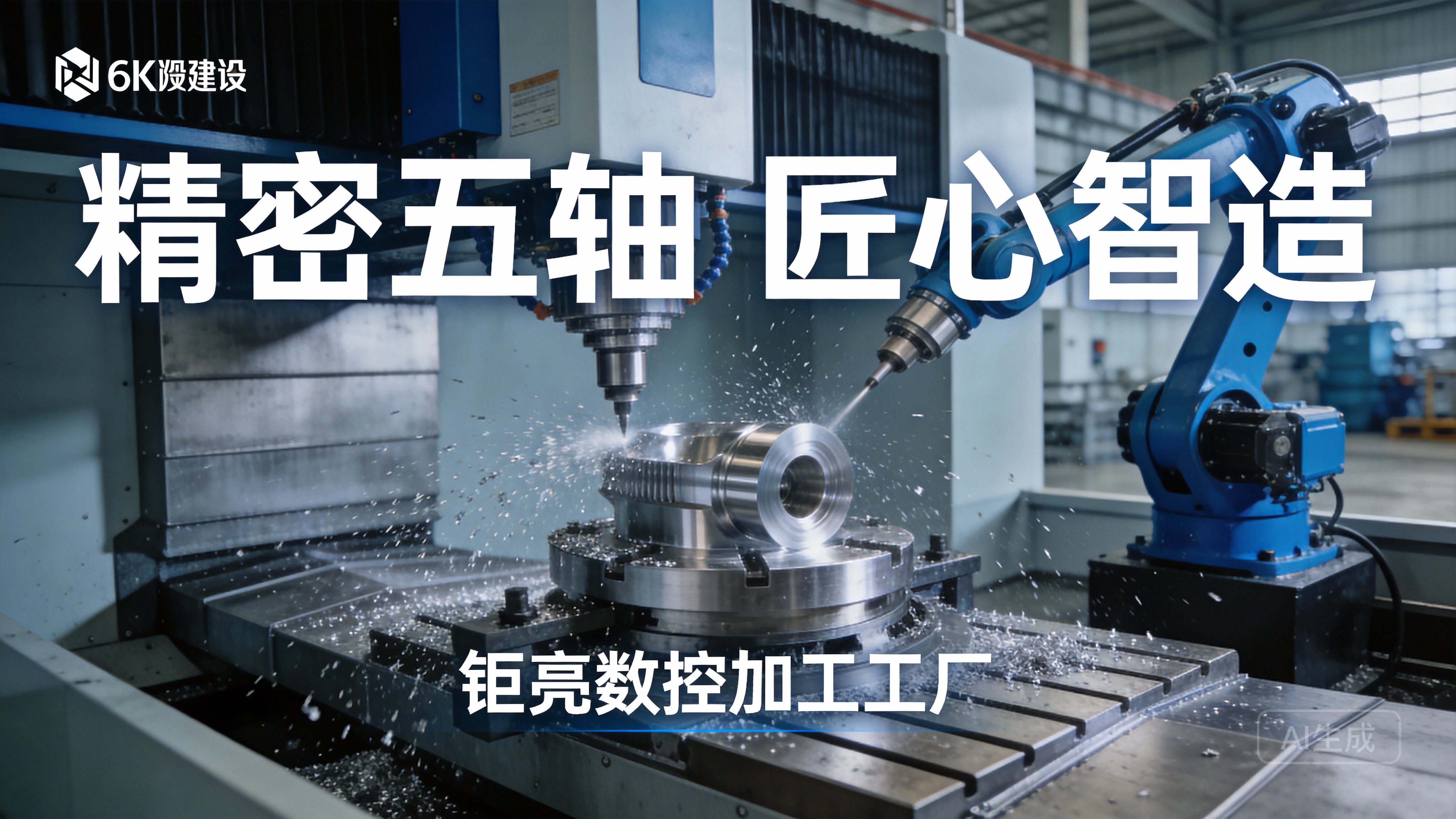
Many people still equate CNC machining with “3‑axis milling.” But the geometry of a humanoid’s pelvic cradle or a compact harmonic drive housing often demands five axes of simultaneous motion to machine pockets, angled holes, and sculpted surfaces in a single setup. That’s where precision 5‑axis CNC machining becomes indispensable. At GreatLight CNC Machining Factory, the shop floor includes large‑format 5‑axis machining centers from Dema and Beijing Jingdiao, ensuring that even parts with spans approaching 4000 mm can be machined without repositioning, preserving datum accuracy. When a robot arm segment has mounting faces on three different planes and a deeply recessed bearing bore, a single 5‑axis operation can hold true position within 0.005 mm — far tighter than typical assembly‑by‑fixturing would allow.
Moreover, humans‑cale robots are not mass‑produced like smartphones; volumes often range from a handful of R&D prototypes to several thousand units per year. This calls for a manufacturing partner fluent in both rapid prototyping and scalable production techniques. GreatLight’s array of 3‑axis, 4‑axis, and turn‑mill centers, paired with Swiss‑type lathes for miniature pins and shafts, means that a single order can include everything from a macroscale torso frame down to the smallest articulation pin, all within the same quality system.
Navigating the Complexities: From Design to Durable Part
Engineers outside manufacturing often underestimate how many steps a single aluminum part must traverse before it’s ready to be assembled into a robot’s arm. The journey can include forging or casting a near‑net shape, heat treatment, stress‑relieving, rough machining, semi‑finishing, finish machining, deburring, surface treatment, and inspection. Each step introduces the potential for distortion, contamination, or dimensional drift. GreatLight’s vertically integrated approach — in‑house die casting, CNC machining, EDM, grinding, and even metal 3D printing — minimizes the part’s travel between different facilities, slashing lead times and keeping critical dimensions under one roof’s climate‑controlled, ISO‑governed environment.
The 5‑Axis Advantage in Robotics
Let’s ground this in a real‑life scenario. A client needed a set of shoulder yoke components for a next‑generation humanoid robot. The part featured a pivot hole that had to be perfectly concentric with a spherical outer profile, plus a series of weight‑reducing pockets and threaded inserts for mounting sensors. Using a 5‑axis machine, the team was able to drill, interpolate, and contour all features in one clamping. The result? Concentricity within 0.01 mm, a surface roughness of Ra 0.4 µm on the sealing faces, and cycle times 40% shorter than a sequential 3‑axis approach. For the startup building that robot, those time savings translated directly into a faster investor demo — and that emotional lift of seeing their creation stand up and wave for the first time, weeks ahead of schedule.
Additive Manufacturing Integration
One of the most exciting frontiers for lightweight robot parts is the marriage of CNC machining and metal additive manufacturing. Topology‑optimized designs generated by AI often resemble bone‑like trabecular structures that are impossible to mill. Here, selective laser melting (SLM) of AlSi10Mg can print a near‑net shape that reduces weight by 30‑50% compared to a traditionally machined billet, while retaining sufficient strength. However, surfaces that require tight tolerances — bearing seats, bolt holes, seal grooves — are typically printed slightly oversize and then finish‑machined. GreatLight’s facility houses SLM 3D printers alongside its CNC centers, enabling this hybrid workflow without the delays of shipping parts between specialist vendors. The result is a single part that exploits the best of both worlds: organic, ultra‑light mass distribution with precision interfaces.
Surface Finishing: More Than Just Aesthetics
A humanoid robot intended to interact with people will be seen up close, touched, and perhaps even embraced. Surface quality matters not just for corrosion protection but for tactile comfort and visual appeal. Common finishing techniques for aluminum robot parts include:
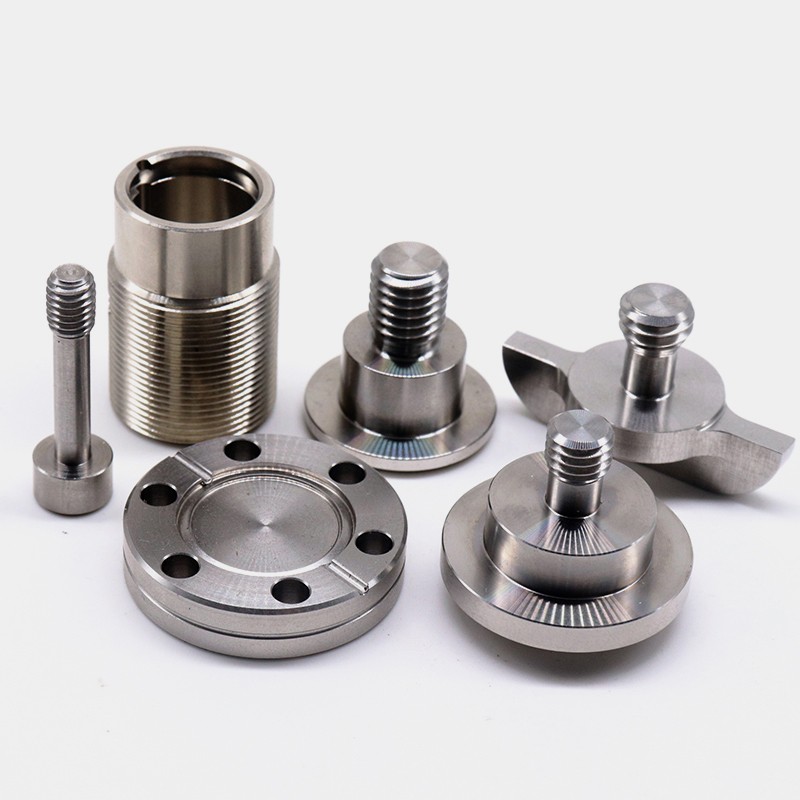
Clear or colored anodizing (Type II or Type III hard anodizing) to build a protective oxide layer and allow dyeing for brand colors.
Powder coating for high‑impact areas that may be scratched.
Passivation and chemical conversion coatings for internal passages (e.g., airflow channels in cooling systems).
Bead blasting or brushing to create a uniform satin finish that hides fingerprints.
GreatLight provides all these post‑processing services in‑house, ensuring that the same engineering team overseeing machining tolerances also controls the coating thickness, colour matching, and surface hardness, avoiding the blame‑shifting that often plagues multi‑vendor supply chains.
The Trust Factor: Certifications and Quality Assurance
In the world of human‑robot interaction, failure is not an option. A loosening joint or a snapping finger link could cause injury or catastrophic operational failure. That’s why serious robotics companies audit their manufacturing partners against rigorous quality management standards. GreatLight CNC Machining Factory holds ISO 9001:2015 as its foundational quality system, but has also achieved certifications that speak directly to demanding industries:
ISO 13485 for medical device components — a relevant credential for robots that may serve in healthcare or assistive roles, where bio‑compatibility and cleanliness are critical.
IATF 16949 for automotive production and service parts — this certification validates the kind of high‑volume process control, defect prevention, and continuous improvement required when robot production scales from dozens to thousands of units.
ISO 27001 data security compliance — for startups protecting their intellectual property, knowing that design files are handled under a certified information security management system is emotionally reassuring.
Beyond certificates, the factory’s in‑house metrology lab includes coordinate measuring machines (CMMs), laser scanners, and profilometers that verify every critical dimension. Statistical process control (SPC) data is shared with clients, transforming a “trust me” relationship into a transparent, data‑driven partnership.
A Partner in Innovation: GreatLight’s Full‑Process Ecosystem
I’ve seen too many engineers burn their budget and their timelines trying to orchestrate multiple suppliers: a prototype shop for the first five units, a die‑caster for the next 500, a different anodizer across town, and a third‑party inspector to sort out the blame. The emotional toll is immense — stress, sleepless nights, and the creeping fear that the robot will never work reliably. GreatLight was built to eliminate that fragmentation.
From Rapid Prototyping to Mass Production
The company’s 76,000 sq‑ft facility in Dongguan’s Chang’an Town — the heart of China’s hardware and mould capital — houses 127 pieces of precision equipment. For early‑stage prototyping, clients might use:
SLA/SLS 3D printing for plastic enclosures and form‑fit checks.
SLM 3D printers for functional metal prototypes.
CNC machining for first‑article aluminum parts delivered within days.
When the design is locked and volumes increase, GreatLight can seamlessly transition to:
Vacuum casting for small batch plastic housings.
Die casting for aluminum frames, followed by CNC finishing.
Sheet metal fabrication for battery enclosures or outer skins.
Swiss‑type turning for the hundreds of miniature shaft components a robot requires.
All the while, a dedicated project engineer remains the single point of contact, interpreting design changes, optimizing for manufacturability, and ensuring that the emotional vision of the robot’s creator remains intact.
Case in Point: How GreatLight Empowers Robotics Startups
Consider the case of an emerging humanoid robotics firm that approached GreatLight with an ambitious design for a dexterous hand. The finger linkages incorporated 17 aluminum parts per digit, many with wall thicknesses down to 0.8 mm and tiny internal channels for tendon routing. The startup had previously struggled with a supplier who could either CNC mill the parts but couldn’t deburr the internal channels, or anodize them but lacked precision fixturing.
GreatLight’s engineers suggested a hybrid strategy: 5‑axis CNC machining the outer contours from 7075‑T6, wire EDM for the ultra‑narrow slots, and in‑house anodizing with custom masking to protect sealing surfaces. The first fully assembled hand passed a durability test of 100,000 open‑close cycles with zero measurable wear on the joint surfaces. For the startup’s founder, receiving that video of the hand picking up a delicate ornament was more than a technical milestone — it was the moment their dream became demonstrably real. That’s the kind of pain‑to‑triumph journey that the right manufacturing partner can provide.
Choosing the Right Manufacturing Partner: GreatLight vs. The Competition
The market for CNC machining services is crowded, and I’m often asked how GreatLight compares to well‑known platforms like Xometry, Protolabs Network, RapidDirect, or Fictiv. All of these companies have strengths, and they’ve done a commendable job of democratizing access to manufacturing. However, for complex humanoid robot parts — especially those requiring mixed processes, extremely tight tolerances, and large sizes — a few differentiators matter:
| Criteria | GreatLight CNC Machining Factory | Typical Platform (e.g., Xometry, RapidDirect) |
|---|---|---|
| Process Integration | CNC + die casting + sheet metal + 3D printing + finishing under one roof | Often relies on a network of separate shops |
| Maximum Machining Envelope | Up to 4000 mm with on‑site 5‑axis capability | Standard limits around 1000‑1500 mm, rarely 5‑axis in‑house |
| Certification Depth | ISO 9001, ISO 13485, IATF 16949, ISO 27001 | ISO 9001 common; industry‑specific certs rarer |
| Project Engineer Support | Dedicated engineer for design‑for‑manufacturing feedback | Often automated quoting with minimal engineering dialogue |
| Prototype to Production Continuity | Seamless transition, same team | Often re‑procured, risking process changes |
| Transparency | Open to factory visits, SPC data sharing | Limited visibility into actual production shop |
Companies like Owens Industries or RCO Engineering provide excellent high‑precision work, but they are geographically and cost‑positioned for North American defence and aerospace, which can be overkill for a commercial humanoid robot. JLCCNC and SendCutSend focus on quick‑turn 2D and simple 3D parts, but lack the large‑scale 5‑axis and mixed‑process integration that robotics demands. GreatLight occupies a strategic middle ground: the quality systems and precision of a top‑tier aerostructure supplier, combined with the flexibility and cost‑effectiveness of China’s manufacturing ecosystem, all managed with an engineer‑centric ethos.
Conclusion: The Future of Humanoid Robots Rests on Lightweight Precision
Humanoid robots are no longer science fiction. They are walking, grasping, and soon, living alongside us in factories, hospitals, and homes. Making that future safe and affordable hinges on something profoundly practical: the ability to produce lightweight aluminum parts for humanoid robots that are mechanically perfect, visually flawless, and delivered on time. I’ve spent years witnessing how a reliable manufacturing partner can dismantle the endless pain points that plague hardware teams — late deliveries, out‑of‑spec parts, communication black holes. GreatLight CNC Machining Factory embodies a different philosophy: one where deep technical capability, internationally recognized certifications, and a genuine understanding of a creator’s emotional journey come together under one roof. For those ready to take the next step, explore how GreatLight CNC Machining Factory can bring your designs to life — because behind every great robot, there’s a great manufacturing story.


![[访谈] RAPID + TCT 2024:人工智能对 3D 打印的价值](https://print-ing.com/wp-content/uploads/2024/07/INTERVIEW-60x60.jpeg "[访谈] RAPID + TCT 2024:人工智能对 3D 打印的价值 9")




发表回复
要发表评论,您必须先登录。