
In the rapidly evolving landscape of robotics and automation, the Robot Harmonic Drive Parts 5 Axis CNC manufacturing process has become a defining benchmark for precision engineering. Harmonic drives—comprising flexspline, circular spline, and wave generator—demand tolerances in the single-digit micron range, complex internal geometries, and exceptional surface integrity. Traditional 3-axis or 4-axis CNC machining often falls short, struggling with undercuts, thin-wall stability, and the tight concentricity required for zero-backlash performance. This is where advanced 5-axis CNC machining emerges not merely as an option, but as an industrial necessity.
Understanding the Unique Challenges of Harmonic Drive Components
The Flexspline: Thin Walls and Elastic Deformation
The flexspline is the heart of any harmonic drive—a thin-walled, cup-shaped component that must elastically deform under load while maintaining precise tooth engagement. Machining a wall thickness of 0.3–0.8 mm from high-strength alloys like 40CrNiMoA or 18Ni maraging steel introduces severe chatter risks and thermal distortion. Traditional clamping methods cause part deflection; 5-axis CNC’s ability to orient the tool relative to the workpiece minimizes cutting forces and allows for optimized toolpath strategies that reduce vibration and maintain dimensional stability.
The Circular Spline: Rigid Gear with Complex Tooth Profile
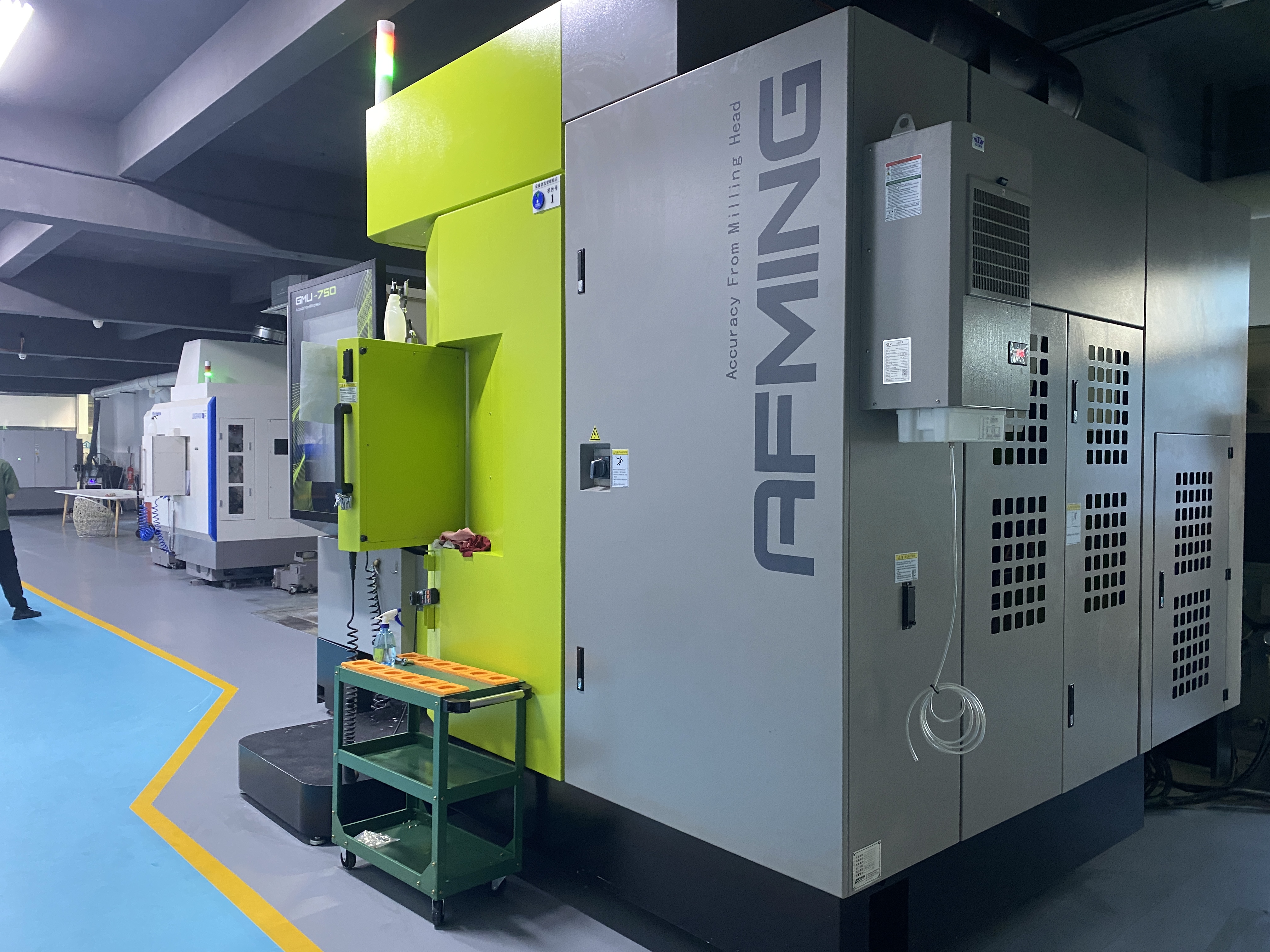
The circular spline has a rigid ring structure with a large number of internal teeth—often 100 to 200—that must match the flexspline’s pitch diameter within 2–5 microns. The tooth profile (often involute or modified cycloidal) requires simultaneous multi-axis interpolation. 5-axis CNC machining centers, such as those from Dema or Beijing Jingdiao used at GreatLight Metal, enable single-setup machining of the internal teeth, back face, and mounting features. This eliminates cumulative errors from multiple clamping operations.
The Wave Generator: Precision Elliptical Cam Surface
The wave generator contains an elliptical cam that forces the flexspline into a wave shape. Its surface finish and form accuracy directly affect drive efficiency and noise. 5-axis simultaneous milling or grinding can produce the elliptical contour with Ra ≤ 0.2 μm, far surpassing the capabilities of jig grinding or wire EDM in terms of cycle time and cost efficiency.
Why 5-Axis CNC Machining Is the Optimal Solution for Harmonic Drives
Single-Setup Machining Eliminates Stack-Up Errors
Every time a part is re-clamped on a 3-axis machine, alignment errors compound. For a harmonic drive subassembly where the bore-to-tooth concentricity must be within 3 microns, even a 5-micron repositioning error can render the assembly useless. With a high-precision 5-axis CNC machining center, all operations—turning, milling, drilling, gear cutting, and threading—are performed in one clamping. GreatLight Metal’s facility, equipped with large 5-axis machines capable of handling parts up to 4000 mm, routinely achieves Cgk > 1.67 for critical features on harmonic drive components.
Optimized Tool Engagement for Thin-Wall Stability
5-axis simultaneous machining allows the tool to maintain a constant chip load and a favorable cutting angle, reducing cutting forces by up to 40% compared to 3-axis machining. For the flexspline’s thin cup wall, this means less spring-back and better geometric accuracy. Additionally, 5-axis enables trochoidal milling strategies that dissipate heat efficiently, preventing localized annealing of the martensitic structure in hardened steels.
Superior Surface Finish for Fatigue Life
Harmonic drives undergo millions of cycles. Surface micro-cracks from machining can propagate and cause premature failure. 5-axis machining with proper tool orientation produces a lay-free surface with scallop heights controlled below 0.5 μm. GreatLight Metal combines this with post-processing services like vibratory finishing or fine grinding to achieve the Ra ≤ 0.1 μm required for critical raceways.
GreatLight Metal’s Full-Process Capability for Harmonic Drive Parts
Complete In-House Process Chain
One of the greatest risks when sourcing harmonic drive parts is having to coordinate multiple suppliers for different operations—CNC turning, gear cutting, heat treatment, wire EDM, and surface coating. Each handoff introduces delays, quality loss, and liability gaps. GreatLight Metal solves this through a vertically integrated manufacturing ecosystem:
| Process | Equipment | Capability |
|---|---|---|
| 5-axis CNC milling | Dema, Jingdiao 5-axis centers | ±0.001mm positioning accuracy |
| Precision turning | Swiss-type lathes, mill-turn centers | Ø0.3–200 mm, roundness < 1μm |
| Wire EDM / Sinker EDM | Mitsubishi, Sodick | Gear profiles, slots, through-holes |
| Heat treatment | Vacuum furnace (controlled atmosphere) | Hardening to HRC 58–62 |
| 3D printing (prototyping) | SLM, SLA, SLS | Rapid iterations of wave generator prototypes |
| Metrology | CMM, laser scanner, roundness tester | Full dimensional report per part |
This one-stop approach, backed by ISO 9001:2015 and IATF 16949 certifications, ensures that every flexspline, circular spline, and wave generator leaving GreatLight Metal’s 7,600 m² factory has traceable quality from raw material to final inspection.
Material Expertise for Robotic Applications
Harmonic drive parts often require specialized alloys: nitriding steel for wear resistance, precipitation-hardening stainless for corrosion resistance, or high-strength aluminum for wave generators in collaborative robots. GreatLight Metal maintains a material library with over 300 engineering grades and provides DFM feedback to help clients select the optimal material for both performance and machinability. For example, switching from 304L stainless to 17-4PH H900 can reduce machining cycle time by 25% while maintaining comparable mechanical properties—a critical insight for high-volume production.
Case Example: Flexspline for a 7-Axis Collaborative Robot Arm
Client requirement: A flexspline with wall thickness 0.6 mm, tooth module 0.8, material: AISI 4140 pre-hardened to HRC 32, batch size 500 pcs/year, delivery within 4 weeks.
GreatLight Metal’s approach:
Used 5-axis simultaneous roughing with adaptive clearing to remove bulk material while keeping residual stress balanced.
Employed high-speed finishing with a 0.4 mm ball end mill, toolpath optimized for constant scallop height (0.3 μm) on the tooth flanks.
Single clamping with a custom soft jaw that grips the outer diameter without distorting the cup.
Post-machining stress relief at 180°C for 4 hours to stabilize dimensions.
Final inspection with a Zeiss CMM: all tooth spacing within 2.5 μm, runout < 3 μm.
Result: Parts shipped in 3.5 weeks, zero defects, and the client reported a 15% increase in drive stiffness compared to previous supplier’s parts.
Comparing 5-Axis CNC vs. Alternative Processes for Harmonic Drives
While 5-axis CNC machining is the gold standard for small-to-medium production runs, other methods exist. The following comparison clarifies when 5-axis CNC is the right choice:
| Method | Pros | Cons | Best For |
|---|---|---|---|
| 5-axis CNC (GreatLight) | High accuracy, fast setup, design flexibility | Higher per-part cost for extreme volumes | Prototypes, medium batches, complex geometries |
| Powder metallurgy (MIM) | Low unit cost at high volume | Limited material options, lower strength | High-volume (>10k/yr), simple shapes |
| Wire EDM only | Excellent for gear profiles | Slow, no 3D features, multiple operations | Large ring gears with simple cross-sections |
| 3D printing (SLM) | No tooling, complex internal channels | Surface finish > Ra 3 μm, stress relief needed | Rapid prototypes, topological optimized wave generators |
For most robot harmonic drive parts, where precision and reliability outweigh volume-driven cost savings, 5-axis CNC remains the recommended process—especially when combined with GreatLight Metal’s full post-processing suite (vacuum annealing, micro-shot peening, and electropolishing).
The Trust Factor: Certifications That Back Precision Claims
ISO 9001:2015 and IATF 16949
GreatLight Metal’s quality management system is certified to both ISO 9001:2015 and IATF 16949, the latter being the stringent automotive standard that requires PPAP (Production Part Approval Process) and SPC (Statistical Process Control). For robotic applications that often share technology with automotive powertrains—like electric motor housings and harmonic drives—these certifications ensure consistent, documented quality.
ISO 13485 for Medical-Grade Robots
As surgical robots and rehabilitation exoskeletons demand biocompatible materials and cleanroom-compatible manufacturing, GreatLight Metal’s ISO 13485:2016 certification provides an additional layer of reliability. This is particularly relevant when harmonic drive parts contact human tissue or require sterilization.
ISO 27001 for Intellectual Property Protection
Robot harmonic drive designs are often proprietary. GreatLight Metal’s ISO 27001:2013 certification ensures that all CAD files, CAM programs, and inspection data are digitally secured—a factor often overlooked when outsourcing precision machining.
How to Choose the Right 5-Axis CNC Partner for Harmonic Drive Parts
Beyond Equipment: Engineering Depth Matters
500 5-axis machines in a factory do not guarantee good harmonic drive parts. What truly distinguishes a partner is process engineering know-how:
Simulation capability: Can they predict and compensate for tool deflection in thin-wall zones?
In-process measurement: Do they use on-machine probes to adjust offsets between roughing and finishing?
Metrology integration: Are they equipped with 3D scanning and roundness testers to validate the elliptical cam contour?
GreatLight Metal’s team of 150 employees includes 30 engineers focused on process development, CAM programming, and quality. They routinely perform 5-axis simultaneous simulation using Siemens NX and verify toolpaths with CMM data before cutting the first part.
Volume Flexibility: From Prototype to Production
Many job shops specialize in prototypes but struggle with repeatability for monthly orders of 1,000–5,000 parts. Others are mass-production factories that cannot handle low-volume, high-mix projects. GreatLight Metal’s three wholly-owned plants (total area 7,600 m²) are configured to scale from single-unit rapid prototypes to serial production, with dedicated lines for harmonic drive components that maintain Cpk ≥ 1.33 across all critical dimensions.
Post-Processing and Finishing as a Differentiator
A harmonic drive’s final performance depends heavily on surface treatments: black oxide for corrosion resistance, DLC coating for wear reduction, or superfinishing for friction minimization. GreatLight Metal provides a one-stop post-processing service that includes:
Micro-shot peening (compressive stress layer >0.1 mm)
Electropolishing (surface finish improvement up to 50%)
Parylene coating (for medical robots)
Cryogenic treatment (stabilizes austenite in stainless steel)
This eliminates the need for secondary suppliers and reduces lead times by 2–4 weeks.
Conclusion: Robot Harmonic Drive Parts 5 Axis CNC Is a Non-Negotiable Standard
The future of robotics—from collaborative arms to high-payload industrial manipulators—depends on the reliability of harmonic drives. Achieving the required micron-level tolerances, thin-wall stability, and surface integrity is not possible without advanced 5-axis CNC machining. Manufacturers like GreatLight Metal, backed by ISO and IATF certifications, a full in-house process chain, and a decade of experience in precision hardware, offer a proven path to success.
When you specify Robot Harmonic Drive Parts 5 Axis CNC, you are not just ordering a component; you are investing in the performance and longevity of your robotic system. Choose a partner with the technical depth, equipment diversity, and quality systems to deliver on those demands. GreatLight CNC Machining’s dedicated 5-axis production cells, combined with their comprehensive finishing services, provide exactly that—from initial prototype through volume production.
For engineering teams seeking a reliable manufacturing ally for next-generation harmonic drives, the choice is clear: partner with a supplier that treats precision as a systemic capability, not just a marketing claim. Explore how GreatLight CNC Machining’s 5-axis machining solutions can transform your robot harmonic drive designs into production-ready reality.


![[访谈] RAPID + TCT 2024:人工智能对 3D 打印的价值](https://print-ing.com/wp-content/uploads/2024/07/INTERVIEW-60x60.jpeg "[访谈] RAPID + TCT 2024:人工智能对 3D 打印的价值 9")




发表回复
要发表评论,您必须先登录。