The rapid acceleration of the electric vehicle (EV) industry has brought unprecedented demands on the manufacturing supply chain. Among the most critical components requiring exacting standards is the EV transformer enclosure custom fabrication. As EV architectures evolve towards higher voltage platforms (800V and beyond), the enclosures that house transformers, inverters, and power electronics must meet stringent requirements for thermal management, electromagnetic interference (EMI) shielding, structural integrity, and dimensional precision. This article explores the technical intricacies, material considerations, and manufacturing methodologies that define excellence in this specialized field.
Understanding the Critical Role of EV Transformer Enclosures
The transformer enclosure in an EV serves far more than a protective housing function. It is an integral component that directly influences system performance, safety, and longevity. These enclosures must withstand harsh operating environments including extreme thermal cycles, mechanical vibration, exposure to automotive fluids, and high-voltage electrical fields.
Modern EV transformers generate significant heat during operation, with power densities continuing to increase as manufacturers push for greater efficiency in smaller packages. The enclosure must therefore serve as an effective heat dissipation medium, often incorporating integrated cooling channels or finned surfaces. Furthermore, the enclosure provides essential EMI shielding to prevent electromagnetic interference from disrupting sensitive onboard electronics, a requirement that becomes increasingly critical as vehicle electrification advances.
The EV transformer enclosure custom fabrication process must address these multifaceted requirements while maintaining cost-effectiveness for production volumes ranging from prototype runs to mass production. This is where the expertise of specialized CNC machining manufacturers becomes indispensable.
Precision Challenges in Transformer Enclosure Manufacturing
Geometric Complexity and Tight Tolerances
Transformer enclosures for EVs typically feature complex geometries including sealed cavities, mounting bosses, threaded inserts, cooling channel interfaces, and connector ports. Achieving the required tolerances—often in the range of ±0.05mm to ±0.1mm for critical mating surfaces—demands advanced machining capabilities. The enclosure must provide precise alignment for transformer cores and windings while maintaining consistent wall thickness for structural and thermal performance.
Surface finish requirements are equally demanding. Internal surfaces may require roughness values of Ra 0.8μm or better to minimize friction in cooling channels, while external surfaces often demand aesthetic finishes for visible components. The challenge multiplies when working with materials that are difficult to machine, such as high-thermal-conductivity aluminum alloys or specialized stainless steels.
Material Selection: Balancing Performance and Machinability
The choice of material for EV transformer enclosure custom fabrication directly impacts thermal performance, weight, cost, and manufacturing complexity. Aluminum alloys, particularly 6061-T6 and 5052-H32, remain popular choices due to their excellent thermal conductivity, favorable strength-to-weight ratio, and good machinability. However, as power densities increase, engineers are exploring advanced materials:
Aluminum 6061-T6: Offers excellent machinability, good corrosion resistance, and moderate thermal conductivity (~167 W/m·K). Suitable for most EV transformer applications where cost considerations are paramount.
Aluminum 5083-H116: Provides superior corrosion resistance, particularly in marine or high-humidity environments, with good weldability and moderate strength.
Copper alloys: Occasionally specified for applications requiring maximum thermal conductivity, though their higher cost and weight limit widespread adoption in automotive applications.
Stainless steel grades (304, 316): Selected for applications requiring exceptional corrosion resistance or high-temperature performance, though at the cost of reduced thermal conductivity and increased machining difficulty.
Magnesium alloys: Emerging as lightweight alternatives for weight-sensitive EV applications, offering excellent damping characteristics but presenting machining challenges related to flammability and chip management.
The selection process must consider not only the material’s inherent properties but also its compatibility with subsequent finishing operations such as anodizing, plating, or powder coating, which are often essential for corrosion protection and EMI shielding effectiveness.
Manufacturing Methodologies for Transformer Enclosures
Five-Axis CNC Machining: The Gold Standard
For complex EV transformer enclosure custom fabrication, five-axis CNC machining has emerged as the preferred manufacturing method. Unlike traditional three-axis machining, five-axis technology enables the production of complex geometries in a single setup, eliminating the errors and time associated with multiple fixture changes. This capability is particularly valuable for enclosures with angled cooling channels, compound-curve surfaces, or internal features that are inaccessible with conventional machining approaches.
Advanced five-axis machining centers, such as those employed by GreatLight CNC Machining Factory, can achieve positioning accuracies of ±0.001mm or better while maintaining high material removal rates. The ability to machine complex internal cavities, undercuts, and threaded features without secondary operations significantly reduces lead times and improves part consistency.
The factory’s state-of-the-art equipment includes large high-precision five-axis, four-axis, and three-axis CNC machining centers capable of handling parts up to 4000mm in size. This scale capability is essential for EV transformer enclosures, which can range from compact units for auxiliary converters to substantial housings for main traction transformers.
Complementary Manufacturing Processes
While CNC machining forms the core capability, effective EV transformer enclosure custom fabrication often requires integration of multiple manufacturing technologies:
Die casting: Suitable for high-volume production of simpler enclosure geometries, offering excellent dimensional consistency and surface finish. However, die-cast parts typically require secondary machining operations to achieve the tight tolerances needed for sealing surfaces and precision interfaces.
Sheet metal fabrication: Used for enclosures with simpler geometries or where rapid prototyping is required. Laser cutting, bending, and welding processes can produce functional prototypes quickly, though dimensional accuracy may be lower than machined alternatives.
3D printing (additive manufacturing): Increasingly employed for prototype enclosures and complex internal channel geometries that cannot be produced through subtractive methods alone. SLM (Selective Laser Melting) technology enables the production of aluminum and titanium enclosures with integrated cooling channels and optimized lattice structures.
Quality Assurance and Certification Requirements
Meeting Automotive-Grade Standards
EV transformer enclosure custom fabrication must comply with stringent automotive quality standards. GreatLight CNC Machining Factory’s ISO 9001:2015 certification provides a foundation for consistent quality management, but automotive applications often require additional certifications:
IATF 16949: This internationally recognized quality management system standard specifically for the automotive industry builds upon ISO 9001 requirements. It mandates defect prevention, waste reduction, and continuous improvement throughout the supply chain. For EV transformer enclosures that are critical to vehicle safety and performance, IATF 16949 certification from suppliers provides essential assurance of process control and product quality.
ISO 13485: While primarily a medical device standard, this certification demonstrates a supplier’s capability to manage processes with exceptional rigor, benefiting applications where reliability is paramount.
Verification and Testing Protocols
Beyond certification, effective quality assurance requires robust inspection capabilities. Leading manufacturers employ in-house precision measurement equipment including CMM (Coordinate Measuring Machines), optical comparators, surface roughness testers, and leak testing systems. For EV transformer enclosure custom fabrication, critical inspection points include:
Dimensional verification of sealing surfaces and mounting interfaces
Wall thickness measurements to ensure consistent structural performance
Helium leak testing for hermetically sealed enclosures
Surface finish verification for cooling channels and sealing surfaces
Material certification and traceability documentation
Cost Optimization in Custom Fabrication
Design for Manufacturability (DFM)
Early engagement between design engineers and manufacturing experts can significantly reduce EV transformer enclosure custom fabrication costs. DFM principles that apply to transformer enclosures include:
Minimizing deep cavities and undercuts that require specialized tooling
Specifying standard thread sizes and insert configurations
Designing uniform wall thicknesses to reduce machining time and material waste
Incorporating draft angles where feasible for casting or molding operations
Selecting materials that balance performance requirements with machinability
Volume Considerations and Production Strategy
The optimal manufacturing approach for transformer enclosures depends heavily on production volume. For prototype and low-volume production (1-100 units), CNC machining offers the fastest turnaround and greatest design flexibility. As volumes increase, consideration may shift towards:
Soft tooling for castings: Suitable for medium volumes (100-10,000 units), offering reduced per-unit costs while maintaining reasonable tooling investment
Hard tooling for die casting: Economical for high volumes (10,000+ units), though requiring significant upfront tooling investment
Hybrid approaches: Combining cast or formed blanks with precision CNC machining of critical features
GreatLight CNC Machining Factory’s comprehensive capabilities across multiple manufacturing technologies enable clients to scale production seamlessly from prototypes through mass production while maintaining consistent quality and specifications.
Case Studies: Real-World Applications
High-Voltage Traction Transformer Enclosure
A manufacturer of EV powertrain systems required an enclosure for an 800V traction transformer operating at 150kW. The enclosure needed to accommodate integrated liquid cooling channels, provide EMI shielding effectiveness of >60dB at 100MHz, and maintain fluid-tight sealing under thermal cycling from -40°C to +125°C.
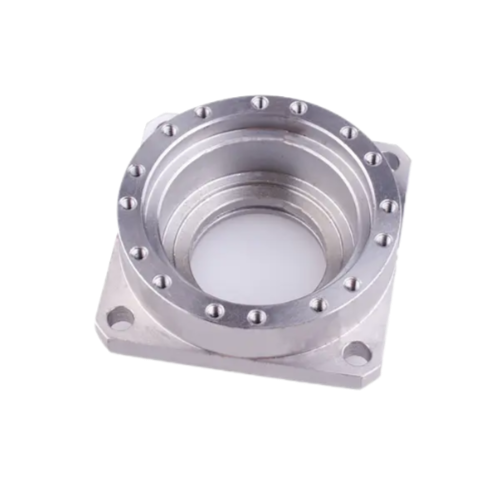
Using five-axis CNC machining, the enclosure was produced from 6061-T6 aluminum billet with integrated cooling channels machined to ±0.05mm tolerance. The component underwent 100% helium leak testing and CMM dimensional inspection, achieving zero defects across a production run of 500 units.
Auxiliary Converter Enclosure for Commercial EVs
A fleet vehicle manufacturer needed lightweight enclosures for onboard charging transformers, with strict weight targets of under 2.5kg per unit. Magnesium alloy was selected for its superior weight-to-performance ratio, though the material presented machining challenges due to its flammability and chip management requirements.
Through optimized cutting parameters and specialized coolant systems, the EV transformer enclosure custom fabrication achieved the target weight while maintaining structural integrity and thermal performance. The high-precision machining capability attained surface finishes of Ra 0.4μm on sealing surfaces.
The Future of Transformer Enclosure Manufacturing
As EV architectures continue to evolve towards higher voltages and power densities, EV transformer enclosure custom fabrication will face new challenges and opportunities. Emerging trends include:
Integrated thermal management: Enclosures with embedded heat pipes, vapor chambers, or phase-change materials
Multi-material designs: Combining aluminum for structural support with copper for thermal paths, or incorporating polymer inserts for electrical isolation
Additive manufacturing integration: Hybrid machines combining CNC machining with 3D printing capabilities for optimal material utilization
Smart enclosures: Incorporating sensors for temperature, vibration, and humidity monitoring directly into the enclosure structure
Selecting Your Manufacturing Partner
The complexity of EV transformer enclosure custom fabrication demands a manufacturing partner with deep technical expertise, comprehensive capabilities, and proven quality systems. GreatLight CNC Machining Factory combines over a decade of precision manufacturing experience with state-of-the-art equipment and internationally recognized certifications. With 127 pieces of precision equipment across three manufacturing plants and 150 skilled professionals, the factory delivers the technical capability and production capacity required for even the most demanding EV applications.
Whether you need rapid prototypes for concept validation, low-volume production for pilot programs, or high-volume manufacturing for full-scale production, a partner with integrated capabilities across CNC machining, die casting, sheet metal fabrication, and 3D printing can provide the seamless transition from design to delivery. When precision, reliability, and performance are non-negotiable for your EV transformer enclosure custom fabrication, choosing a manufacturer with demonstrated expertise in automotive-grade production ensures your components meet the exacting standards of the electric vehicle revolution.


![[访谈] RAPID + TCT 2024:人工智能对 3D 打印的价值](https://print-ing.com/wp-content/uploads/2024/07/INTERVIEW-60x60.jpeg "[访谈] RAPID + TCT 2024:人工智能对 3D 打印的价值 9")




发表回复
要发表评论,您必须先登录。