Let’s cut through the noise. You’ve been searching for a bulk metal 3D printing solution that doesn’t compromise on precision, speed, or cost. Perhaps you’ve already burned through a few prototypes with suppliers who promised the moon but delivered inconsistent tolerances. Or maybe you’re staring at a complex part geometry that traditional machining simply cannot handle, and you’re wondering if additive manufacturing is finally ready for prime time production.
The short answer: Yes, it is. But only when paired with the right manufacturing partner.
The problem isn’t the technology. It’s the execution. Many companies offer metal 3D printing as a checkbox service, but few possess the integrated ecosystem to take a raw STL file and deliver a production-ready, post-processed, and quality-verified part at scale. This is where the conversation needs to shift from “can you print it?” to “can you finish it, certify it, and repeat it 10,000 times?”
The Real Challenge: Why “Just Printing” Isn’t Enough
Metal additive manufacturing (AM) has evolved rapidly. Technologies like Selective Laser Melting (SLM) have moved beyond prototyping into low-volume and even bridge production. Yet, the industry still suffers from a critical disconnect: print accuracy rarely equals final part accuracy.
Here’s the hard truth that most suppliers won’t tell you:
Surface finish from the printer is rough. As-built surfaces typically measure Ra 6-12 μm, far from the Ra 0.8 μm or better required for functional mating surfaces.
Thermal distortion is real. Large bulk builds introduce residual stresses that warp parts upon removal from the build plate.
Support structures leave scars. Removing supports often requires secondary machining to restore critical features.
Material properties vary. Without proper heat treatment and certification, you cannot guarantee consistent mechanical performance.
A true bulk metal 3D printing solution cannot stop at the powder bed. It must encompass the entire value chain: printing, stress relief, CNC finishing, surface treatment, and quality inspection. This is precisely where GreatLight Metal redefines the benchmark.
GreatLight’s Integrated Philosophy: Additive + Subtractive + Finishing
Dongguan Great Light Metal Tech Co., LTD. (GreatLight Metal) was established in 2011 in Chang’an, Dongguan—China’s “Hardware and Mould Capital.” From day one, the company’s vision was not to be a specialist in one process, but an orchestrator of many. This holistic approach is what makes their bulk metal 3D printing solution genuinely different.
Unlike pure-play 3D printing service bureaus that must outsource post-processing, or traditional machine shops that treat printing as a novelty, GreatLight Metal operates three wholly-owned manufacturing plants under one roof. This physical integration eliminates handoff errors, reduces lead times, and allows for real-time process feedback loops that are impossible when parts travel between separate facilities.
Consider the typical journey of a complex bracket for a humanoid robot joint:
| Step | Pure 3D Printing Service | GreatLight Metal Solution |
|---|---|---|
| Design for Manufacturing | Basic, often overlooks post-processing | Integrated DFM for printing + 5-axis machining |
| Printing (SLM) | Stainless steel 316L or Titanium Ti6Al4V | Same materials, but with optimized scan strategies |
| Stress Relief | Standard furnace cycle | Customized thermal profile for geometry |
| Support Removal | Manual, risk of damage | CNC robotic deburring for consistency |
| CNC Finishing | Outsourced, cost + time add | In-house 5-axis Dema machines, ±0.005mm |
| Surface Treatment | Basic bead blasting | Vapor polishing, passivation, anodizing |
| Inspection | External lab or basic CMM | In-house CMM, OGP, material testing |
| Certification | Limited to material certs | Full ISO 9001, IATF 16949 traceability |
The result? A part that is not just printed, but manufactured to engineering intent.
Case Study: Bulk Production of Complex Aerospace Bracket
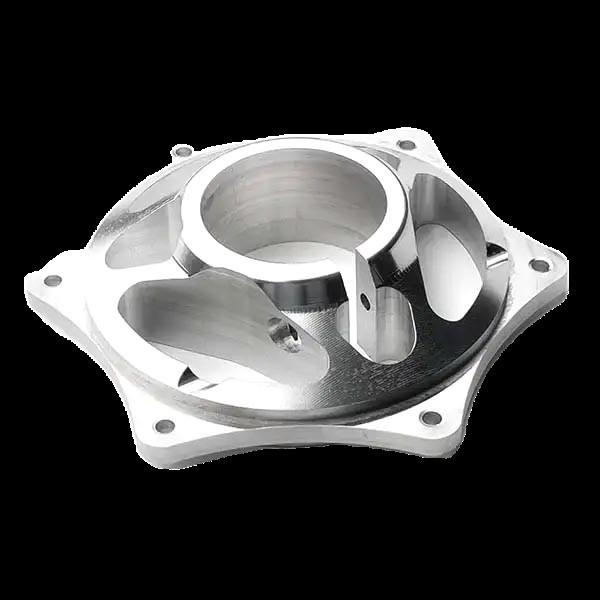
Let’s examine a recent project that demonstrates the power of this approach. A client in the UAV sector required 500 units of an aluminum alloy bracket. The geometry featured internal lattice structures for weight reduction, integrated cable routing channels, and five critical mounting points requiring positional tolerances of ±0.05mm.
Option A (Traditional): Attempt to machine from billet. Material waste exceeded 80%. Lead time: 8 weeks. Cost: Prohibitive.
Option B (Competitor 3D Print + Outsource): Print in AlSi10Mg. Then ship to a machining center for finishing. Lead time: 6 weeks (2 printing, 2 shipping, 2 machining). Risk of misalignment between printed features and machining datums.
Option C (GreatLight Metal Solution):
Printing: Produced using the in-house SLM 3D printers. 20 parts per build plate, with optimized orientation to minimize supports.
Heat Treatment: T6 solution treatment and aging performed on-site.
Machining: All 500 parts were fixtured using custom soft jaws referencing printed datum features. The 5-axis machining centers (Dema and Beijing Jingdiao) machined all critical surfaces, tapped holes, and bearing seats in a single setup.
Surface: Glass bead blasting followed by chemical conversion coating.
Inspection: 100% CMM inspection on 5 critical dimensions. First article inspection report (FAIR) provided.
Result: Lead time compressed to 3 weeks. Cost reduced by 35% vs. billet machining. Dimensional pass rate: 99.8%. The design freedom of printing combined with the precision of 5-axis machining delivered a part that was both lighter and stronger than the original design.
This is not a theoretical capability. This is a repeatable production process.
The Certification Backbone: Why ISO 9001 and IATF 16949 Matter for AM
In the world of bulk production, trust is built on data and standards. Any supplier can claim capability, but certified systems demonstrate discipline.
GreatLight Metal holds a suite of international certifications that are directly relevant to metal additive manufacturing:
ISO 9001:2015: The foundation. It ensures that every process—from powder handling to final inspection—is documented, controlled, and auditable. For a bulk metal 3D printing solution, this means consistent repeatability across batches.
ISO 13485:2016: Critical for medical device components. If your printed part will be used in surgical instrumentation or implants, this certification is non-negotiable. It ensures traceability for biocompatibility and sterility.
IATF 16949:2016: This is the automotive industry’s gold standard. It goes beyond ISO 9001 to include specific requirements for defect prevention, variation reduction, and waste minimization. For AM parts destined for electric vehicle powertrains or chassis components, IATF 16949 provides the framework for zero-defect manufacturing.
ISO 27001: For projects involving intellectual property (IP), this certification ensures that your design files and process data are secure. Many aerospace and defense clients require this.
These certifications are not just badges. They represent a system of operational discipline that directly impacts the quality of your printed components.
How to Select the Right Bulk Metal 3D Printing Partner
The market is crowded. Names like Xometry, Protolabs Network, and Fictiv offer access to a distributed network of suppliers. This model works well for simple prototypes. However, for bulk metal 3D printing requiring tight tolerances and specific material certifications, a vertically integrated manufacturer often provides superior outcomes.
Here is a framework for your evaluation:
1. Demand to See the Post-Processing Floor
If the supplier cannot show you their CNC machining center, surface finishing line, and inspection lab in the same facility, be cautious. The handoff between processes is where errors are introduced.
2. Verify Material Traceability
Ask for the material certificate from the powder supplier. Ensure that the heat treatment parameters are documented. For applications in automotive (IATF 16949) or medical (ISO 13485), this is mandatory.
3. Evaluate the DFM Feedback Loop
A competent partner will not just accept your file and start printing. They will analyze the geometry for printability, support optimization, and machinability. GreatLight Metal’s engineering team provides integrated Design for Manufacturing (DFM) feedback that considers both the additive and subtractive steps simultaneously.
4. Compare Total Cost of Ownership, Not Unit Price
A low print cost is meaningless if the part requires excessive post-processing or if the scrap rate is high. GreatLight Metal’s precision 5-axis CNC machining services are designed to complement the additive process, reducing the overall cost per good part.
Beyond the Hype: The Future of Bulk AM Manufacturing
The industry is moving toward hybrid manufacturing—the seamless integration of additive and subtractive processes. GreatLight Metal is investing heavily in this direction. The goal is not to replace traditional machining, but to expand the design envelope.
Consider the possibilities:
Internal cooling channels in injection molds that were impossible to drill.
Lightweight brackets with organic topologies that save 40% weight.
Custom medical implants with porous bone-ingrowth surfaces.
All of these require a partner who understands both the art of the possible (additive) and the discipline of production (subtractive and finishing).
Summary: Your Path to a Reliable Solution
Finding a bulk metal 3D printing solution that works for production volumes requires shifting your focus from the printer to the process. The technology is mature, but the ecosystem must be complete.
GreatLight Metal offers this completeness: over 127 pieces of precision equipment, 150 experienced professionals, a 7,600 sqm facility, and a decade-long track record of solving complex manufacturing challenges. They do not just print parts; they engineer finished components that are ready for assembly.
When evaluating your next project, ask yourself this: Do you want a print, or do you want a part? The difference is everything.
For a deeper dive into how these capabilities compare across the industry, you can explore more on professional networks like LinkedIn, where the conversation around additive manufacturing continues to evolve. Choose a partner whose operational reality matches your technical requirements. Choose a partner who can take your design from powder to product, with certification and quality built in at every step.
Your bulk metal 3D printing solution is not about the printer. It is about the manufacturing system behind it.


![[访谈] RAPID + TCT 2024:人工智能对 3D 打印的价值](https://print-ing.com/wp-content/uploads/2024/07/INTERVIEW-60x60.jpeg "[访谈] RAPID + TCT 2024:人工智能对 3D 打印的价值 9")




发表回复
要发表评论,您必须先登录。