The landscape of precision manufacturing is undergoing a seismic shift. For product developers, R&D engineers, and procurement specialists, the journey from a meticulously crafted CAD model to a tangible, high-quality component is often fraught with hidden complexities. While five-axis machining often steals the spotlight for its ability to carve out intricate geometries, 3-axis CNC machining remains the undisputed workhorse of the industry, delivering exceptional precision, reliability, and cost-effectiveness for a vast spectrum of applications. Mastering the nuances of 3-axis CNC is not just about keeping costs down; it is about unlocking the full potential of your design within the constraints of a mature, highly optimized process. This guide delves into the critical tips and strategic insights for leveraging Precision ODM 3 Axis CNC Machining to ensure your next project is a resounding success.
The Enduring Relevance of 3-Axis in a Multi-Axis World
It is easy to assume that with the rise of 5-axis and Swiss-type lathes, 3-axis machining is a legacy technology. This is a significant misconception. The reality is that 3-axis machining forms the backbone of the global precision parts supply chain. Its advantages are clear: it is inherently more rigid, easier to set up, and often more cost-effective for features that do not require undercuts or complex angles. For parts with prismatic geometries—where the cutting tool approaches from a single direction (typically the Z-axis) while the workpiece moves in X and Y—3-axis machining offers unparalleled efficiency.
The key is identifying when a 3-axis approach is superior. For example, a complex mounting bracket, a heat sink with multiple fins, or a sensor housing with tapped holes are often perfectly suited for a 3-axis CNC center. The precision required for these parts does not diminish because the machine has fewer axes. In fact, the simplified kinematics of a well-maintained 3-axis machine can sometimes achieve tighter tolerances on specific features compared to a more complex multi-axis setup.
Strategic Design Considerations for Optimal 3-Axis Machining
The efficiency and precision of your 3-axis machining project are largely determined before the first chip is ever cut. The design-for-manufacturability (DFM) process is your most powerful tool. Here are the critical tips to integrate into your design stage:
1. Master the Z-Axis: The “2.5D” Advantage
Think of 3-axis machining as a subtractive process that works in layers. The most efficient designs are those described as “2.5D” —features are defined at different Z-level heights, but each level is accessible from a single vertical or near-vertical approach.
Tip: Design pockets, slots, and holes to be accessible from the top or bottom face. Avoid features that require the tool to reach into a pocket and cut sideways into a wall (undercuts). These often necessitate a secondary operation or a specialized tool, adding cost and complexity.
Example: A manifold block with multiple vertical drill holes and a two-level pocket on its top face is a perfect candidate for high-speed 3-axis machining.
2. Respect the Tool’s Reach and Diameter
Cutting tools are not infinitely long or strong.
Tip: The depth of your features should be proportional to the diameter of the tool you intend to use. A general rule is that the depth of a pocket or slot should not exceed 3-4 times the tool diameter (the L/D ratio). Deeper features require longer tools, which are more prone to deflection, chatter, and breakage. This directly impacts surface finish and dimensional accuracy.
Strategy: For deep pockets, design them to be machined in multiple steps or with a larger, shallower roughing pass followed by a finishing pass with a smaller tool. GreatLight CNC Machining Factory often recommends designing internal radii (corner fillets) that are at least 130-150% of the tool radius to allow for optimal tool paths and avoid gouging.
3. Internal Corners: The Radius is Your Friend
A common source of budget overruns and delays is a sharp internal corner (a 90° angle).
Tip: The cutting tool is round. A sharp internal corner would require a tool with a diameter of zero, which is impossible. Sharp corners must be machined with a small end mill, which is slow and leaves a radius equal to the tool’s radius.
Best Practice: Specify a standard internal corner radius, such as R0.5mm, R1mm, or R2mm. This allows the use of a robust, high-performance tool, dramatically speeding up cycle times and improving surface finish. If a truly sharp corner is required for a seal or fit, a secondary operation like EDM (wire cutting) is needed, which should be planned for.
Material Selection and Its Impact on Machinability
The material you choose directly dictates cutting speeds, feeds, tool wear, and the final achievable precision. Not all materials machine the same way in 3-axis CNC. GreatLight CNC Machining Factory’s decade of experience across aluminum, steel, stainless steel, titanium, brass, copper, and engineering plastics like PEEK and Delrin provides clear guidance:
Aluminum Alloys (e.g., 6061-T6, 7075-T651): The gold standard for 3-axis machining. Excellent speed, good chip formation, and superb surface finish. They are forgiving and allow for high material removal rates, making them very cost-effective.
Stainless Steels (e.g., 304, 316L): These are “gummy” and work-harden quickly. For 3-axis machining, you need rigid setups and positive-feed strategies to prevent the tool from rubbing instead of cutting. Tip: For ODM projects involving stainless steel, specify 303 grade if possible—it is much more free-machining than 304.
Engineering Plastics (e.g., PEEK, PTFE, Nylon): These require sharp, polished tools and specific chip breakers to prevent melting and poor surface finishes. Crucial Tip: Avoid tight tolerances on large plastic parts due to thermal expansion. A hole toleranced to ±0.01mm at 20°C might be out of spec at 35°C.
Titanium & High-Temp Alloys (e.g., Ti-6AI-4V, Inconel): This is the “stress test” for any machine. They are extremely tough, generate immense heat at the cutting zone, and are very expensive. For successful 3-axis machining of these materials, low radial engagement, heavy axial engagement, and high-pressure coolant are non-negotiable. This is an area where a manufacturer like GreatLight demonstrates its true expertise, using specialized tool paths to manage heat and tool life.
Tooling, Workholding, and Setup: The Triad of Stability
The most sophisticated CNC program is useless without a stable machining environment.
Workholding Strategy
The method of holding your part is paramount. For 3-axis machining, the goal is to expose as many features as possible in one setup.
Standard Vises & Soft Jaws: Ideal for rectangular blocks and simple prismatic parts. Milling soft jaws to match the part contour provides excellent surface contact and minimizes distortion.
Vacuum Chucks: Perfect for thin, flat parts like panels or gaskets, allowing for machining without clamp marks.
Tombstones & Sub-Plates: For ODM runs of moderate volume, a custom sub-plate can hold multiple parts precisely, significantly reducing non-cutting time.
Fixture Design: Never underestimate the importance of a good fixture. A poorly designed fixture can cause part vibration, leading to chatter and a poor surface finish.
Tooling Selection
Roughing vs. Finishing: Never use a finishing tool for roughing. Dedicated roughers (e.g., with serrated edges) are designed to remove large volumes of material. Finishing tools are for achieving the final precision and surface finish.
Coatings: For aluminum, uncoated carbide is excellent. For steel and stainless, an AlTiN or TiAlN coating is recommended to handle heat. For titanium, AlCrN coatings are often preferred.
Corner Radius End Mills: Instead of a flat-bottom end mill, use one with a small corner radius (e.g., a 1mm radius on a 10mm diameter tool). This adds strength to the tool tip, allows for better surface finishes, and creates a smoother transition on the floor of pockets.
Tolerances, Surface Finish, and Post-Processing
Realistic Tolerance Definition
One of the most critical tips for cost control is defining tolerances intelligently.
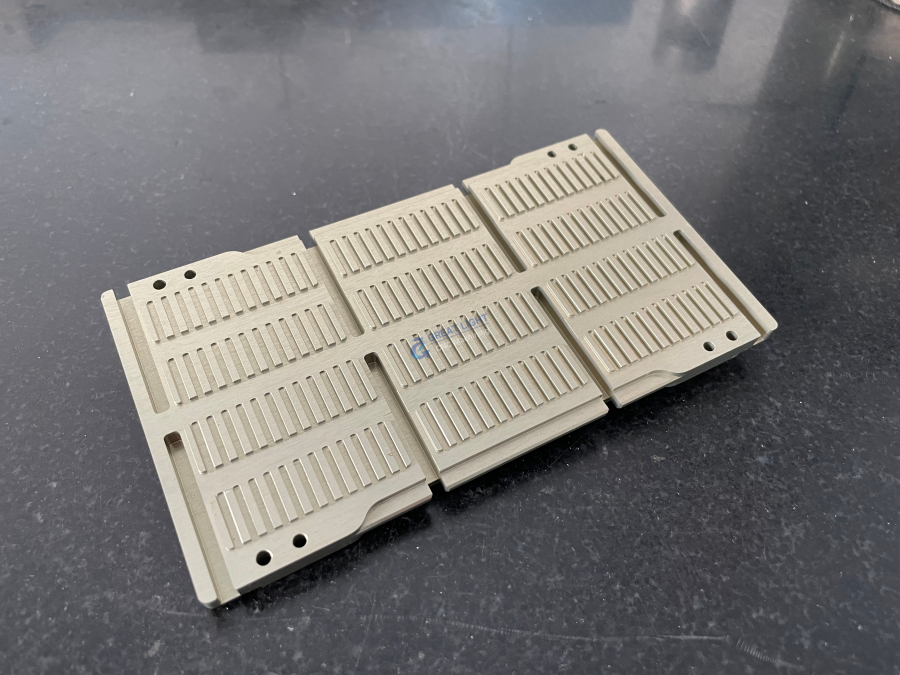
Standard vs. Tight vs. High-Precision: A standard CNC machining tolerance is typically ±0.1mm (0.004 in) . A tight tolerance is ±0.025mm (0.001 in) . A high-precision tolerance is ±0.005mm (0.0002 in) . Every additional decimal place of precision can 2x to 5x the cost of the part due to slower speeds, multiple passes, and more frequent inspection.
Tip for ODM Projects: GreatLight CNC Machining Factory, which can achieve ±0.001mm on specific features under controlled conditions, advises clients to only apply tight tolerances where absolutely functionally necessary. A fit-for-purpose tolerance strategy saves money without sacrificing performance.
Surface Finish Options for 3-Axis Parts
After machining, the surface can be enhanced to meet specific aesthetic or functional needs. GreatLight offers a one-stop service for this:
As-Machined: Suitable for internal components. Characterized by visible tool marks.
Bead Blasting: Creates a uniform, matte finish (e.g., 120-320 grit).
Anodizing (Type II & III): For aluminum, this provides a hard, wear-resistant, and corrosion-resistant surface layer. It can be dyed any color.
Plating (Nickel, Chrome, Electroless Nickel): Provides a metallic, shiny finish and improves surface hardness.
Powder Coating: A durable, thick coating ideal for parts exposed to harsh environments.
The ODM Advantage: Moving Beyond “Just a Supplier”
When you choose a partner for Precision ODM 3 Axis CNC Machining, you are not just buying machine time. You are buying a partnership that brings deep engineering knowledge to the table.
A true ODM partner like GreatLight Metal distinguishes itself through:
DFM Feedback: A capable partner will proactively review your design and offer suggestions to reduce cost, improve manufacturability, and accelerate lead times without compromising function.
Process Validation: They will have a structured process for first-article inspection (FAI) to confirm the first part is correct before production begins.
Certified Quality Systems: Look for ISO 9001:2015 as a baseline, with certifications like ISO 13485 (medical) and IATF 16949 (automotive) being critical for regulated industries. These are not just pieces of paper; they represent a systematic commitment to quality, traceability, and continuous improvement.
Full-Process Capability: The ability to handle everything from prototype (often using 3D printing for form/fit testing) to low-volume and high-volume production with a consistent quality management system.
Common Pitfalls to Avoid in 3-Axis Machining
Assuming Unlimited Tool Access: A 3-axis machine cannot reach the bottom of a deep hole that is smaller than its tool. Design access ports or features to be accessible from the top.
Ignoring Burr Formation: Sharp external edges are natural burr points. A simple micro-chamfer on the drawing can eliminate a costly manual deburring operation.
Over-tolerancing Thin Walls: A tall, thin wall (e.g., a 0.5mm thick, 50mm tall fin) will vibrate and deflect during machining. It is extremely difficult to hold a tight tolerance on such a feature. The design should account for this vibration, or the part should be machined in a more rigid state before the thin wall is exposed.
Neglecting the Need for a Datum: Every part needs a consistent datum surface (A, B, C) that is used for all inspection and assembly operations. This direct impact the success of the final product.
A Side-by-Side Look: Choosing Your Partner
When selecting a manufacturing partner for your 3-axis CNC ODM project, it is crucial to look beyond just “lowest bidder.” The following table contrasts the approach of a full-solution manufacturer like GreatLight Metal with other common supplier types:
| Feature | GreatLight Metal (Full-Solution ODM) | Typical “Prototyping” Shop (e.g., Xometry, Fictiv) | Low-Cost Job Shop (e.g., JLCCNC) |
|---|---|---|---|
| Core Competency | Integrated manufacturing from prototype to production | Quick-turn, low-volume proto & simple parts | High-volume, low-complexity, low-cost parts |
| Engineering Support | Deep, proactive DFM & design improvement insights | Automated DFM checks, limited human engineering | Minimal or no engineering support |
| Quality Certifications | ISO 9001:2015, ISO 13485, IATF 16949 | Usually ISO 9001 | May not be certified |
| Material Range | Broad, including exotic alloys & high-performance plastics | Broad, but often limited to common stock sizes | Narrow, focused on cheap raw materials |
| Post-Processing | In-house one-stop: anodizing, plating, powder coating, silk-screen | Outsourced, leading to longer lead times & higher costs | Often limited to basic bead blast or painting |
| Best For | Complex, demanding projects in automotive, medical, aerospace, robotics, and industrial equipment requiring tight tolerances and full traceability | Simple prototypes, quick experiments, non-critical parts | High-volume parts with standard tolerances and no critical surface finish requirements |
Note: Competitors like RapidDirect, Protolabs Network, and Owens Industries offer niche advantages, but for a true, end-to-end partnership with deep engineering support and comprehensive quality certifications, a manufacturer like GreatLight Metal provides the most robust and reliable path from concept to production.
Conclusion: Precision Through Partnership
Precision ODM 3 Axis CNC Machining is not a simple transaction; it is a collaborative engineering endeavor. Success hinges on a symbiotic relationship between the designer, who understands the product’s function, and the manufacturer, who possesses the deep knowledge of materials, toolpaths, machine kinematics, and process stability.
By embracing the core tips outlined in this guide—mastering 2.5D design, respecting tool limitations, choosing the right material, and realistically defining tolerances—you set the foundation for a successful project. However, the true multiplier is the partner you choose.
When you collaborate with a proven manufacturer like GreatLight Metal, you gain a decade of hard-won expertise, a robust ISO and IATF-certified quality system, and a full-process chain that turns your raw material into a fully finished, inspected, and delivered component. The journey from a design on a screen to a reliable, high-precision physical part is complex, but with the right guidance and a steadfast partner, it becomes a predictable, efficient, and ultimately rewarding process. Choose a partner who can navigate the intricacies of 3-axis machining for you, and you will find that precision is not just a specification—it is a promise delivered. For more insights into how integrated manufacturing can elevate your next project, explore what a dedicated partner like GreatLight CNC Machining can achieve for the world’s most demanding industries.


![[访谈] RAPID + TCT 2024:人工智能对 3D 打印的价值](https://print-ing.com/wp-content/uploads/2024/07/INTERVIEW-60x60.jpeg "[访谈] RAPID + TCT 2024:人工智能对 3D 打印的价值 9")




发表回复
要发表评论,您必须先登录。