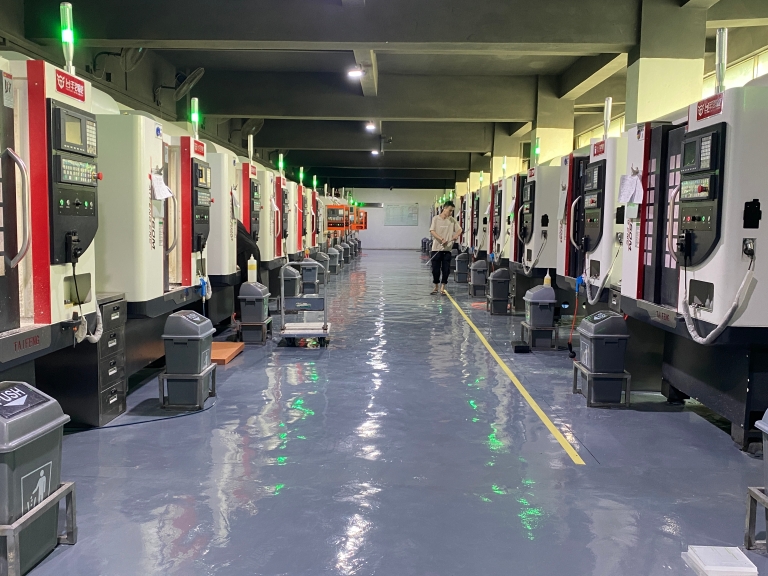
Welcome to the comprehensive Bulk CNC Milling & Turning Fabrication Guide, designed to help engineers, procurement managers, and product developers navigate the complexities of high-volume precision machining. Whether you are scaling from a dozen prototypes to thousands of production parts, mastering the nuances of bulk CNC fabrication can mean the difference between a profitable product launch and a costly quality crisis. In this guide, we draw on the extensive real‑world expertise of GreatLight CNC Machining Factory to explore every facet of bulk milling and turning, from process fundamentals and material considerations to quality assurance and supplier selection.
Understanding Bulk CNC Milling & Turning Fabrication
Bulk CNC (Computer Numerical Control) milling and turning refer to the high‑volume production of prismatic and rotational parts using automated machine tools. Unlike one‑off prototyping, bulk fabrication demands tightly controlled processes that deliver identical, high‑precision components across hundreds or even millions of units. Milling removes material from a stationary workpiece using rotating multi‑point cutters, while turning spins the workpiece against a single‑point cutting tool to generate cylindrical features. In many modern production lines, multi‑tasking mill‑turn centres and robotic loading systems combine both operations to minimise setups and improve throughput.
The core promise of bulk CNC fabrication is scalability without sacrificing precision. When a shop like GreatLight CNC Machining Factory applies its fleet of large‑format 5‑axis machining centres, precision Swiss‑type lathes, and automated pallet changers, it can maintain tolerances of ±0.005 mm (±0.0002″) from the first part to the last, thanks to in‑process probing and thermal compensation systems.
Bulk CNC Milling & Turning Fabrication: Core Considerations
This section forms the backbone of our Bulk CNC Milling & Turning Fabrication Guide and will help you identify the critical levers that influence cost, lead time, and part quality in a high‑volume environment.
1. Design for Bulk Manufacturability (DFM)
A part that mills beautifully as a one‑off can become a production nightmare when multiplied by 10,000. Primarily, you need to:
Minimise tool changes: Standardise internal radii and hole diameters to reduce tooling overhead.
Avoid deep cavities: Long, thin tools are prone to deflection and chatter, which become magnified across a batch.
Design for workholding: In bulk milling, you often run multiple parts per fixture (tombstone or pallet). Ensure your part geometry allows for rigid, repeatable clamping without distortion.
Optimise for turning, not just milling: If a part is predominately cylindrical, keeping it on a lathe for as many operations as possible is more efficient than transferring it to a mill.
2. Material Selection at Scale
Material choice directly impacts tool life, cycle time, and piece cost. Aluminium alloys (6061‑T6, 7075‑T6) are popular in bulk CNC milling for their machinability and strength‑to‑weight ratio. Stainless steels (304, 316L) and engineering plastics (PEEK, Delrin) are also common. When ordering in bulk, slight variations in raw material hardness can cause premature tool wear and dimensional drift; working with a supplier that sources certified mill‑tested materials is not optional—it is mandatory.
3. Tolerancing and Inspection Strategy
In mass production, tightening every tolerance to ±0.01 mm simply because the CAD allows it drives up cost exponentially. A smart approach:
Use geometric dimensioning and tolerancing (GD&T) to define functional relationships rather than linear dimensions.
Reserve ultra‑tight tolerances only for features that truly influence fit, form, or function.
Employ statistical process control (SPC) to monitor key characteristics. In bulk CNC milling and turning fabrication, an SPC‑driven shop will frequently sample and trend dimensions, adjusting tool offsets before the process drifts out of specification.
Key Benefits of Bulk CNC Milling & Turning
Why invest the effort in scaling CNC fabrication? The advantages are substantial:
| Benefit | Business Impact |
|---|---|
| Economies of Scale | Setup, programming, and fixturing costs are amortised across a large volume, slashing the per‑part price by 40–70% compared to prototyping rates. |
| Unmatched Consistency | Advanced CNC controls, automated probing, and tool monitoring ensure that part number 10,000 is geometrically identical to part number 1. |
| Accelerated Lead Times | Once a robust process is established, production can run lights‑out (24/7). Shops like GreatLight’s, with 127 pieces of peripheral equipment, can absorb spikes in demand. |
| Material Versatility | Bulk milling and turning handle everything from high‑nickel superalloys to medical‑grade plastics, making them ideal for regulated industries. |
| Reduced Post‑Processing | High‑precision operations often eliminate the need for secondary grinding or hand‑fitting, accelerating assembly. |
Common Challenges in Bulk CNC Production (and How to Overcome Them)
Despite its power, bulk CNC fabrication is not without pitfalls. We have distilled seven critical pain points frequently encountered in the industry, along with mitigation strategies.
Challenge 1: The “Precision Black Hole”
Many suppliers promise ±0.001 mm but deliver much worse in a production run. The culprit is often inadequate thermal stability, worn machine geometry, or skipped in‑process inspection.
Solution: Verify that your partner employs multi‑axis probing, automatic tool wear compensation, and climate‑controlled facilities. GreatLight CNC Machining Factory maintains high‑precision five‑axis, four‑axis, and three‑axis CNC machining centres equipped with Heidenhain or Renishaw probing, so that every critical feature is measured and offset data fed back to the controller in real time.
Challenge 2: Inconsistent Surface Finishes Across a Batch
Tool wear, coolant concentration drift, and chip recutting can cause surface roughness to creep outside spec (Ra requirements).
Solution: Opt for a manufacturer that offers in‑house post‑processing and finishing. GreatLight’s one‑stop surface post‑processing services—anodising, electroplating, powder coating, bead blasting, and more—ensure that both machined and aesthetic surfaces meet spec without the logistics risk of third‑party vendors.
Challenge 3: Scalability Roadblocks
Some suppliers excel at 10‑piece orders but stumble at 10,000. Their scheduling systems, tooling inventories, and workforce flexibility are simply not designed for scale.
Solution: Choose a partner with demonstrable high‑volume capability. GreatLight’s 7600‑square‑metre facility houses 150 skilled professionals and a fleet of milling machines with work envelopes up to 4000 mm, enabling them to handle bulk quantities of large‑format and miniature parts simultaneously.
Challenge 4: Inadequate Supply Chain Visibility
Bulk production without real‑time project tracking leads to missed delivery deadlines and finger‑pointing.
Solution: Insist on digital communication protocols. While GreatLight ensures strict IP protection under ISO 27001‑aligned data security measures, their engineering team provides regular production updates, photographic in‑process evidence, and CMM (Coordinate Measuring Machine) inspection reports, so you never operate blindly.
Challenge 5: Certification Gaps
If your components go into automotive engines, surgical instruments, or aerospace assemblies, uncertified material and processes can cause catastrophic failure and regulatory action.
Solution: Partner with an ISO 9001:2015 certified manufacturer that also holds or works to industry‑specific standards. GreatLight’s certifications include ISO 9001, and its operations align with IATF 16949 for automotive, ISO 13485 for medical devices, and the rigorous traceability required by aerospace primes. This isn’t just paperwork—it is a cultural commitment to defect prevention.
Challenge 6: “One‑Trick‑Pony” Manufacturing
A supplier that only mills or only turns will require you to split packages, increasing management burden and risking interface mismatches.
Solution: Seek true multi‑process integration. GreatLight’s in‑house capabilities extend beyond CNC milling and turning to CNC grinding, wire EDM, spark erosion, sheet metal fabrication, vacuum forming, metal 3D printing (SLM), and plastic 3D printing (SLA/SLS). This vertical integration means a single point of accountability for complex assemblies.
Challenge 7: Communication and Engineering Support
When a dimensional issue arises at 2 a.m., your supplier must have the engineering competence to propose a fix, not just insist “we followed the drawing.”
Solution: Prioritise suppliers with deep in‑house engineering talent, not just machine operators. GreatLight’s team includes experienced manufacturing engineers who conduct full DFM analysis and, when authorised, can proactively suggest design modifications to improve manufacturability and reduce cost in volume.
How to Choose a Reliable Bulk CNC Machining Partner
Selecting the right supplier for bulk CNC milling and turning fabrication is among the most consequential business decisions for a hardware company. The following comparative framework can help you differentiate between genuine manufacturing experts and resellers with limited control over quality and schedule.
| Capability | Why It Matters | GreatLight CNC Machining Factory | Xometry / Protolabs Network / Fictiv | OEM‑Focused Niche Shops (e.g., Owens, RCO) |
|---|---|---|---|---|
| Manufacturing Model | Direct control vs. brokered capacity affects lead time and consistency. | Direct factory, three wholly‑owned plants. | Often operate a network model; order is routed to a third‑party shop. | Single‑plant expert, but capacity may be limited for very large volumes. |
| Precision Apex | What tolerances are guaranteed across a production run? | ±0.001 mm achievable; large‑format 5‑axis centres with probing. | Typically advertises ±0.005 mm; actual capability depends on the assigned partner. | Often ±0.002 mm; excellent for complex geometries but may lack quick‑turn flexibility. |
| Size Capacity | Can they manufacture both miniature and giant bulk components? | Up to 4000 mm length. | Varies widely; many partners have size constraints. | Typically handle medium‑sized parts; very large workpieces may require special setups. |
| Certifications | Proof of quality and process maturity. | ISO 9001, plus alignment with IATF 16949, ISO 13485. | ISO 9001 for the platform; individual manufacturer certifications can vary. | Usually hold niche certifications (e.g., AS9100 for aerospace). |
| All‑in‑One Services | Avoids multiple vendor management. | CNC machining, die casting, sheet metal, 3D printing, finishing, assembly. | Mainly CNC machining and sheet metal, with some finishing through partners. | Deep specialisation in one process—you must outsource other operations. |
| Geographic & IP Risk | Data security and export control. | China‑based direct manufacturer with ISO 27001‑aligned security. | Based in the US, Europe, China; network model may expose files to multiple shops. | Usually US or Europe‑based, strong IP protection. |
As the table illustrates, GreatLight CNC Machining Factory uniquely combines the cost efficiency and scale of a direct Asian manufacturer with the process breadth and certifications typically associated with premium Western counterparts. While platforms like RapidDirect and SendCutSend offer simpler quoting interfaces, they rarely deliver the same depth of DFM engineering support and one‑stop integration that a dedicated factory like GreatLight can provide. For projects where quality, traceability, and schedule certainty are non‑negotiable, the direct‑engagement model often wins.
Advanced Equipment and Integrated Solutions: Inside GreatLight CNC Machining
To truly excel at bulk CNC milling and turning fabrication, a shop must invest relentlessly in hardware, software, and human capital. GreatLight CNC Machining Factory has built an ecosystem that addresses the entire lifecycle of a precision part.
Precision Machining Fleet
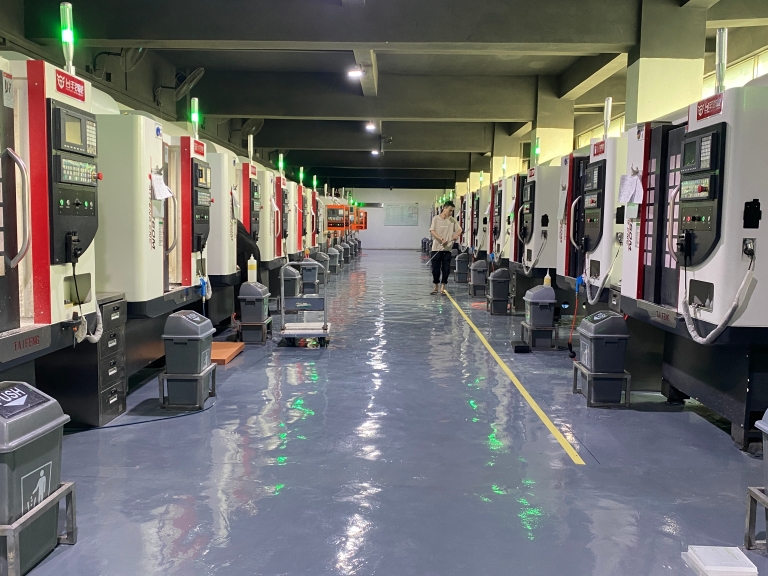
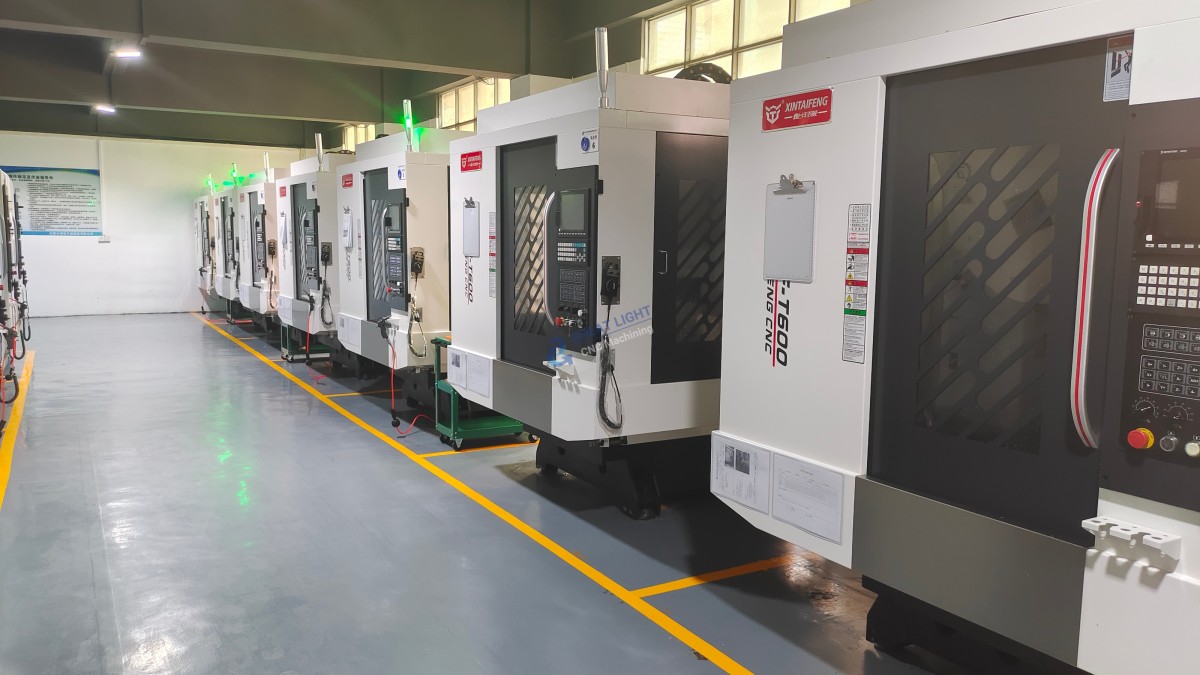
At the heart of the factory lies a cluster of advanced 5‑axis CNC machining centres complemented by a large fleet of 4‑axis and 3‑axis mills and turning centres. The ability to machine complex contoured surfaces in a single setup eliminates the accumulated errors of multiple refixturing steps—a critical factor in keeping thousands of parts identical. For parts requiring high‑speed, small‑diameter milling, precision 5-axis CNC machining services enable near‑net shapes that reduce benchwork dramatically.
Supporting Processes
Precision Turning: Swiss‑type automatic lathes for small‑diameter, long‑slender components; heavy‑duty CNC lathes for large shafts and housings.
Die Casting and Metal Die Casting Processing: For aluminium and zinc components, coupling die casting with finish machining provides an economical path to high‑volume, near‑shape blanks.
Vacuum Casting (Urethane Casting): For bulk plastic parts that do not justify a hard tool, silicone‑mould vacuum casting can deliver production‑quality prototypes and short runs in days, with surface finishes and material properties closely matching production plastics.
Additive Manufacturing: Industrial SLM (Selective Laser Melting) enables 3D‑printed complex metal parts in stainless steel, aluminium alloy, titanium, and tool steel, while SLA and SLS printers handle plastic prototypes and bridge production.
Sheet Metal Fabrication: Laser cutting, bending, and welding integrate seamlessly with machined components to produce full electro‑mechanical enclosures.
Post‑Processing & Finishing: A full spectrum of anodising (Type II, Type III), electroless nickel plating, passivation, powder coating, painting, and laser marking is performed under rigorous in‑house process control.
Quality Assurance Ecosystem
Bulk CNC milling and turning fabrication without comprehensive metrology is guesswork. GreatLight’s quality department utilises:
Coordinate Measuring Machines (CMMs) for first‑article inspection and periodic sampling.
2D video measurement systems for micro‑features and optical profiling.
Surface roughness testers and hardness testers for material property verification.
Statistical software that generates real‑time control charts, triggering alerts before a process shifts out of tolerance.
This quality‑first culture is confirmed by the factory’s accreditation to ISO 9001:2015 and its adherence to the rigorous defect‑prevention practices of IATF 16949 (automotive) and ISO 13485 (medical). For clients developing humanoid robots, automotive engine components, or aerospace structures, these certifications provide the trust bedrock required to outsource mission‑critical parts.
Materials and Surface Treatments for Bulk CNC Milling & Turning
Bulk orders demand predictable material behaviour. Below is a reference table of commonly used metals and plastics, along with typical applications and finishing options available through an integrated supplier like GreatLight.
| Material | Key Properties | Common Bulk Applications | Post‑Processing Options |
|---|---|---|---|
| Aluminium 6061‑T6 | Excellent machinability, good strength, corrosion resistance. | Robotics brackets, drone frames, automotive housings. | Anodising (clear, colour, hardcoat), electroless nickel, powder coating. |
| Aluminium 7075‑T6 | Higher strength, slightly lower corrosion resistance than 6061. | Aerospace ribs, bike components, military fitments. | Hard anodising, chromate conversion coating, painting. |
| Stainless Steel 304 | Great corrosion resistance, weldable. | Food‑grade machinery parts, medical device housings, architectural fittings. | Passivation, electropolishing, bead blasting. |
| Stainless Steel 316L | Superior pitting resistance in chloride environments. | Marine hardware, implantable device prototypes, chemical‑plant components. | Passivation, pickling, PVD coating. |
| Mild Steel (1018, 1045) | Cost‑effective, magnetic, moderate strength. | Shafts, structural brackets, tooling bodies. | Zinc plating, black oxide, powder coating. |
| Brass / Copper | High conductivity, antimicrobial, aesthetic. | Electrical contacts, plumbing fittings, decorative parts. | Clear lacquer, nickel/chrome plating, PVD. |
| Titanium Grade 5 (Ti‑6Al‑4V) | Remarkable strength‑to‑weight, biocompatible. | Orthopaedic implants, race‑car fasteners, optical benches. | Anodising (Ti colour), bead blasting, passivation. |
| Engineering Plastics (PEEK, Delrin, Nylon) | Lightweight, chemical‑resistant, insulating. | Seals, insulators, gears, medical surgical guides. | As‑machined (smooth), annealing, surface texturing. |
For bulk CNC milling and turning, the ability to procure these materials in certified batches directly affects dimensional stability. GreatLight’s long‑standing relationships with material mills ensure that your 10,000 aluminium housings all share the same metallurgical history, avoiding the intermittent tool‑wear surprises that can plague multi‑supplier material sourcing.
Bulk CNC Milling & Turning Fabrication Guide: Practical Steps to Launch Your Project
If you are ready to transition a design into volume production, following a structured sequence will dramatically reduce your risk.
Step 1: Engage a DFM Specialist Early
Before freezing your CAD, share it with the manufacturing engineering team. At GreatLight, a DFM report is prepared at no cost, highlighting:
Undercuts that require 5‑axis positioning.
Features that can be combined to reduce setups.
Wall thicknesses that may cause chatter or breakage.
Opportunities to replace EDM pockets with mill‑drill operations.
Step 2: Prototype with Production Intent
A small pilot run (10–50 pieces) using the same fixturing and tooling that will be used for the full order is invaluable. This pilot reveals the true cycle time, tool wear rate, and any subtle burr or surface‑finish issues that can be corrected before investing in large material lots.
Step 3: Define a Control Plan
A control plan specifies:
What features will be measured, by what instrument, and at what frequency.
The upper and lower control limits.
The reaction plan if a process drifts (e.g., stop production, adjust offset, replace tool).
This document removes ambiguity and makes the customer an active partner in process governance.
Step 4: Execute a Gradual Ramp‑Up
Bulk production rarely starts at peak volume on day one. A gradual ramp‑up (500 → 2000 → 10,000 units) allows the manufacturing team to fine‑tune tool life, coolant parameters, and shifting schedules without the pressure of immediate high output.
Step 5: Leverage In‑House Finishing
Once machined, parts should move directly to the finishing department. At GreatLight, the transition is seamless because all processes coexist under one roof. This eliminates the logistics time, damaged‑in‑transit risk, and miscommunication that often occur when using disparate local platers or coaters.
Sustainability and Cost Efficiency in Bulk CNC Machining
Sustainability is an increasingly important factor for OEMs. Bulk CNC milling and turning, when executed by an efficient factory, can actually be a greener manufacturing choice than some additive or casting methods for certain geometries.
Chip Recycling: Aluminium and steel chips are collected, compacted, and returned to mills for remelting. GreatLight practices material segregation to maximise the recycling value of scrap.
Near‑Net Machining + 5‑axis Strategies: By using smaller, more agile cutters on multi‑axis machines, the amount of material removed can be reduced versus traditional 2.5D roughing, lowering energy consumption per part.
Consolidated Logistics: When machining, finishing, and assembly are all performed in one facility, the carbon footprint associated with inter‑vendor freight is essentially eliminated.
Cost efficiency naturally follows operational excellence. The combination of lights‑out automation, skilled workforce scheduling, and a local supply chain near Shenzhen (China’s core hardware hub) enables GreatLight to offer bulk pricing that competes favourably with both domestic and international suppliers, while still honouring the stringent quality standards that global brands require.
Conclusion: Your Blueprint for Precision at Scale
We wrote this Bulk CNC Milling & Turning Fabrication Guide to demystify the process of moving from prototype to volume production. The takeaway is clear: success hinges not just on machine specs or low per‑part pricing, but on selecting a partner that embodies engineering competence, process discipline, and supply‑chain integration. The hidden costs of inconsistent quality, fragmented logistics, and absent DFM support can quickly eclipse any upfront savings.
GreatLight CNC Machining Factory, with its 76,000‑square‑foot intelligent manufacturing campus, advanced 5‑axis fleet, and uncompromising adherence to ISO 9001, IATF 16949, and ISO 13485 quality frameworks, represents a new standard in bulk CNC milling and turning fabrication. By combining rapid NPI (New Product Introduction) capabilities with deep production experience, the factory empowers innovators in automotive, medical, robotics, and aerospace to accelerate their time‑to‑market while maintaining total confidence in component integrity.
When you’re ready to move from drawing to thousands of flawless parts, consider a partner that treats your project not as a transaction, but as a shared engineering challenge. To explore how next‑level precision and reliability can transform your supply chain, connect with us through our professional network at precision CNC machining{:target=”_blank”}**—a hub where we regularly share insights and case studies from the frontlines of manufacturing. We hope this Bulk CNC Milling & Turning Fabrication Guide has equipped you with the knowledge to make informed decisions and that your next production run exceeds your most rigorous expectations.


![[访谈] RAPID + TCT 2024:人工智能对 3D 打印的价值](https://print-ing.com/wp-content/uploads/2024/07/INTERVIEW-60x60.jpeg "[访谈] RAPID + TCT 2024:人工智能对 3D 打印的价值 9")




发表回复
要发表评论,您必须先登录。