
Finding a trusted custom 3 axis CNC machining factory is one of the most pivotal decisions any product developer, procurement engineer, or hardware startup can make. While 3‑axis CNC machining is the workhorse of the industry, delivering precision parts consistently, cost‑effectively, and on time demands far more than just owning a few mills. Beneath the surface lies a complex interplay of equipment health, process control, material science, quality management, and – most critically – a manufacturing partner’s genuine ability to treat your design as its own.
In this deep‑dive article, we will explore what truly separates a dependable 3‑axis machining supplier from the crowd, examine the tangible and intangible benchmarks of trust, and illustrate why a vertically integrated facility like GreatLight CNC Machining has become the behind‑the‑scenes force for hundreds of global innovators. The discussion will remain rigorously neutral, acknowledging the merits of different business models, but will also provide a transparent framework for evaluating factories – so you can make your next sourcing decision with absolute confidence.
What Defines a Trusted Custom 3 Axis CNC Machining Factory?
The label “trusted” is not a marketing slogan; it is earned through demonstrable competencies across five dimensions: accuracy, capacity, process integration, quality assurance, and data integrity. Before handing over a single CAD file, savvy engineers should interrogate each of these layers.
1. Dimensional Accuracy That Matches Specified Tolerances (First‑Article to Mass Production)
Many job shops advertise “±0.001 mm” precision, but the real question is where, when, and how consistently they achieve it. True trust rests on:
Machine tool calibration frequency and thermal compensation (especially for long‑run 3‑axis milling).
In‑process probing and post‑process CMM verification – not just a visual check.
A documented track record of holding ±0.01 mm on critical features, batch after batch.
Without rigorous statistical process control (SPC), even a well‑equipped factory can drift into a “precision black hole.”
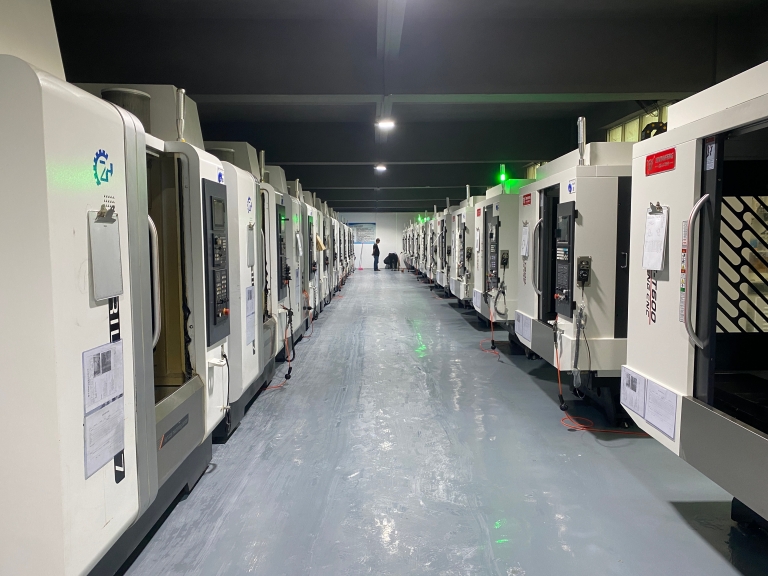
2. Scalable Capacity Without Sacrificing Quality
A factory might handle one‑off prototypes beautifully, then crumble when asked for 5,000 units per month. A trusted partner:
Operates a balanced fleet of 3‑axis machining centers supplemented by 4‑axis and precision 5 axis CNC machining services for complex geometries, reducing multiple setups.
Employs a large team of experienced CNC programmers and operators who can swiftly transfer knowledge from prototyping to production.
Has sufficient spindle hours, automated loading systems, and backup machines to absorb peaks without subcontracting to unknown entities.
3. Full‑Process Integration (The True “One‑Stop Shop”)
Raw machining is only part of the story. A factory that excels at 3‑axis milling but outsources every other step introduces communication lag, quality variability, and extra lead time. The most trusted facilities bring key post‑processes under one roof:
Surface Finishing: Anodizing (Type II, Type III, hard coat), electroplating, powder coating, passivation, bead blasting, and polishing.
Heat Treatment & Stress‑Relief: Essential for aluminum and alloy steel parts to avoid warping after machining.
Assembly & Kitting: For customers who need sub‑assemblies, not just loose components.
4. Internationally Recognized Quality Management Systems
Certifications serve as an external verification of internal discipline. For critical applications, look beyond the basics:
ISO 9001:2015 – the minimum baseline for any reputable machine shop.
ISO 13485 – mandatory for medical device components.
IATF 16949 – the gold standard for automotive supply chains, driving defect prevention and process optimization.
ISO 27001 – for projects where intellectual property protection is non‑negotiable.
5. Engineering Collaboration & Design‑for‑Manufacturability (DFM) Feedback
A trustworthy factory acts as an extension of your engineering team. Rather than blindly machining a drawing, its process engineers should proactively flag over‑specified tolerances that inflate cost, suggest geometric changes to reduce setups, or recommend a more suitable material without compromising function.
How GreatLight CNC Machining Embodies the Standard of a Trusted 3‑Axis Factory
Established in 2011 and located in Chang’an, Dongguan – the veritable capital of precision hardware and mold processing in China – GreatLight CNC Machining has methodically built a manufacturing ecosystem explicitly designed to eliminate the pain points that most vex hardware buyers. Spanning 7,600 square meters and staffed by 150 skilled professionals, the facility is a living case study of what it means to merge deep technical capability with uncompromising operational rigor.
Technical Arsenal: Beyond Basic 3‑Axis Capabilities
While 3‑axis CNC machining centers form the backbone of high‑volume production, GreatLight’s machine list reads like an engineer’s wish list:
Brand‑Name 5‑Axis Machining Centers (such as Dema and Beijing Jingdiao) for monolithic parts requiring complex undercuts and angle changes in a single clamping.
Dozens of 4‑Axis and 3‑Axis CNCs with high‑speed spindles, enabling the factory to allocate jobs based on feature complexity, not just press a single button.
Mill‑Turn Centers and Swiss‑Type Lathes for cylindrical components.
Precision EDM (wire and mirror‑spark) for mold inserts and micro‑features.
Additive Manufacturing Pod: SLM, SLA, and SLS 3D printers for quick functional prototypes in aluminum, titanium, stainless steel, and engineering plastics.
This investment in multi‑process technology – including precision 5 axis CNC machining services – directly benefits 3‑axis clients. When a part design evolves from simple flat‑machined features to include a tiny angled port, the same engineering team can pivot without having to re‑qualify an entirely new supplier. The factory’s maximum machining envelope extends to 4000 mm, covering everything from miniature surgical instruments to large automotive housing components.
Unwavering Commitment to Quality & Certifications
Trust is not built on promises but on auditable systems. GreatLight holds a suite of certifications that act as a universal language of reliability:
ISO 9001:2015 – certifying that every production line operates under a controlled, documented quality loop.
ISO 13485 – enabling output for medical hardware that demands traceability and risk management.
IATF 16949 – aligning the factory with the automotive sector’s obsession over defect prevention and supply chain resilience.
ISO 27001 – providing clients of IP‑sensitive projects with a framework for data security.
Incoming materials are verified using in‑house spectrometers and hardness testers; every machined lot passes through Coordinate Measuring Machines (CMMs) and optical inspection stations before being released. The factory’s policy is clear: free rework for quality issues, and a full refund if rework is still unsatisfactory. This is the type of contractual confidence that separates a serious manufacturing partner from a transactional job shop.
Full‑Chain Service: Machining, Finishing, and Beyond
What elevates GreatLight above many 3‑axis‑only outfits is its vertically integrated post‑processing capability. Clients routinely receive parts that are not just machined but are fully finished, laser engraved, and packaged exactly as needed for their assembly line. The one‑stop service suite includes:
Precision CNC milling & turning
Die casting (mold design & fabrication + casting)
Sheet metal fabrication (laser cutting, bending, welding)
Vacuum casting for low‑volume plastic replicas
Metal & plastic 3D printing for rapid iteration
Comprehensive surface treatments under one roof
This integration slashes the finger‑pointing that occurs when one supplier blames another for anodizing defects or delayed delivery.
Real‑World Value Creation (Hypothetical yet Representative Use Cases)
Case 1: Automotive Sensor Housings
An emerging EV sensor company needed 3‑axis machined aluminum 6061 housings with a ±0.025 mm bore tolerance and IP67‑rated sealing. GreatLight’s DFM review reduced the cycle time by 40% through optimized fixturing, and the in‑house anodizing line applied a hard coat that passed 96‑hour salt spray tests. The part moved from prototype to 2,000‑unit production in six weeks.
Case 2: Medical Diagnostic Instrument Frame
A medical startup required a large, thin‑walled stainless steel frame where flatness after machining was critical. The factory used pre‑stress analysis, cryogenic stabilization, and careful toolpath sequencing to hold flatness within 0.05 mm over a 500 mm span – far outperforming the local job shop the client had previously used.
Case 3: Robotics Joint Components
A humanoid-robot developer needed aluminum and titanium linkages with complex pocketing, initially designed for 5‑axis. However, by collaborating with GreatLight’s engineers, a clever 3‑axis setup with indexed fixtures achieved the same net shape at 60% lower cost, while retaining the flexibility to switch to 5‑axis for later versions.
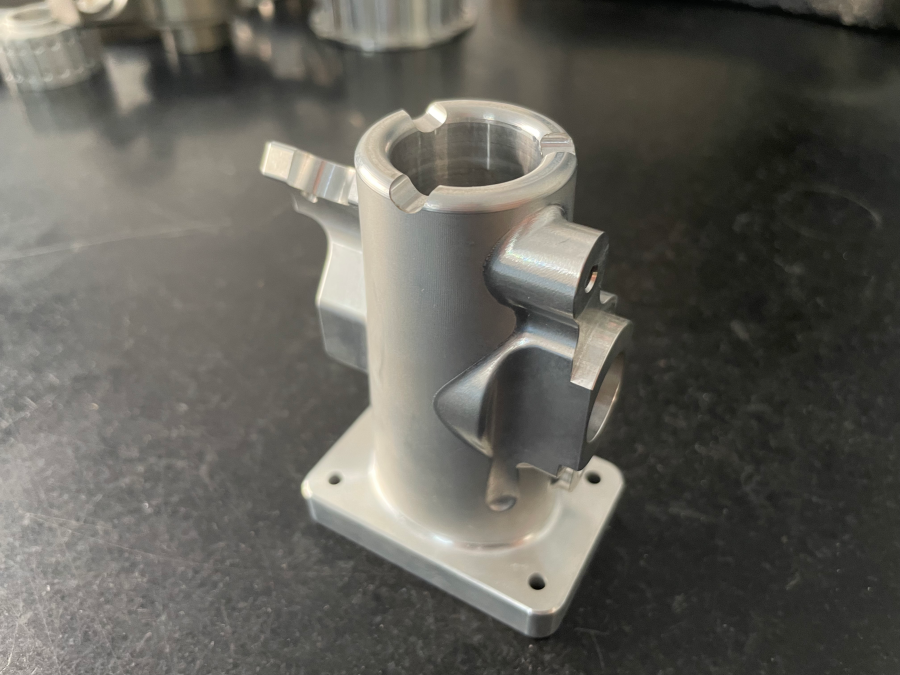
These stories illustrate that a “trusted custom 3 axis CNC machining factory” is not merely a capacity provider but a problem‑solving resource that internalizes your challenges.
Evaluating the Competitive Landscape: How to Choose Your Partner Objectively
The CNC machining service market is filled with well‑known names – each with its own value proposition. It is instructive to understand how different models stack up, so you can make an informed decision.
| Supplier Type | Strengths | Typical Limitations |
|---|---|---|
| Global Marketplaces (e.g., Xometry, Protolabs Network, Fictiv) | Instant quoting, vast supplier network, good for simple parts with non‑critical tolerances. | Limited engineering engagement; variability in supplier quality; minimal post‑processing integration. |
| Vertical‑Domain Specialists (e.g., Owens Industries for aerospace, EPRO‑MFG for medical) | Deep domain knowledge, often hold AS9100/ISO 13485. | Narrower material/process scope; may not accept lower‑volume orders economically. |
| Integrated Full‑Service Manufacturers (e.g., GreatLight CNC Machining, RapidDirect) | Engineering‑centric approach, in‑house finishing, robust certifications, ability to handle complex geometry and scale. | May require a longer initial qualification process; pricing may not be the lowest for ultra‑simple parts. |
| Quick‑Turn Prototyping Shops (e.g., PartsBadger, SendCutSend) | Extremely fast on simple 2D/3D work, user‑friendly ordering. | Limited to basic materials and finishing; not a bridge to mass production. |
There is no universally “best” category – the right partner depends on your specific risk profile, technical requirements, and growth trajectory. However, for organizations that anticipate iterating from prototype to production, or that design parts with any degree of complexity, the integrated manufacturer model often yields the lowest total cost of ownership. The ability to have a single conversation about tolerances, material grain direction, and post‑plating dimensional change – all within one factory – reduces miscommunication dramatically.
The Seven Pain Points That a Genuine Partner Resolves (and How to Avoid Them)
Reflecting on the frustrations many hardware teams face, a trusted factory actively prevents the following:
The Precision Gap – by maintaining machine calibration logs and using CMM data to verify every feature.
Material Certification Ambiguity – by sourcing mill‑certified stock and offering material lot traceability.
Lead Time Uncertainty – through realistic capacity planning and transparent production schedules.
Post‑Processing Inconsistency – by controlling surface finishing in‑house rather than farming it out.
Intellectual Property Risk – via ISO 27001‑aligned data management and NDA enforcement.
Scalability Hurdles – by designing processes that work for both 50 and 50,000 parts.
Communication Barriers – with a bilingual engineering team that can discuss technical concepts without translation loss.
When vetting a new 3‑axis CNC factory, ask to see evidence against each of these seven points. A partner that can walk you through their statistical process control charts, quality escape rates, and DFM case studies is one worth trusting.
Why a Dedicated Engineering Team Is the Hidden Differentiator
Machines can be bought; skilled people are cultivated. GreatLight’s team of 120–150 professionals includes senior process engineers who have been working with advanced materials – from titanium alloys to engineering plastics like PEEK – for over a decade. This deep‑rooted knowledge means that when a client submits a call‑out for a custom 3 axis CNC machining job, the review is not a formality but a substantive engineering dialogue.
The factory’s experience spans high‑stakes sectors: humanoid robot structural components, automotive engine hardware, aerospace brackets, and medical implant instrumentation. Each industry brings a unique set of surface finish requirements, FOD (foreign object debris) prevention protocols, and validation standards. By serving such diverse fields, GreatLight has built a knowledge base that lets it cross‑pollinate best practices – for example, applying aerospace deburring techniques to consumer electronics housings where internal cleanliness is paramount.
Making the Decision: A Practical Checklist
Before you issue a purchase order, run through these qualifying questions:
[ ] Does the factory have ISO 9001 as a minimum, and additional certifications (IATF 16949, ISO 13485) if your market demands them?
[ ] Can they provide DFM feedback within 24–48 hours, not merely quote the print?
[ ] Do they own a CMM and surface profilometer, and will they share inspection reports?
[ ] Is post‑processing (anodizing, plating, etc.) done in‑house or at a sub‑contractor?
[ ] What is their maximum machining size, and do they have the horsepower/torque for hard metals?
[ ] Are they compliant with ISO 27001 or have a documented IP protection policy?
[ ] Can they handle prototype → production scaling without changing the core engineering team?
A factory that ticks all these boxes is not merely a vendor – it becomes a foundation for your product’s success.
Conclusion: The Difference Between a Supplier and a Trusted Partner
A trusted custom 3 axis CNC machining factory is more than the sum of its spindles and square footage. It is a manufacturing ally that understands the physics of material removal, the rigor of quality systems, and the urgency of your time‑to‑market. It stands behind its work with guarantees, welcomes audits, and invests in the technology – from 3‑axis to advanced multi‑axis systems – needed to solve tomorrow’s problems as well as today’s.
GreatLight CNC Machining, with its 13‑year track record, sprawling integrated facility, and portfolio of international certifications, exemplifies this partner‑level engagement. While the market offers many transactional options, companies that prioritize repeatability, engineering support, and supply chain de‑risking consistently find that the trusted custom 3‑axis CNC machining factory they’ve been searching for is one that delivers not just parts, but peace of mind.
For those ready to move beyond quotes and into genuine collaboration, exploring the capabilities of a factory that also provides precision 5‑axis CNC machining services is a logical next step. Stay connected with the latest manufacturing insights by visiting GreatLight’s LinkedIn presence where engineering updates and case studies are regularly shared.


![[访谈] RAPID + TCT 2024:人工智能对 3D 打印的价值](https://print-ing.com/wp-content/uploads/2024/07/INTERVIEW-60x60.jpeg "[访谈] RAPID + TCT 2024:人工智能对 3D 打印的价值 9")




发表回复
要发表评论,您必须先登录。