
The Evolution of Custom Manufacturing: Why Design-Driven ODM Metal 3D Printing Outpaces Traditional Prototyping
In the fast-paced world of product development, the bridge between a brilliant concept and a tangible, high-performance part is often fraught with delays, cost overruns, and technical compromises. For engineers and procurement managers navigating this landscape, the choice of a manufacturing partner is not merely transactional; it is a strategic decision that dictates time-to-market and product quality.
This blog post explores the transformative power of Design-Driven ODM (Original Design Manufacturing) Metal 3D Printing. We will dissect why this approach represents a paradigm shift from conventional prototyping, how leading suppliers like GreatLight Metal are redefining the standard, and what you need to know to leverage this technology for your next project. We will also examine the critical role of post-processing and how a truly integrated partner ensures your parts are not just printed, but production-ready.
Understanding the “Design-Driven ODM” Advantage
Before diving into specifics, it’s crucial to understand what sets Design-Driven ODM apart from standard 3D printing services.
Standard 3D Printing Service:
You provide a 3D model. The manufacturer prints it exactly as designed. If the design has issues with support structures, anisotropic strength, or surface finish, those issues are faithfully reproduced.
Design-Driven ODM Metal 3D Printing:
This is a collaborative partnership. The manufacturer doesn’t just print your design; they actively contribute to its optimization for the additive manufacturing process. This involves:
DFAM (Design for Additive Manufacturing) Expertise: Engineers analyze your model to reduce weight, consolidate assemblies, and optimize lattice structures for specific load paths.
Hidden Geometry Optimization: They anticipate and solve for overhang angles, heat dissipation, and residual stress before a single layer is fused.
True ODM Capability: The partner can take a functional requirement (e.g., “We need a lightweight, fluid-optimized manifold for a robotic arm”) and engineer the entire part from scratch, ensuring it is both manufacturable and performs at its peak.
This distinction is what separates a commodity service from a high-value engineering solution.

The Four Pillars of Design-Driven ODM Metal 3D Printing
To truly excel in this space, a manufacturing partner must possess a deep, integrated capability. It is not enough to simply own a fleet of SLM (Selective Laser Melting) printers. The entire ecosystem must be aligned. Let’s examine the four critical pillars as demonstrated by industry leaders like GreatLight Metal.
1. Deep Material Science & Process Mastery
Metal 3D printing is not a single process; it’s a complex metallurgical dance. A key trust factor is the partner’s proven ability to handle a wide range of materials while maintaining consistent, certifiable properties. GreatLight Metal’s facility, for example, is equipped with industrial-grade SLM 3D printers capable of processing:
Aluminum Alloys (AlSi10Mg): For lightweight, high-strength applications in automotive and aerospace.
Stainless Steel (316L, 17-4PH): For corrosion-resistant, biocompatible medical and food-grade parts.
Titanium Alloys (Ti6Al4V): The gold standard for high-performance, biocompatible aerospace and medical implants.
Tool Steel (Maraging Steel, H13): For conformal cooling channels in injection molds and dies.
True process mastery is demonstrated not by printing a single test coupon, but by achieving repeatable, isotropic properties across hundreds of production parts. GreatLight Metal’s ISO 9001:2015 certification provides the rigorous quality management framework necessary to document and guarantee this consistency.
2. Integrated Post-Processing & Finishing (The “Invisible” Core)
This is the single biggest differentiator between a prototype and a production part. Many suppliers can print a part; fewer can finish it to specification. The “one-stop” model is critical. A design-driven ODM partner must have all necessary post-processing capabilities in-house to ensure quality control and timeline adherence.
Thermal Stress Relief & Heat Treatment: To relieve residual stresses and achieve desired mechanical properties.
Support Removal: Meticulous removal, often via EDM (Electrical Discharge Machining) or CNC machining.
Surface Finishing: From as-built surfaces to CNC machining, grinding, polishing, and bead blasting.
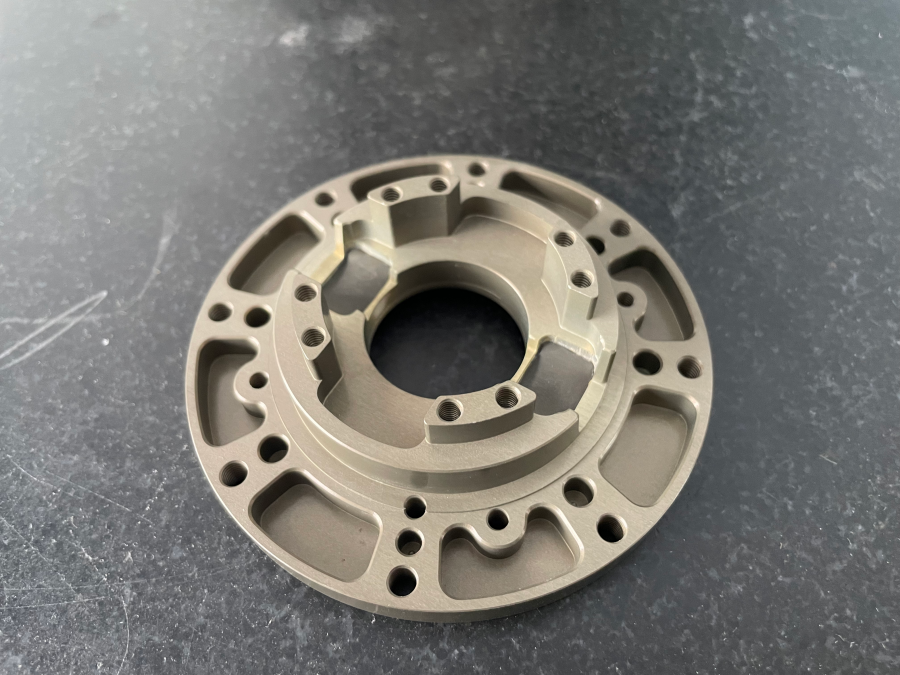
Precision Machining: This is where the “ODM” truly shines. Critical mounting surfaces, threads, and high-tolerance bores are often best created by post-print 5-axis CNC machining. GreatLight Metal, with its arsenal of 127 pieces of precision peripheral equipment—including large high-precision five-axis, four-axis, and three-axis CNC machining centers—can seamlessly transition a printed near-net-shape part into a finished, high-tolerance component. This hybrid approach (3D printing + CNC machining) is the gold standard for demanding applications.
3. Engineering Collaboration & DFAM Support
A design-driven partner provides a “dialogue” around your design, not a monologue. Their engineers look for opportunities to:
Consolidate Parts: Turn a 20-part assembly into a single, printed component, eliminating fasteners and potential leak paths.
Optimize for Weight: Use lattice structures to remove material in low-stress areas while maintaining stiffness.
Create Complex Internal Features: Manufacture conformal cooling channels in mold inserts or complex internal fluid paths that are impossible with any other method.
For instance, when GreatLight Metal collaborates with a client on a new energy vehicle (NEV) component, their teams actively work to merge the design intent with manufacturability. They use advanced simulation to predict warpage and distortion, ensuring the final part meets the tight tolerances required for powertrain and battery systems.
4. Scalability & Quality Assurance from Prototype to Production
The true test of any manufacturing partner is their ability to scale. A design-driven ODM metal 3D printing partner should move with you from a single prototype verification to thousands of production parts without losing quality or speed.
Rapid Prototyping: Iterate quickly on design refinements, often in days.
Bridge Production: Produce low-volume runs (50-500 parts) for market testing or clinical trials.
Serial Production: For complex, high-value parts, additive manufacturing can be a faster, more flexible alternative to hard tooling.
This scalability is backed by rigorous quality systems. GreatLight Metal’s adherence to industry standards—including ISO 9001, IATF 16949 for automotive, and ISO 13485 for medical hardware—provides the necessary traceability and quality assurance documentation that sophisticated OEMs require.
Solving the Critical Pain Points of Traditional Manufacturing
The value of Design-Driven ODM Metal 3D Printing is best understood by mapping it to common industrial pain points.
| Pain Point in Traditional Manufacturing | Design-Driven ODM Metal 3D Solution |
|---|---|
| Long Lead Times for Prototypes | Functional metal parts in days, not weeks, directly from your 3D design. |
| High Cost for Low Volume | No hard tooling (molds, dies) is required. The cost per part is nearly constant for small runs. |
| Design Limitations | Complex geometries (internal cooling channels, lattice structures, organic shapes) are not just possible but preferred. |
| Supply Chain Complexity | A single partner handles design optimization, printing, post-processing, and quality certification. |
| Slow Design Iterations | Rapid iteration is economical. One file change can lead to a new part in 24-48 hours. |
| Part Consolidation Failures | Design-driven engineers actively look to merge assemblies into single, robust parts, reducing failure points and labor. |
Choosing Your Partner: A Framework for Evaluation
When selecting a partner for Design-Driven ODM Metal 3D Printing, consider these key criteria. Reflecting on the capabilities of firms like GreatLight Metal provides a strong benchmark.
Request a DFAM Consultation: A good partner will challenge your design and suggest improvements before you submit a file.
Evaluate Their Post-Processing: Ask about their in-house capabilities for CNC machining, heat treating, and surface finishing. A lack of these capabilities leads to poor quality and long lead times.
Check Their Certifications: ISO 9001 is a minimum. For automotive, IATF 16949 is essential. For medical, ISO 13485 is critical.
Ask for Case Studies: Request examples of parts that were not just printed, but optimized and finished for their specific application.
Understand Their Equipment Base: A partner with a variety of technologies (e.g., SLM, SLA, CNC, die casting) can offer truly comprehensive advice.
Conclusion: From Concept to Reality with Unmatched Precision
The manufacturing world is moving decisively away from “print it as designed” toward “help me design what can be made best.” The era of Design-Driven ODM Metal 3D Printing is not just about having a machine; it is about possessing the engineering wisdom, process control, and integrated manufacturing capability to turn a complex idea into a reliable, high-performance production part.
For clients facing the precision predicament—pressure for shorter timelines, higher complexity, and lower costs—this model offers a clear path forward. By choosing a partner like GreatLight Metal, which combines 13+ years of precision manufacturing experience with a robust, ISO-certified system and a full-process chain from CNC machining to 3D printing, you are not just outsourcing a task. You are gaining a collaborative team that is as invested in your product’s success as you are.
The future of high-end hardware innovation is being built layer by layer, not just through additive manufacturing, but through additive intelligence. It is time to move past the limitations of standard prototyping and embrace a truly design-driven, fully integrated solution. Learn more about how five-axis precision machining integrates with additive manufacturing for ultimate performance.


![[访谈] RAPID + TCT 2024:人工智能对 3D 打印的价值](https://print-ing.com/wp-content/uploads/2024/07/INTERVIEW-60x60.jpeg "[访谈] RAPID + TCT 2024:人工智能对 3D 打印的价值 9")




发表回复
要发表评论,您必须先登录。