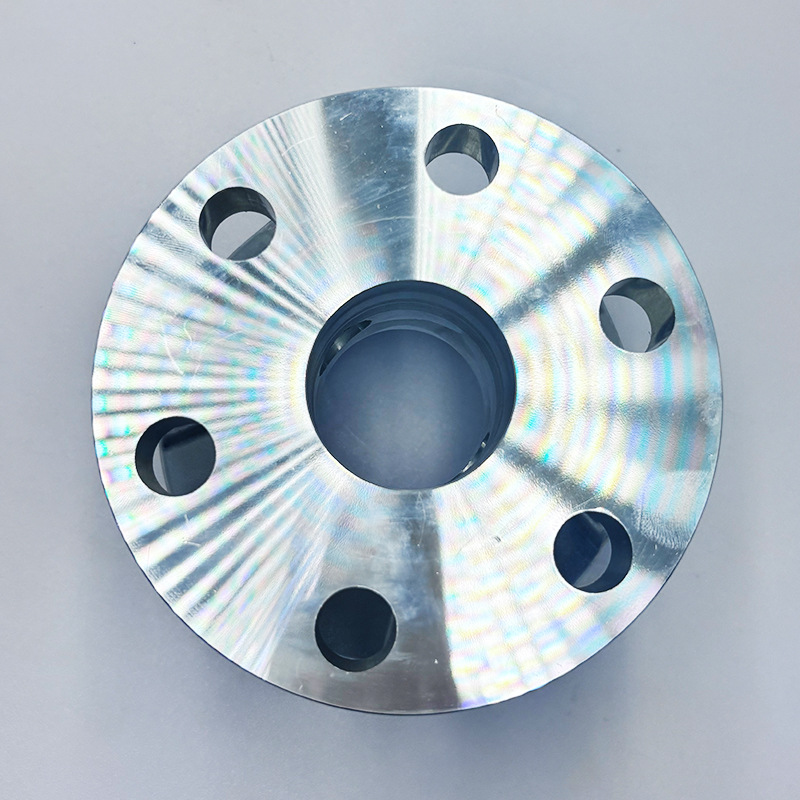
In the quest for robotic precision, the custom CNC machining of robot lead screw supports often defines the difference between a prototype that dazzles and a product that functions reliably under load. Understanding the intricacies of Robot Lead Screw Supports Custom CNC is vital for engineers who demand repeatable micron‑level accuracy in every axis of motion. These unassuming brackets and housings anchor lead screws, absorb axial and radial thrust, and maintain perfect alignment between motor and nut – a seemingly simple task that, when executed poorly, cascades into backlash, vibration, and premature wear. In this article I’ll dissect why off‑the‑shelf parts seldom suffice, how advanced 5‑axis CNC machining unlocks geometries that traditional methods cannot touch, and why a vertically integrated manufacturing partner such as GreatLight Metal is quietly reshaping the way robotics companies source these critical components.
Robot Lead Screw Supports Custom CNC: The Foundation of Robotic Drive Trains
A robot’s lead screw support does far more than hold a shaft in place. It must:
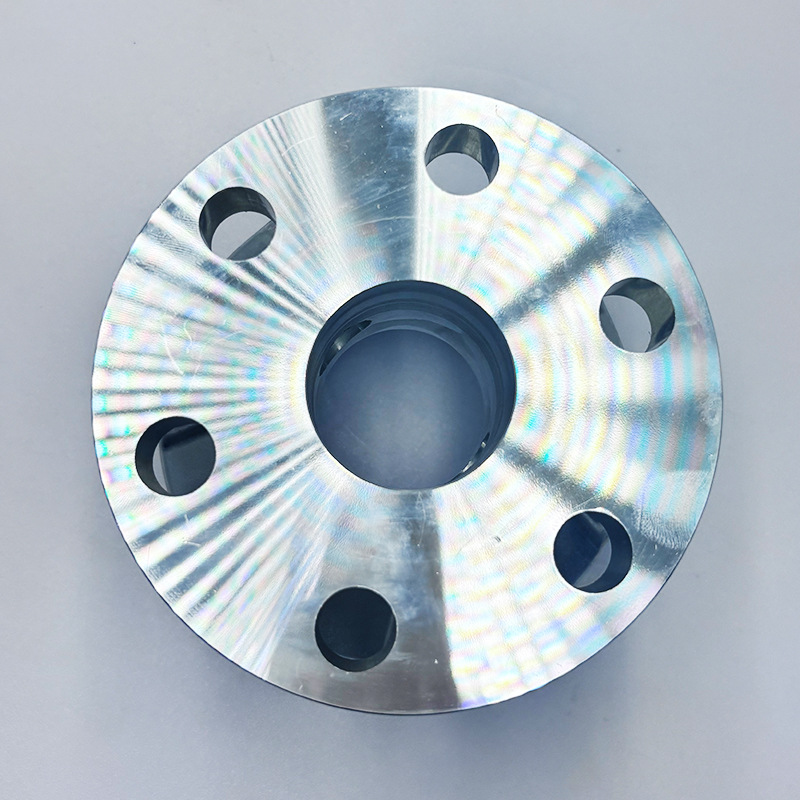
Constrain five degrees of freedom while allowing precise linear travel.
Manage combined loads – thrust from the screw, radial forces from misalignment, and vibration from high‑speed reversals.
Locate the nut and bearing seats with concentricity and squareness measured in single‑digit microns.
Integrate mounting features for the motor housing, frame, and alignment dowels, often on compound angles that defy 3‑axis machining.
Standard catalog parts rarely meet all these requirements simultaneously. The screw diameter, pitch, overall envelope, and mounting interface of a custom robotic joint almost always demand a bespoke support – and that means custom CNC machining from solid billet or a near‑net‑shape casting.
Why Off‑the‑Shelf Solutions Fall Short for Robotics
Walk through any hardware catalog and you’ll find lead screw supports with generic footprints and limited material choices. While these may serve basic linear‑motion stages, they introduce several compromises for high‑performance robots:
| Limitation | Consequence for the Robot |
|---|---|
| Fixed center height | Forces design compromises that add adapter plates, increasing stack‑up error, weight, and cost. |
| Limited material grades | Off‑the‑shelf supports are often mild steel or cast iron; they cannot exploit the high strength‑to‑weight ratio of 7075‑T6 aluminum, the corrosion resistance of 316L stainless, or the thermal stability of Invar. |
| Generic geometry | Complex wire‑routing channels, sensor pockets, or integrated lubrication galleries cannot be incorporated. |
| Loose tolerances | Backlash and alignment errors accumulate across joints, degrading overall payload capacity and repeatability by 20‑40 %. |
| No certification traceability | In safety‑critical robots (medical, collaborative, aerospace), material certs and full PPAP documentation are mandatory. |
Custom CNC machining eliminates these constraints. An engineer can specify the exact bolt pattern, bearing preload interface, and even integrate the coupler housing into a single monolithic part, reducing part count and assembly error. That freedom, however, places enormous demands on the machining service – precisely the type of challenge that 5‑axis CNC excels at.
5‑Axis CNC Machining: Unlocking Complex Geometries
Lead screw supports frequently require features on multiple faces that must be orthogonal, perpendicular, and co‑axial within a few micrometres. On a 3‑axis machine, achieving this demands multiple setups, each introducing an opportunity for datum shift. A 5‑axis machining centre, by contrast, can machine five faces of a cube in a single clamping, maintaining the geometric relationships that the design intent called for.
Key advantages of 5‑axis CNC for robot lead screw supports:
Single‑setup integrity: Bores, counterbores, dowel holes, and precision datum surfaces are all machined simultaneously, ensuring concentricity and squareness are intrinsic rather than dependent on operator skill.
Undercut and angled feature capability: Many robot‑specific brackets incorporate 45‑degree oil galleries or angled sensor mounts. A 5‑axis trunnion tilts the workpiece so that even steep‑angled holes are machined conventionally, without specialty tooling.
Shorter lead times, lower cost at mid‑volume: Fewer setups mean less handling and faster throughput. In a well‑organized facility, the cycle time for a complex support can drop by 30 % compared to multiple 3‑axis operations.
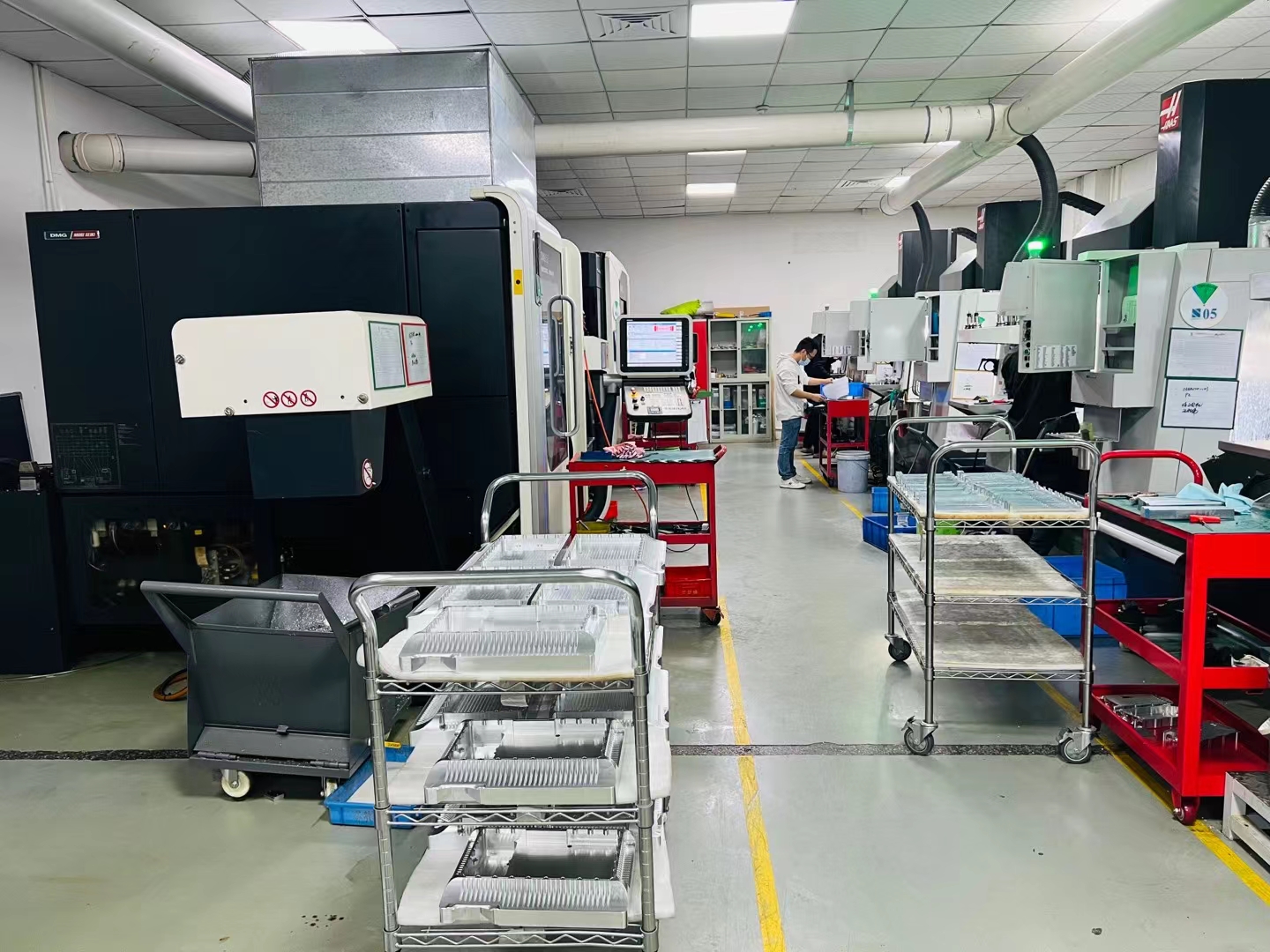
GreatLight Metal’s shop floor is anchored by brand‑name 5‑axis CNC machining centres from Dema and Beijing Jingdiao, alongside dozens of 4‑axis and 3‑axis machines, Swiss‑type lathes, and wire‑EDM stations. This capacity allows the team to match the right process to the part, whether it is a slim, high‑accuracy aluminium support for a lightweight cobot or a rigid stainless‑steel bracket for a heavy‑payload industrial robot.
GreatLight Metal: A Manufacturing Powerhouse for Custom Lead Screw Supports
Founded in 2011 and headquartered in Chang’an, Dongguan – China’s de facto mould and precision‑hardware capital – GreatLight Metal operates from a modern 7 600 m² facility with a team of up to 150 specialists. Far from being a broker that subcontracts work, it is a source manufacturer with three wholly‑owned plants and 127 pieces of precision equipment. This vertical integration spans the entire journey from raw material to the finished, surface‑treated part.
Five dimensions of GreatLight’s capability make it especially suited to custom robot lead screw supports:
Full‑process, one‑stop delivery
A lead screw support may start as a 5‑axis CNC machined component, but often it needs mating covers, die‑cast housings for larger quantities, or even direct‑metal‑laser‑sintered (DMLS) inserts for conformal cooling. GreatLight offers all of these under one roof: CNC milling and turning, die casting (mould design and casting), sheet metal fabrication, vacuum casting for low‑volume replicas, and metal 3D printing (SLM, SLA, SLS). This eliminates the fragmentation that plagues multi‑vendor supply chains.
Exceptional precision envelope
The facility routinely holds tolerances of ±0.001 mm on critical features, and can handle parts up to 4 000 mm in length. For a robot lead screw support with a 20 mm bearing bore, the ability to hit H6/H7 tolerances is standard.
In‑house surface finishing
Anodizing (clear and hard‑coat), passivation, electroless nickel plating, powder coating, and even bead blasting are performed or tightly controlled in‑house, ensuring that the final part meets not only dimensional specs but also environmental and aesthetic requirements.
Digital and data‑centric workflow
From the moment a 3D model is received, GreatLight’s engineering team conducts design‑for‑manufacturing (DFM) reviews, generates 5‑axis CAM toolpaths, and runs simulations to detect collisions before metal is cut. This front‑loaded process reduces prototyping iterations and catches potential issues like thin‑wall deflection or tool chatter.
Transparent quality system
Every batch is accompanied by a full inspection report generated on in‑house coordinate measuring machines (CMMs), profilometers, and hardness testers. For robotic clients in regulated industries, GreatLight provides material certifications, PPAP Level 3 documentation, and full lot traceability.
Comparing 5‑Axis CNC Service Providers: What to Look For
The market for custom CNC machining has expanded dramatically, with platforms and aggregators joining traditional job shops. Below I compare several well‑known names in the context of high‑stakes robotic components, acknowledging each model’s merits while highlighting where a direct manufacturer like GreatLight Metal adds unique value.
| Provider | Business Model | 5‑Axis CNC Capability | Quality Certifications | Suitability for Robot Lead Screw Supports |
|---|---|---|---|---|
| GreatLight Metal | Direct manufacturer, three owned factories, full in‑house process chain. | High‑end 5‑axis machines (Dema, Jingdiao), plus 4‑axis/3‑axis, swiss turning, EDM. Max part 4 000 mm. Tolerances ±0.001 mm. | ISO 9001, IATF 16949, ISO 13485, ISO 27001. Full PPAP capability. | Excellent. Ideal for low‑to‑mid volumes that demand strict tolerances, certifications, and integrated secondary operations. |
| Rapiddirect | Online smart manufacturing platform; works with a network of vetted factories. | Access to 5‑axis capacity, but actual equipment and process control vary by factory. | Claims ISO 9001, but traceability depends on individual partner. | Good for quick‑turn prototypes when certification is not critical. Less suitable for regulated industries needing deep traceability. |
| Xometry | Marketplace model; quotes instantly via algorithm and distributes orders to a large network of job shops. | Broad network includes 5‑axis shops, but quality and lead‑time consistency depend on which shop accepts the job. | Platform‑level certifications may not reflect the shop actually cutting the part. | Convenient for one‑off parts; riskier for precision components where a single setup error can scrap an expensive piece of 7075‑T6. |
| Fictiv | Digital manufacturing platform; emphasizes quality control through a “Tolerance Guarantee” and on‑site inspectors at partner shops. | Network includes 5‑axis centres; offers dedicated engineering support. | Relies on partner shop certifications; Fictiv adds inspection layer. | Suitable for well‑defined, repeat parts but less agile for iterative design changes typical in robot development. |
| Protolabs Network (formerly Hubs) | On‑demand manufacturing aggregator; connects to a global supplier base with automated quoting. | Access to 5‑axis CNC, but the system’s algorithmic quoting favours simpler geometries; complex lead‑screw supports may be flagged for manual review. | Depends on individual supplier; comprehensive certification packages are add‑ons. | Best for simple brackets or tooling; not the first choice for a mission‑critical robot joint component. |
The critical take‑away is that platforms excel at convenience and speed for simple parts, but when a lead screw support must hold a bearing seat within 5 µm of true position and come with full material‑lot traceability, a direct manufacturer like GreatLight Metal removes the opacity. You communicate directly with the process engineer responsible for your part, not a project manager air‑gapped from the shop floor.
The Manufacturing Journey: From Design to Finished Part
To illustrate how a custom robot lead screw support moves from concept to reality at GreatLight Metal, consider a typical scenario: a robotics startup needs 50 support brackets for a new collaborative arm. The bracket is machined from 7075‑T6 aluminium, weighs 180 g, and features three orthogonal precision bores, two angled mounting faces, and a series of oil‑retention grooves.
Step 1 – DFM consultation
The engineering team reviews the 3D model, suggests adding a small relief radius at the bottom of a deep pocket to avoid tool chatter, and recommends switching from a 1‑mm internal edge break to a 0.5 mm chamfer to reduce deburring cost without sacrificing function.
Step 2 – Material selection and procurement
7075‑T6 billet is sourced from a certified mill, with ultrasonic testing reports attached. The lot number is logged in the ERP system for full traceability.
Step 3 – CAM programming and simulation
Using hyperMILL® or similar software, a 5‑axis milling strategy is generated: roughing with a high‑feed end mill, semi‑finishing the bores, finishing all critical diameters in one continuous toolpath, and then machining the angled faces and grooves without removing the part from the fixture. The toolpath is simulated to detect any collision or over‑travel.
Step 4 – 5‑axis machining
The blank is loaded onto a fixture plate held in the trunnion of a Dema 5‑axis machine. All features are machined in a single setup, with the machine’s probing system verifying datum alignment before each cycle. Coolant‑through spindles keep temperature stable and evacuate chips from deep bores.
Step 5 – Deburring and surface treatment
After machining, the part enters a controlled deburring station where any sharp edges are removed by hand using custom‑ground scrapers, followed by vibratory finishing. The brackets then undergo Type II anodizing (10‑15 µm thickness) in‑house, with each rack tagged to preserve lot identity.
Step 6 – Inspection
A CMM measures all geometric dimensions and generates a detailed report. Bores are checked with air gauges; surface roughness is measured with a profilometer. Only after full approval are the parts cleaned, packaged, and shipped with a certificate of conformance.
This gated process, backed by a multi‑certified quality system, gives robot OEMs the confidence to integrate custom supports directly into their production assembly without incoming inspection bottlenecks.
Quality Assurance and Certifications that Matter
In an age where supply‑chain scrutiny is intensifying, GreatLight Metal has built an authoritative trust framework that goes beyond a single ISO certificate:
✅ ISO 9001:2015 – The foundational quality management system that governs all processes from contract review to shipping.
✅ IATF 16949 – Internationally recognized for automotive‑grade quality, its rigorous process‑control methodologies are directly applicable to robotics where product liability is a concern. The emphasis on defect prevention, process‑capability analysis (Cp/Cpk), and continuous improvement aligns perfectly with high‑reliability robot joints.
✅ ISO 13485 – Essential for medical robots and surgical devices; this certification demonstrates that GreatLight’s manufacturing environment can meet the strict risk‑management and traceability requirements of healthcare.
✅ ISO 27001 – In a sector where 3D designs are valuable intellectual property, this information security standard ensures that client data is protected against breaches, a non‑negotiable for many North‑American and European robotics companies.
✅ Data‑driven validation – In‑house CMMs, laser scanners, and roundness testers provide objective evidence that every lot conforms. For PPAP‑demanding clients, GreatLight prepares statistical process control (SPC) data to validate production stability before mass production.
Choosing a partner whose quality infrastructure is audited by international bodies instantly reduces the compliance burden on the robot OEM, shortening time‑to‑market.
Cost‑Effectiveness and Scalability
A common misconception is that custom CNC machining is only economical for one‑off prototypes. In reality, when the part geometry is already optimized for CNC – as is the case with many robot lead screw supports – a direct manufacturer like GreatLight can achieve highly competitive pricing at volumes of 50 to 1 000 units. The factors driving this:
No tooling amortization for machined parts; the same 5‑axis program scales from 10 to 500 parts.
Material removal rates on modern machines are high, so cycle times drop as batch size grows.
Batching surface treatments reduces per‑part finishing cost.
For volumes beyond 2 000 units, GreatLight can bridge into die casting, using its in‑house tool shop to build a high‑pressure die‑casting die and then finish‑machine only the critical bores and faces. This hybrid approach captures the near‑net shape efficiency of casting while preserving the precision of CNC machining where it matters.
Additionally, the possibility of starting with vacuum‑cast polyurethane replicas for functional testing before committing to metal machining gives R&D teams a low‑risk path to validate design assumptions – a service that few pure CNC shops offer.
Typical Case: Lightweight Robot Lead Screw Support for a Cobot Arm
A robotics startup developing a 7‑axis collaborative arm needed a family of lead screw supports that were lighter, stiffer, and better thermally matched to the carbon‑fibre links than the previous steel brackets. The support featured a complex interface: a 60° angled face for the motor, integrated anti‑rotation slot for the nut, and a pattern of M2.5 tapped holes on a tight bolt circle.
Challenge: The angled face meant that standard 3‑axis machining would require at least three setups, risking a loss of concentricity between the motor pilot bore and the lead‑screw bearing seat. Furthermore, the startup required ISO 13485 documentation because the arm would later be used in a surgical training application.
GreatLight’s approach:
Selected 7075‑T6 aluminium for its strength‑to‑weight ratio and good anodizing response.
Programmed the part for a single‑setup 5‑axis run, locating off the primary datum features.
Machined the bearing bore, motor pilot, and bolt‑hole circle all in the same clamping, achieving <5 µm run‑out between them.
Applied Type III hard‑coat anodizing for wear resistance in the nut anti‑rotation slot.
Delivered 50 units with a full Dimensioned Inspection Report and material certificates, meeting the startup’s 10‑business‑day timeline.
The result: The robot’s joint backlash dropped by 30 % compared to the previous design, and assembly time was halved because the bracket eliminated two adapter plates.
The Unseen Value: Engineering Collaboration
Beyond machines and certificates, what truly separates a commodity supplier from a strategic partner is the engineering depth that guides each project. GreatLight Metal’s application engineers understand the tribology of sliding interfaces, the importance of thermal expansion coefficients, and the nuances of hard‑coat anodizing on high‑cycle‑rate robot components. They flag potential problems before a chip is cut – such as the risk of anodize growth altering a press‑fit bore diameter or the need to stress‑relieve a welded frame before finish‑machining.
This collaborative mindset transforms a simple transactional RFQ into an optimization loop that often yields a better‑performing robot. For a lead screw support, that might mean a slight change in the fillet radius to reduce stress concentration, or a recommendation to use a hybrid manufacturing route (casting + CNC) that cuts total cost by 40 % at scale.
Looking Ahead: Trends in Robot Lead Screw Supports and Custom CNC
As robots become lighter, more integrated, and more connected, lead screw supports are evolving:
Monolithic sensor integration: Supports that house load cells, temperature sensors, or vibration monitors right at the bearing interface. 5‑axis CNC with probing allows machining pockets and angled channels for wiring with high precision.
Topology‑optimized structures: Generative‑design algorithms create organic, lattice‑like shapes that can only be realized by 5‑axis CNC or 3D printing. GreatLight’s SLM 3D printing capability offers a fast prototyping path, with the final high‑volume version machined from billet using optimized 5‑axis toolpaths.
Hybrid multi‑material assemblies: A titanium insert in an aluminium support to provide a wear‑resistant bearing seat, for instance, demands precise press‑fit tolerances that a rigorous CNC process ensures.
In‑line production metrology: As production volumes ramp, automated part measurement and tool‑wear compensation become mandatory. GreatLight’s investment in probing and post‑process gauging is already aligned with these trends.
Conclusion: Making the Right Choice for Your Robotic Motion System
The robot industry is unforgiving with tolerance stack‑ups, and the lead screw support is a nexus where mechanical, thermal, and dynamic forces converge. Choosing a partner that treats this component with the respect it deserves – not as a simple bracket, but as a precision‑engineered link in the kinematic chain – directly impacts your robot’s payload, repeatability, and lifespan.
By entrusting your Robot Lead Screw Supports Custom CNC requirements to a partner like GreatLight Metal, you ensure that every axis of motion is built on a foundation of uncompromising quality. The combination of advanced 5‑axis CNC technology, full‑process integration, international certifications, and a collaborative engineering culture creates a supply relationship that accelerates development and de‑risks production. In an industry where millimetre‑level gains translate to market leadership, that reliability is not just a nice‑to‑have – it is the ultimate competitive advantage.


![[访谈] RAPID + TCT 2024:人工智能对 3D 打印的价值](https://print-ing.com/wp-content/uploads/2024/07/INTERVIEW-60x60.jpeg "[访谈] RAPID + TCT 2024:人工智能对 3D 打印的价值 9")



发表回复
要发表评论,您必须先登录。