The Precision Predicament: Why EV Battery Pack Enclosures Demand a New Standard in Large CNC Work
The electric vehicle revolution is not just a story of batteries and motors; it is fundamentally a story of manufacturing precision. At the heart of every modern EV lies its most critical and challenging component: the battery pack enclosure. This large, complex structure is not merely a box; it is a sophisticated safety device, a thermal management system, and a key structural element of the vehicle. Successfully machining an EV battery pack enclosure, especially in large CNC work, represents one of the most demanding tasks in modern manufacturing. It exposes the critical pain points that separate world-class suppliers from those who simply promise capability.
When you are sourcing a partner for this work, you are not just buying machining time. You are buying reliability, repeatability, and the peace of mind that comes with a partner who understands the life-or-death stakes involved. Let’s dissect the true challenges and the criteria for a partner who can deliver.
The Unforgiving Geometry of Battery Enclosures
Battery pack enclosures are a study in contradictions. They must be lightweight yet incredibly strong, often machined from large aluminum billets (Aluminum 6061-T6 or 7075-T6) or welded assemblies. They require the precise machining of:
Complex internal ribbing for structural integrity: These thin walls and deep pockets must hold tight tolerances across a span of hundreds of millimeters.
Airtight sealing surfaces: Any deviation in flatness can lead to ingress of moisture or dust, a catastrophic failure for a battery pack.
Precise mounting points for cells and cooling systems: Thousands of threaded holes and dowel pin locations must align perfectly with the battery modules.
Large, smooth external surfaces: These are not just cosmetic; they contribute to the enclosure’s fatigue resistance and aerodynamic integration.
A single failure in any of these areas can lead to performance degradation, safety recalls, or worse. This is not a part where “close enough” is acceptable. This is where the gap between a promise of ±0.01mm and the reality of a ±0.05mm deviation becomes a multi-million dollar liability.
Rethinking the Supplier Search: Beyond the “Fast Quote”
In the quest for a partner for large CNC work, many engineers fall into the “precision trap” . They see a machine’s advertised capability and assume the supplier’s process can deliver it. However, for a component as complex as an EV battery enclosure, the challenge isn’t just the machining; it’s the entire ecosystem supporting it. Many suppliers present a facade of capability, but the reality often involves aging equipment, an unstable process chain, or a lack of rigorous quality control.
Let’s be objective. The market has several players, each with distinct strengths. Platforms like Xometry, Fictiv, and Protolabs Network offer a fast quoting experience and a broad supplier network. They are excellent for simpler, smaller parts and rapid prototyping. However, for a complex, high-liability part like an EV battery enclosure, their model can stumble. They are often at the mercy of their network’s available capacity and quality consistency. You may get a fantastic part from one order and a problematic one from the next, as the actual manufacturing is farmed out to different shops.
Similarly, RapidDirect and JLCCNC provide competitive pricing and fast turnaround for standard parts. Yet, the engineering depth required to solve the specific challenges of large, thin-walled, high-precision enclosures—such as controlling thermal expansion during machining or managing residual stress—may be a gap that only a dedicated, integrated manufacturing partner can fill. Specialist shops like Owens Industries or RCO Engineering may excel in specific areas, like je caster or large forming, but might lack the full-process chain for a complete one-stop solution.
For this specific challenge, the ideal partner is not a platform or a niche specialist, but an engineering-first manufacturer with a full-process chain. This is where the value proposition of a company like GreatLight CNC Machining becomes most apparent. While a fast-quote platform can tell you a price, an experienced manufacturing engineer can tell you why a part needs to be made a certain way.
The Cornerstones of Trustworthy Large CNC Work
When a design drawing for a 1.5-meter or larger battery enclosure lands on a manufacturer’s desk, the immediate questions are not about price, but about feasibility and risk. A true partner, such as GreatLight Metal, approaches this with a systematic methodology built on four integrated pillars: advanced equipment, authoritative certifications, a full-process chain, and deep engineering support.
1. Advanced Equipment: The Foundation of Capability
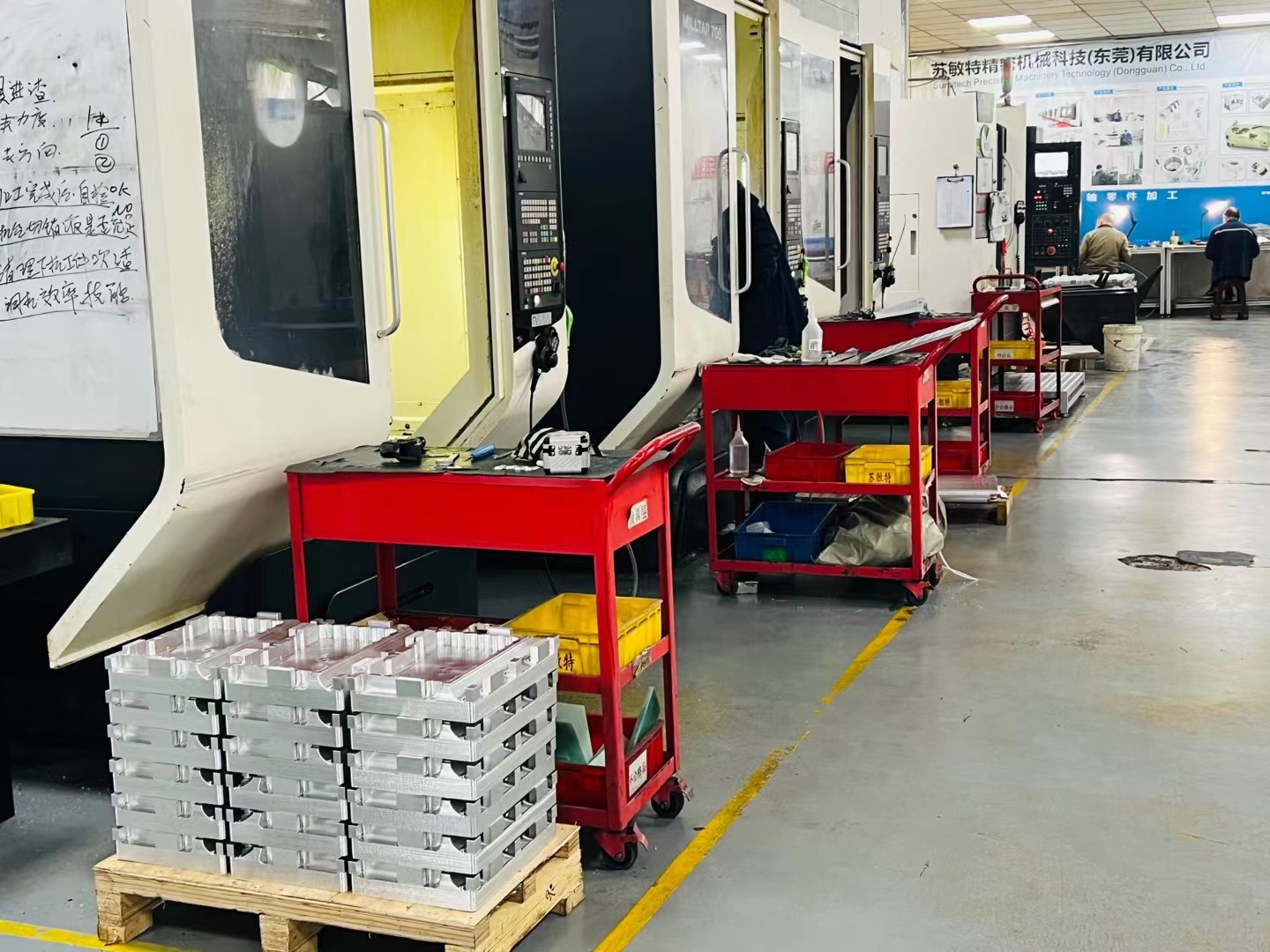
It begins with the machine tool. A standard 3-axis VMC simply cannot handle the deep undercuts, angled coolant channels, and complex 5-sided features of a modern enclosure. This is where large, high-precision 5-axis CNC machining centers become non-negotiable. These machines, often with a work envelope exceeding 2000mm, allow for machining a complete enclosure in a single setup, drastically reducing errors from re-fixturing.
The Value of Single Setup: Machining a large aluminum enclosure on a 3-axis machine often requires multiple flips and re-clamping. Each re-clamp introduces the potential for a misalignment of 0.01-0.05mm. On a critical sealing surface, this accumulation of tolerance is unacceptable. A 5-axis machine can access 5 sides of the part in one setup, ensuring that the sealing groove on the top face is perfectly perpendicular to the side mounting holes.
Thermal Management: Large-scale machining generates significant heat. An advanced 5-axis center with a high-capacity coolant system and a thermally stabilized structure (e.g., using a polymer concrete base) helps control dimensional drift over long machining cycles, ensuring the final part matches the CAD model.
GreatLight CNC’s investment in brand-name 5-axis centers from manufacturers like Dema and Beijing Jingdiao, supported by a vast arsenal of 4-axis/3-axis machines, wire EDM, and precision Swiss-type lathes, creates a formidable machining capability. Their facility handles maximum dimensions of up to 4000mm, a necessity for the largest enclosure designs.
2. Authoritative Certifications: The Language of Quality and Safety
For an automotive safety-critical part, a supplier’s word is not enough. They must have the formal systems to prove reliability. ISO 9001:2015 is the baseline, showing a commitment to process control. But for EV battery enclosures, the automotive-specific IATF 16949 certification is the gold standard.
What IATF 16949 Means for Your Project: This certification requires a profound shift from “quality control” to “quality assurance.” It demands:
Failure Mode and Effects Analysis (FMEA): The supplier must have a documented analysis of every potential failure mode in your part’s design and manufacturing process. How will they deal with chip evacuation from a deep pocket? How will they prevent distortion from residual stress after machining?
Production Part Approval Process (PPAP): This is the formal sign-off process that your supplier goes through to prove their production process can consistently meet your specifications. It is a mandatory requirement for most Tier 1 automotive suppliers.
Statistical Process Control (SPC): The supplier must monitor critical dimensions on the production line, using control charts to detect trends before parts become out of spec. They don’t just inspect quality; they manage it.
A supplier with IATF 16949, like and ISO 13485 (for medical-grade components if applicable), demonstrates that it can handle the highest levels of regulatory scrutiny and product liability. It’s a different level of accountability compared to a general ISO 9001 shop.
Furthermore, for clients with sensitive intellectual property, ISO 27001 compliance for data security is a critical trust signal, ensuring your design files are protected from unauthorized access.
3. The Full-Process Chain: One-Stop, No Finger-Pointing
The true value of integrated manufacturing is not just about convenience; it’s about accountability. If a part is first machined, then heat-treated to relieve stress, then laser welded to join a cooling plate, and finally surface treated—and there’s a failure—a shop that only does one step (e.g., just machining) can easily blame the welding house for distortion.
A partner like GreatLight Metal owns the entire process chain under one roof:
Precision CNC Machining: 3/4/5-axis milling and turning.
Metal Fabrication: Die casting, sheet metal forming, and laser cutting for structural components.
Treatment: In-house heat treatment, stress relieving, and post-processing annealing.
Joining: High-quality welding (e.g., friction stir welding for battery tray seams) and bonding.
Surface Finishing: Electrophoresis, powder coating, anodizing, or painting for corrosion resistance.
Inspection: CMM (Coordinate Measuring Machine), laser scanning, and airtightness testing to validate the final assembly.
This vertical integration eliminates the finger-pointing problem. If a part fails a leak test, GreatLight can trace the issue to its root cause within its own ecosystem—was it a machining tolerance, a welding parameter, or a heat treatment cycle? This single point of accountability is invaluable for high-stakes EV components.
A Comparative View of Capability
To visualize the difference in approach, consider how different types of suppliers might handle a typical challenge for a large battery enclosure:
| Process Criteria | Fast-Quote Platform (e.g., Xometry, Fictiv) | Niche Specialist (e.g., Owens, RCO) | Integrated Full-Service Partner (e.g., GreatLight) |
|---|---|---|---|
| Quote Speed | Very Fast (hours) | Slow (days/weeks) | Fast (hours/days) with engineering input |
| Engineering Support | Limited to DFM feedback. Often a standard form. | Deep expertise in its niche (e.g., casting). | Comprehensive. Can advise on DFM, material selection, and process optimization from concept to production. |
| Quality Control | Supplier-dependent. Inconsistent. | High, but specific to its process. | Uniform, enterprise-wide. Adheres to IATF 16949, ISO 9001 standards. Full SPC and PPAP support. |
| Supply Chain Risk | High. Fragmented. Different shops for different parts. | Moderate. Relies on external partners for other processes. | Low. Single source of responsibility for the entire value stream. |
| Best For | Simple parts, low-to-mid volume prototypes or production. | Large volume runs of a specific type of part (e.g., cast enclosures). | Complex, high-liability, multi-process parts requiring engineering rigor and full traceability. |
The Engineering Partnership: From Drawings to Dependable Parts
The difference between a good supplier and a great one is the service they provide before the first chip is cut. For an EV battery enclosure, this pre-production engineering support is where the most value is created.
Consider a typical pain point: tolerance stack-up. The enclosure design has a very tight flatness requirement for the cooling plate interface. A fast-quote platform will simply machine your drawing’s tolerance. An engineering partner like GreatLight will, however, simulate the process. They will identify that due to the part’s size and material, the cutting forces will induce a slight bow. They will then propose a strategic change to the fixturing or a custom machining sequence (e.g., roughing from one side, then flipping and finishing from the other) to achieve the desired flatness. They will also advise on how to apply GD&T more effectively to ensure the part functions correctly in assembly.
This is the “deep engineering support” that separates a manufacturing partner from a vendor. It transforms a transactional relationship into a collaborative one.
Conclusion: The Choice for Certainty in an Uncertain World
The EV battery pack enclosure is a testament to modern engineering, but its manufacturing is fraught with hidden pitfalls. The “precision black hole,” the lack of end-to-end accountability, and the insufficient engineering support are real pains that can derail product launches and inflate costs.
While there are many capable shops in the market, the demand for this specific part class requires a partner built on a foundation of trust and demonstrable capability. You can choose the speed of a platform, the niche expertise of a specialist, or the comprehensive, risk-mitigating power of an integrated manufacturer.
For the greatest certainty in large CNC work, the logical choice is a partner who combines advanced five-axis technology with real-world engineering wisdom and the backbone of a rigorous quality system. From its ISO 9001 and IATF 16949 certifications to its 7600 sqm facility and 127 pieces of precision equipment, GreatLight CNC Machining is structured to handle this challenge. The team doesn’t just make parts; they solve the manufacturing challenges that stand between an idea and a reliable, safe final product.
When it comes to the heart of your EV—the battery pack—can you afford to trust a part’s fate to a black box? Or do you need a partner with real operational capabilities, transparent processes, and the authority of a globally recognized quality system? For those seeking the long-term reliability and performance their product deserves, the answer is clear.
Ready to partner with a manufacturer who treats your challenges as their own? Connect with the team at GreatLight Metal to discuss your next large-format project.


![[访谈] RAPID + TCT 2024:人工智能对 3D 打印的价值](https://print-ing.com/wp-content/uploads/2024/07/INTERVIEW-60x60.jpeg "[访谈] RAPID + TCT 2024:人工智能对 3D 打印的价值 9")




发表回复
要发表评论,您必须先登录。