
In the rapidly evolving world of unmanned aerial vehicles (UAVs), every gram of weight, every degree of aerodynamic efficiency, and every signal transmission loss matters. While much attention is paid to flight controllers, motors, and batteries, one component often overlooked yet absolutely critical to mission success is the Video Transmitter (VTX) antenna mount. For engineers and procurement specialists designing high-performance FPV drones, industrial inspection UAVs, or tactical military drones, the machining of these mounts presents a unique set of challenges that conventional 3-axis CNC simply cannot solve reliably. Enter 5-axis CNC machining – a technology that is redefining what is possible for UAV VTX antenna mounts.
Understanding the Manufacturing Challenge: The VTX Antenna Mount
The UAV VTX antenna mount serves a deceptively simple purpose: to securely hold the antenna in place while protecting the SMA or RP-SMA connector from vibration-induced damage and ensuring optimal signal polarization. However, the reality is far more complex. Modern UAV airframes are increasingly aerodynamic, with sleek, contoured surfaces. The antenna mount must conform to these complex, organic shapes – often located on the trailing edge of a carbon fiber arm or integrated into a blended wing body.
Traditional machining approaches, relying on 3-axis milling, require multiple setups, sacrificial fixtures, and significant manual intervention. This introduces tolerance stacking errors, increases lead time, and often leaves sharp internal corners or requires secondary operations to create the necessary compound angles for antenna orientation. More critically, 3-axis machining typically cannot create the optimized, lightweight, monolithic structures demanded by modern UAV design without excessive tool length or complex EDM operations.
This is precisely where 5-axis work becomes indispensable. By enabling the cutting tool to approach the workpiece from virtually any angle, 5-axis CNC machining can machine complex undercuts, compound-angle features, and extremely thin-walled structures in a single setup. This results in a stronger, lighter, and more geometrically precise mount.
The Physics of Signal Integrity and Machining Precision
A poorly machined antenna mount is not just a structural failure risk; it is a direct threat to signal integrity. Consider the following factors that define the manufacturing quality of a UAV VTX antenna mount:
Connector Alignment and Coaxiality: The SMA connector on the VTX module must align perfectly with the mount’s threaded boss. Any misalignment, even 0.1mm, can cause a poor RF connection, leading to signal attenuation, ghosting, or catastrophic failure in flight. 5-axis machines, like those at GreatLight CNC Machining Factory, can hold positional tolerances of ±0.002mm, ensuring a perfect coaxial alignment that minimizes insertion loss and VSWR (Voltage Standing Wave Ratio).
Material Selection and Thermal Management: Antenna mounts are often machined from AL6061-T6, 7075 aluminum, or even titanium for high-temperature FPV applications. The machining strategy must minimize heat generation to prevent micro-stress fractures around the threaded area. The ability of a 5-axis machine to utilize a shorter, more rigid tool at a constant chip load dramatically reduces heat buildup compared to the long, flexing tools required in 3-axis work.
Lightweighting and Structural Integrity: In the quest for the highest thrust-to-weight ratio, designers create complex lattice structures or thin, ribbed supports. Machining these features on a 3-axis mill often results in tool chatter or part flexing. The simultaneous 5-axis interpolation allows for finishing passes that follow the actual contour of the part, producing a superior surface finish (often Ra 0.4μm or better) without compromising the thin wall stock.
Why 5-Axis CNC from a Leader Like GreatLight Matters
Not all CNC suppliers are equal, especially when machining high-value, low-volume parts like UAV antenna mounts. Choosing a partner with proven expertise in complex 5-axis work, rather than a generalist job shop, is the difference between a reliable production part and a failed prototype.
The GreatLight Advantage for UAV Components
Founded in 2011 in Dongguan, the precision hardware capital of China, GreatLight CNC Machining Factory has evolved into a full-process intelligent manufacturing powerhouse. With a 7,600 sqm facility, 150 employees, and a fleet of over 127 precision peripheral machines – including high-end 5-axis CNC machining centers from Dema and Beijing Jingdiao – the company is uniquely positioned to handle the nuanced demands of UAV antenna mounts.
1. Solving the “Precision Black Hole”
A common industry pain point is the gap between promised tolerance and delivered reality. Many suppliers claim ±0.005mm but lack the thermal compensation systems or in-process inspection to guarantee it. GreatLight’s ISO 9001:2015 certified production line, combined with in-house precision metrology equipment, ensures that every batch of antenna mounts meets the tight tolerances required for consistent RF performance. For aerospace and defense clients requiring export control compliance, GreatLight also adheres to data security standards consistent with ISO 27001 principles for IP-sensitive projects, a crucial factor often overlooked in the sourcing of drone parts.
2. Authoritative Certifications as a Trust Foundation
GreatLight’s certification stack goes beyond the typical job shop. With IATF 16949 certification (the automotive industry standard) and alignment with ISO 13485 standards for medical hardware production, the factory demonstrates a systemic capability for managing complex quality processes. While a VTX mount is not a medical implant, the same rigorous process control applies. This ensures that the material traceability, heat treatment validation, and surface finish (e.g., Type II hard coat anodizing) are traceable and verifiable.
3. Vertical Integration: From Concept to Finished Part
For an antenna mount, the manufacturing journey often involves CNC machining followed by threading, deburring, and surface finishing. GreatLight’s one-stop service model eliminates the logistical nightmare of coordinating multiple vendors. They can machine the complex 5-axis geometry, perform EDM for any text or logo, and then apply a MIL-SPEC hard anodize or a conductive nickel plating, all under one roof. This radically reduces lead times, a critical advantage for UAV startups moving from prototype to production.
Comparison with Alternative Supply Chain Models
When sourcing complex 5-axis antenna mounts, engineers typically evaluate several platform types. The following table provides a realistic comparison based on industry feedback and documented capabilities.
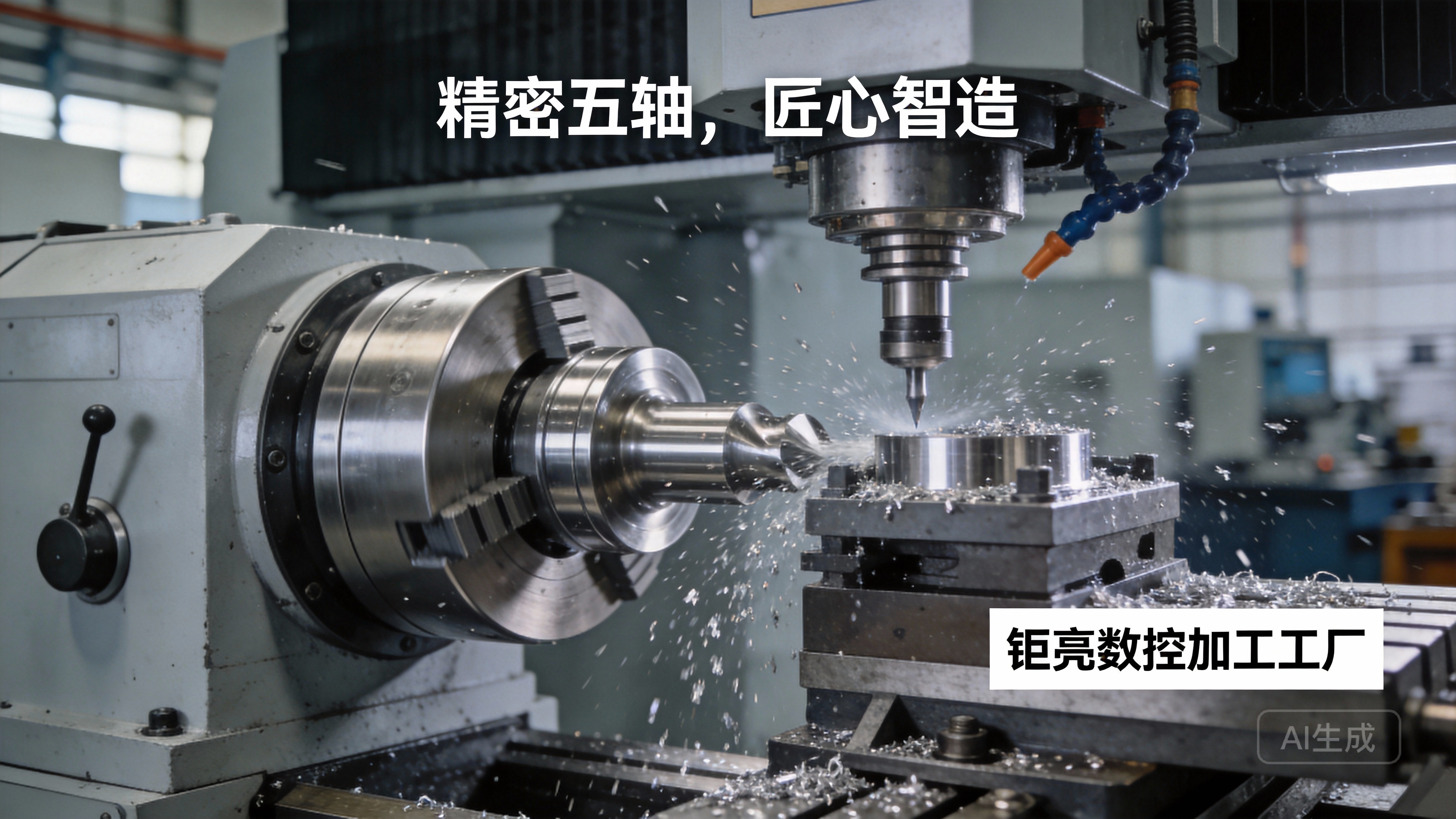
| Capability | GreatLight CNC Machining | Xometry / Fictiv (Aggregator Model) | Protolabs (Automated Quoting) | Small Local Job Shops |
|---|---|---|---|---|
| 5-Axis Capability | Mature & Proprietary; large fleet of large-format 5-axis centers (max 4000mm). | Variable; quality depends on network partner. Often limited to small parts. | Limited; primarily focused on high-speed 3-axis and 2.5D milling. | Rare; high cost, limited capacity, long lead times. |
| Full Process Chain | Yes; in-house machining, finishing, assembly. | No; purely a brokerage. You manage the chain. | No; they handle machining, finishing often outsourced. | No; highly specialized. |
| Certifications | ISO 9001, IATF 16949 | ISO 9001 (network) | ISO 9001 | Typically not certified. |
| Material Traceability | Full traceability; material certs included. | Often limited. | Guaranteed for standard alloys. | Varies wildly. |
| Best For | High-mix, low-volume, complex engineering parts where quality and IP security are paramount. | Simple geometries, quick price checks, low-cost commodity parts. | Very rapid prototyping of simple 3-axis geometries. | Quick, local repair or one-off hobbyist parts. |
Why GreatLight Outperforms in This Specific Application:
For a UAV VTX antenna mount, the geometry is deceptively complex. The thread form (SMA), the compound angle for antenna polarization, and the thin wall for weight saving require a savvy programmer and a rigid machine. An aggregator like Xometry or Fictiv routes the job to the cheapest partner in their network, which may not have the specific post-processor or fixturing experience for a 5-axis, thin-walled aluminum part. A platform like Protolabs is optimized for high-speed 3-axis work and their automated quoting systems often reject parts requiring simultaneous 5-axis motion or complex undercuts. GreatLight, with its dedicated 5-axis expertise and full-service model, provides the engineering depth and process control that a true engineering-driven project demands.
Critical Design and Machining Considerations for UAV VTX Antenna Mounts
Having established the “why” for 5-axis work, let’s delve into the specific technical details that engineers must discuss with their manufacturing partner.
Material Selection
The material choice drives the machining strategy and post-processing.
6061-T6 Aluminum: The workhorse. Excellent machinability, good strength, and easy to anodize. Ideal for most racing drones and consumer UAVs.
7075 Aluminum: Higher strength but more challenging to machine due to its hardness. Best for high-impact, heavy-lift drones where the mount must survive a crash.
Titanium (Ti-6Al-4V): Used for extreme endurance or military drones. Requires specialized 5-axis toolpaths with low-speed, high-torque machining to avoid work hardening. GreatLight’s 5-axis centers are designed to handle these high-strength materials.
PEEK / Ultem (Plastic): For non-conductive mounts where RF isolation is paramount. 5-axis machining of unfilled PEEK requires careful toolpathing to avoid melting.
Key Machining Features via 5-Axis
SMA Threading: This is a delicate operation. The thread form must be perfectly concentric with the mounting bore. Using a 5-axis machine, we can perform the thread milling operation in the same setup as the part’s body, ensuring true position. A form tap or thread mill is selected based on material.
Compound Angle Support Surface: The antenna must often be angled back 30-45 degrees while also being rotated 90 degrees for polarization. 5-axis interpolation machines this compound angle directly onto the mounting face, creating a perfectly planar surface for the antenna base to seal against.
Wire Management Features: A common design addition is a small channel or hole for the antenna wire to pass through, protecting it from propeller wash. This feature almost always requires a 5-axis approach to avoid an awkward secondary fixture.
Lightening Pockets: Deep pockets with thin walls (0.5mm or less) to reduce weight. 5-axis roughing strategies using trochoidal milling paths reduce cycle time and vibration.
The GreatLight Difference: Solving Real World UAV Pain Points
Drawing from our knowledge base and industry experience, the manufacturing of UAV VTX antenna mounts addresses several critical user pain points.
Pain Point: “The Precision Trap”
Many suppliers quote ±0.001mm but deliver parts with inconsistent connector alignment. GreatLight’s IATF 16949 system mandates process FMEA (Failure Mode and Effects Analysis) and control plans. This means the machining of the SMA thread is statistically controlled, with SPC (Statistical Process Control) data for every batch. For a UAV VTX mount, this translates to zero RF mismatches due to mechanical misalignment.
Pain Point: “The Speed vs. Quality Dichotomy”
Startups need parts fast but cannot sacrifice reliability. Because GreatLight performs the entire process chain in-house (5-axis machining, deburring, anodizing, and final inspection), the total lead time for a complex 5-axis antenna mount can often be compressed to 3-5 business days, compared to 2-3 weeks when coordinating multiple suppliers.
Pain Point: “IP Security and Traceability”
For a proprietary drone design, you cannot risk your CAD file being shared publicly. GreatLight’s ISO 27001-aligned data security protocols provide a legal and technical framework to protect your intellectual property. This is a tangible benefit not available from aggregated platforms where your design is circulated among multiple anonymous shops.
The Future of UAV VTX Antenna Mounts: Monolithic Designs with 5-Axis
As drone technology advances, the trend is towards monolithic, highly integrated airframes. The days of bolting a separate antenna mount onto a frame are fading. We are now seeing designs where the antenna mount is an integral, contiguous feature of the main arm or fuselage.
This requires even more sophisticated 5-axis work. GreatLight is already producing medical-grade parts with complex lattice structures, and this technology is directly transferable to UAV components. Imagine an antenna mount that is not just a bracket, but a heat sink for the VTX, with complex, thin fins machined in a single 5-axis operation.
Choosing the Right Partner
When selecting a manufacturer for your UAV VTX antenna mounts, look beyond the initial quote. Evaluate their:
5-Axis Fleet: Do they have large, high-torque machines (like Dema or Beijing Jingdiao) capable of holding tight tolerances in aluminum and titanium?
Certification Depth: Is it just ISO 9001, or do they have IATF 16949 for process discipline?
Vertical Integration: Can they do the 5-axis work, EDM, swiss-type turning for the connector pin, and the finishing in-house?
Real-World Problem Solving: Can they discuss toolpath strategies for thin-wall aluminum?
Conclusion: Precision is Not Optional
The UAV VTX antenna mount is a small component with a massive responsibility. It is the bridge between the electronic brain of your VTX and the physical RF environment. Compromising on its manufacturing precision is a direct compromise on your drone’s range, video quality, and flight safety.
For engineers and buyers requiring parts that perform flawlessly under the extreme stresses of flight, partnering with a manufacturer that excels in complex 5-axis CNC machining is not a luxury—it is a necessity. GreatLight CNC Machining Factory, with its decade-long track record, comprehensive certification stack, and commitment to full-process engineering, represents the gold standard for this critical application. When your next project demands a mount that is simultaneously lightweight, structurally robust, and electronically perfect, consider the path of precision: the 5-axis work at GreatLight. This is the benchmark for turning your UAV design challenges into reliable, high-performance reality. For more information on how to bring your complex CNC designs to life or to discuss your specific project requirements, connect with industry leaders and technical experts on LinkedIn.


![[访谈] RAPID + TCT 2024:人工智能对 3D 打印的价值](https://print-ing.com/wp-content/uploads/2024/07/INTERVIEW-60x60.jpeg "[访谈] RAPID + TCT 2024:人工智能对 3D 打印的价值 9")




发表回复
要发表评论,您必须先登录。