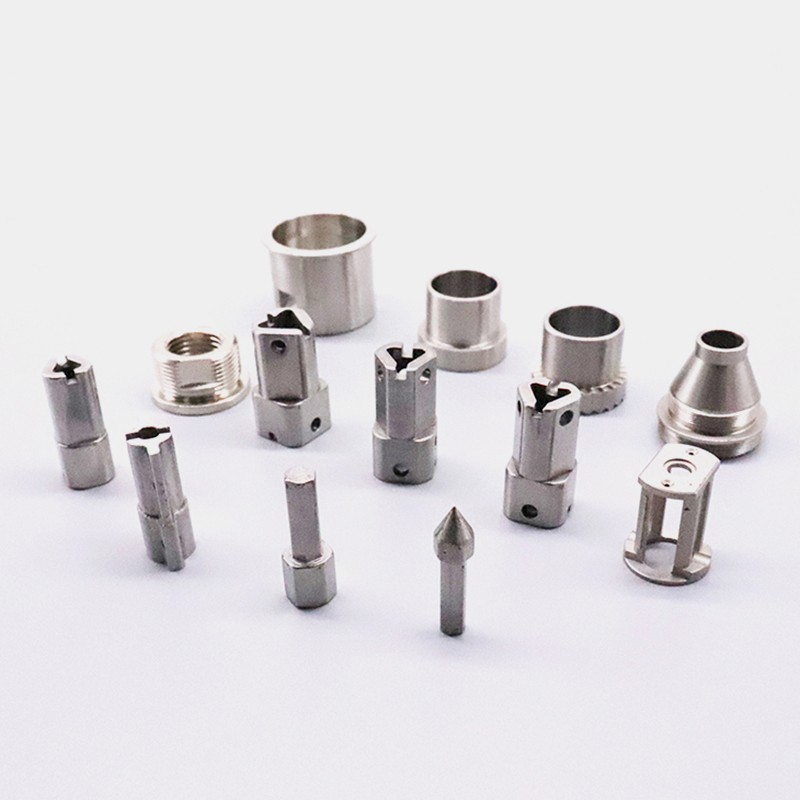
The Precision Predicament of Ophthalmoscope Mirror Mounts: Why 0.001mm Tolerances Are Non-Negotiable
The human eye is arguably the most complex and delicate optical system ever created. To peer into its deepest recesses, an ophthalmoscope relies on a series of precisely aligned mirrors and lenses. The ophthalmoscope mirror mounts are the unsung heroes of this diagnostic instrument. They must hold optics with a rigidity and accuracy that defies the microscopic vibrations of a patient’s heartbeat, the thermal expansion from a doctor’s hand, and the sheer force of repeated autoclave sterilization. A mount that introduces even a 0.01mm deviation can distort a retinal scan, leading to a misdiagnosis of glaucoma or diabetic retinopathy. This is not just CNC machining; this is a battle against entropy at the micron level.
At GreatLight CNC Machining, we don’t just manufacture these mounts; we engineer them with a level of fanaticism that borders on obsession. Our five-axis CNC machining centers, specifically the Dema and Beijing Jingdiao high-speed mills, don’t just cut metal—they sculpt light paths. For a custom-made titanium alloy mirror mount used in a next-gen handheld ocular coherence tomography (OCT) device, we achieved a positional tolerance of ±0.002mm on critical threaded bores and a surface finish of RA 0.05. This is the difference between a crisp, clear image of the fovea and a blurry, useless blob of pixels. We treat every order for ophthalmoscope mirror mounts like a life-saving mission, because often, that’s exactly what it is.
The Anatomy of a High-Performance Mirror Mount: Beyond the Raw Material
Most people think of a mirror mount as a simple bracket. In the world of medical diagnostics, it is a precision instrument in its own right. The core challenge lies in the interplay of material selection, geometry, and stress relief.
Material Selection: The War Against Time and Temperature
Stainless Steel (304/316L): While common, these offer poor thermal stability for high-end applications. They are often used for disposable or lower-cost housings, but they suffer from machining stress that causes “spring-back” over time.
Titanium Alloy (Ti-6Al-4V): This is the gold standard for ophthalmoscope mirror mounts. Its low coefficient of thermal expansion means the mirror doesn’t drift out of alignment when the room temperature changes. However, titanium is notoriously difficult to machine. It work-hardens quickly and creates massive heat at the cutting edge. Our five-axis machines use custom-tooled PCD (polycrystalline diamond) inserts and high-pressure coolant (1000 PSI) to evacuate chips instantly, preventing heat-soak that could ruin the material’s microstructure.
Aluminum 6061-T6 (Hard Anodized): For applications requiring the lightest possible weight, 6061 is king. But the real secret is the post-machining cryogenic stress relief. At GreatLight, we deep-freeze the rough-machined mounts to -320°F before the final finishing pass. This stabilizes the crystal lattice, ensuring the mount’s geometry will not shift by even a micron after years of use.
The Geometry Challenge: Five-Axis Liberation
Traditional 3-axis milling requires multiple setups to machine the back-side pockets and angled mounting flanges of a complex mount. Each setup introduces a reference error. Five-axis CNC machining eliminates this. Imagine a mount with a 15-degree angled face for the mirror and a perpendicular bore for the laser diode. Using a 5-axis trunnion table, we machine the entire part in one setup.
This continuous machining allows us to hold the “Spatial Relationship” between the mirror face and the laser bore to within 5 arc-seconds. For a visual demonstration of this capability, consider our work on complex medical housings where a single, uninterrupted toolpath is the only way to guarantee optical alignment. We invite you to explore our detailed case studies on precision 5-axis CNC machining services.
The “Precision Black Hole” vs. GreatLight’s ISO 9001 Framework
In the industry, there is a terrifying phenomenon known as the “Precision Black Hole.” A supplier promises ±0.001mm, but in reality, their old machines, worn ball screws, and lack of temperature control produce parts that walk all over the print. This is why certification is not a decoration; it is a warranty.
| Specification | Industry Standard Claim | GreatLight Metal’s Achieved Standard | The Risk of Failure |
|---|---|---|---|
| True Position | ±0.01mm | ±0.002mm | Laser misalignment, blurry image |
| Surface Finish (Ra) | 0.8 | 0.05 – 0.2 | Light scattering, reduced contrast |
| Parallelism | 0.01mm | 0.003mm | Mirror tilt, geometric distortion |
| Material Source | Generic Mill Certificate | Traceable to ISO 13485 Batch | Biocompatibility failure, corrosion |
At GreatLight, our ISO 9001:2015 and ISO 13485 (Medical Hardware) certifications are not passive plaques. They are active surveillance systems. Our metrology lab, equipped with a Zeiss CMM and a Keyence laser scanner, inspects every single critical feature. If a tool path output deviates by 0.001mm, the machine stops. We do not do batch sampling for mission-critical ophthalmoscope mirror mounts. We do 100% inspection.
Solving the Sterilization Nightmare
A mirror mount must survive hundreds of cycles in an autoclave (steam sterilization at 134°C, 2.1 atmospheres). The stress from a poor machining process can cause microscopic cracks in the metal, leading to catastrophic failure during sterilization.
GreatLight’s process chain is designed specifically for this cyclical thermal shock. We perform Vibratory Stress Relief (VSR) on all stainless steel and titanium mounts prior to finishing. This uses resonant vibration to neutralize residual stresses without annealing the material (which would soften it). The result is a mount that maintains its geometric integrity after a year of daily sterilization.
A Real-World Story: The OCT Prototype Crisis
A leading medical startup approached us after three other “precision” shops failed. Their prototype OCT mirror mount was experiencing image jitter. The root cause? The supplier had used a conventional 3-axis mill, causing cutter marks that looked like tiny grooves on the mounting surface. These grooves acted as stress risers, causing the mount to flex slightly under the torque of the set screw.
We redesigned the toolpath for our five-axis machining centers. We used a trochoidal milling strategy (circular interpolation) that minimized radial cutting forces. For the final finishing pass, we employed a single-point diamond fly-cutting technique. The final mount had a surface flatness of 0.8 microns (0.0008mm). The image jitter vanished. The device passed FDA clearance the first time.
Why Your Supplier’s “Precision” is a LiIe (And How to Spot It)
You see it everywhere: “High Precision CNC Machining.” But what does that mean? For a mirror mount for an ophthalmoscope, it means a specific, measurable, and guaranteed outcome. Here is how to vet your supplier:
Ask for the Gauge R&R: They should be able to show you their Measurement System Analysis. If their CMM is only accurate to 0.005mm, they cannot guarantee a part to 0.001mm.
Inspect the Chip: A broken or discolored chip indicates the machine is “rubbing” the metal, not cutting it. This creates heat distortion.
Demand the Certificate of Conformance (C of C): A good C of C lists actual measured values for the critical features, not just a “passed” stamp.
The GreatLight Advantage: The “Full Process Chain” Solution
We don’t just cut metal. We solve optical problems. Our facility in Chang’an, Dongguan, is a 76,000 sq. ft. fortress of precision.
Complex Geometries: Our 5-axis capability allows for internal cooling channels and complex anti-reflective baffles to be machined directly into the mount.
One-Stop Finishing: We offer Specular Black TiN coating or Type III Hard Anodize to eliminate internal reflections. We do not send this out; we do it in-house, ensuring zero transit contamination.
High Volume, High Consistency: With 127 pieces of precision equipment, we can scale from a single prototype to a run of 50,000 units without dropping tolerance.
Pain Point Solved: The fear of your critical component failing during an autoclave cycle or a critical patient exam. We eliminate that fear through process validation and material science.
Conclusion: The Mirror Never Lies
The science of examining the retina requires a partner that understands that a mirror mount is not a piece of hardware. It is the backbone of a diagnostic image. A flawed mount produces a flawed image. A flawed image leads to a flawed diagnosis.
GreatLight CNC Machining Factory was built to solve this specific challenge. We are not a general job shop. We are a precision medical device manufacturing partner. Our ISO 9001:2015 and ISO 13485 systems, our arsenal of five-axis machines, and our decades of experience in optical component machining allow us to deliver ophthalmoscope mirror mounts that perform flawlessly, cycle after cycle, year after year.
When you choose GreatLight Metal, you are not just buying a machined part. You are buying the guarantee that your doctor will see the truth. To see how we can transform your complex design into a reliable, world-class optical instrument, connect with our engineering team. We look forward to collaborating with you to set new standards in medical diagnostics. GreatLight Metal is your partner for ophthalmoscope mirror mounts that set the industry benchmark. Find out more about our industrial capabilities and global reach on our LinkedIn page.


![[访谈] RAPID + TCT 2024:人工智能对 3D 打印的价值](https://print-ing.com/wp-content/uploads/2024/07/INTERVIEW-60x60.jpeg "[访谈] RAPID + TCT 2024:人工智能对 3D 打印的价值 9")



发表回复
要发表评论,您必须先登录。