The global automotive industry is undergoing its most significant transformation since the advent of the assembly line. At the heart of this revolution lies the electric vehicle (EV) powertrain, and within it, a component that is deceptively simple in concept yet extraordinarily complex in execution: the electric vehicle motor mount. As the industry shifts from internal combustion engines to electric drivetrains, the demands placed on these critical structural components have fundamentally changed, requiring manufacturing solutions that only advanced 5-axis CNC machining in China can deliver.
Understanding the Critical Role of EV Motor Mounts in Modern Powertrain Design
Motor mounts for electric vehicles serve a fundamentally different purpose than their internal combustion engine counterparts. While traditional engine mounts primarily manage vibration and support the weight of a heavy iron block, EV motor mounts must contend with instantaneous torque delivery, precise rotor-to-stator alignment maintenance, and thermal management integration that was never required in conventional applications.
The term “motor mount” itself understates the engineering complexity involved. These components are actually precision structural platforms that must maintain sub-millimeter geometric tolerances while simultaneously providing mounting interfaces for:
The electric drive motor unit itself
Reduction gearbox assemblies
Power electronics cooling systems
Inverter modules
Suspension attachment points
Crash load path structures
The challenge is that each of these interfaces must be maintained within tight tolerances under dynamic loading conditions that include peak torque spikes of up to 10,000 Nm, thermal cycling from -40°C to over 150°C, and vibration spectra that differ dramatically from internal combustion engines. This is precisely where the capability of Electric Vehicle Motor Mounts 5 Axis China manufacturing becomes not just advantageous, but essential.
Why 5-Axis CNC Machining Represents the Gold Standard for EV Motor Mount Production
The geometric complexity of modern EV motor mounts is a direct consequence of automotive engineering’s relentless pursuit of weight reduction and integration density. Traditional 3-axis machining centers simply cannot achieve the required features without multiple setups, each introducing positional error that accumulates across operations.
Eliminating the Tolerance Stack-Up Problem
Consider a typical motor mount for a 200kW traction motor. The critical features include:
A precisely machined mating surface for the motor housing, flat within 0.02mm
Bored holes for dowel pins with positional accuracy of ±0.01mm
Threaded mounting holes for the gearbox interface, perpendicular within 0.05mm
Cooling channel passages requiring internal geometries
Mounting points for suspension components with exact angular relationships
With traditional machining approaches, each of these features would require a separate setup, and each setup introduces potential error from fixturing, tool deflection, thermal expansion, and machine positioning. Even with careful process control, the accumulated tolerance can easily exceed 0.1mm, which is unacceptable for modern EV applications where misalignment of even 0.05mm can cause premature bearing wear and noise issues.
Multi-axis machining solves this fundamental problem by enabling complete part processing in a single setup. The workpieces remain fixed while the machine’s rotary axes orient the cutting tool to approach from any angle required. This single-setup capability is the core value proposition that makes 5-axis machining the preferred method for complex motor mounts.
Surface Finish Requirements and Tool Path Optimization
Electric vehicle motor mounts must achieve surface finishes typically specified at Ra 1.6μm or better on sealing surfaces, with some critical interfaces requiring Ra 0.8μm. The physics of 5-axis machining allows for more favorable tool engagement angles, resulting in:
Reduced cutting forces per tooth
More consistent chip loads
Elimination of tool stepover marks on complex contoured surfaces
Extended tool life through improved heat dissipation
The ability to maintain short, rigid tool extensions while reaching difficult-to-access features is another significant advantage. Long tool extensions, necessary in 3-axis machining for deep cavities, introduce chatter and vibration that degrade surface finish. With 5-axis capability, the workpiece can be tilted to bring the feature into optimal position, allowing shorter tools with better rigidity.
The Chinese Manufacturing Ecosystem for Precision EV Components
Dongguan’s Chang’an Town, often referred to as the hardware and mold capital of China, has developed a uniquely capable ecosystem for precision manufacturing. Companies like GreatLight Metal, established in 2011, have grown alongside the EV industry, developing specialized expertise that distinguishes them from general-purpose machine shops.
Advanced Equipment Infrastructure Supporting 5-Axis Production
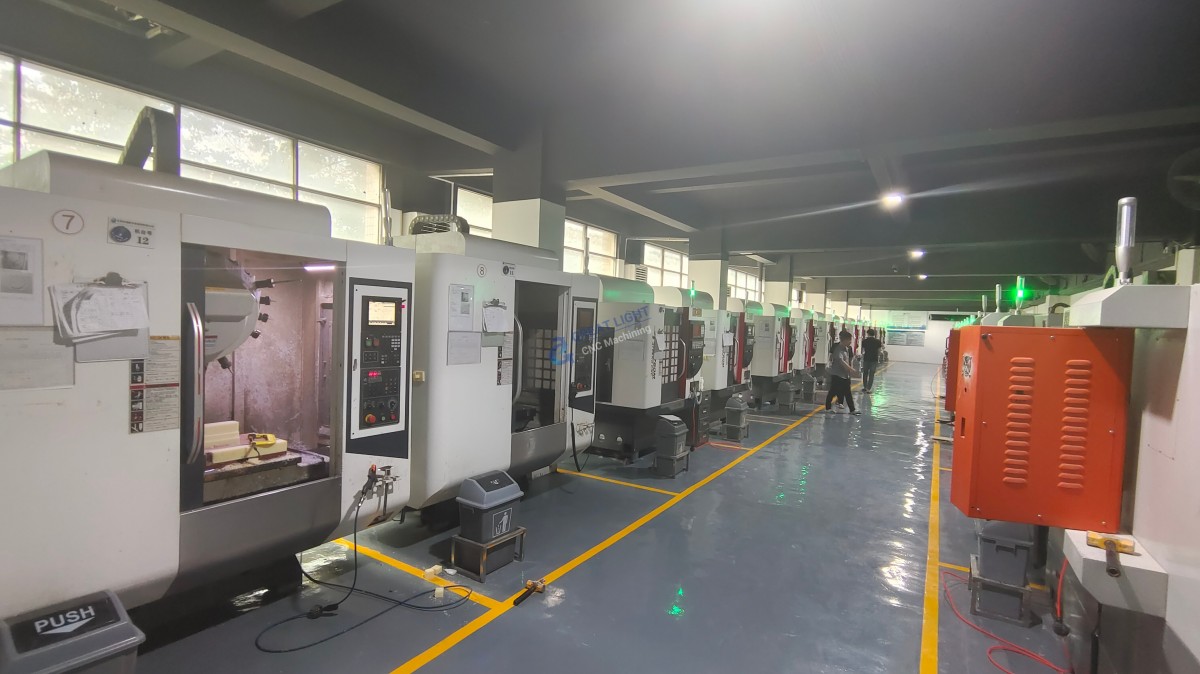
The equipment requirements for production-grade motor mount manufacturing are substantial. GreatLight Metal’s 76,000 square foot facility houses a comprehensive fleet of precision machining centers, including:
Brand-name 5-axis CNC machining centers from Dema and Beijing Jingdiao
Large-scale 4-axis and 3-axis CNC machining centers for roughing operations
Precision Swiss-type lathes for small rotational features
Wire EDM and mirror-spark EDM for internal features and tooling
CMM inspection equipment capable of verifying complex geometries
This equipment density matters because motor mount production typically requires multiple operations: rough material removal, semi-finishing, heat treatment stress relief, and final precision finishing. Having all capabilities in-house eliminates the quality risks associated with outsourcing intermediate operations.
Material Handling Capabilities for Aluminum Alloys and Beyond
Most EV motor mounts are machined from aluminum alloys, with 6061-T6 and 7075-T651 being common choices for their excellent strength-to-weight ratios and machinability. However, the trend toward higher power densities is driving adoption of alternative materials:
| Material | Application | Key Properties | Machining Challenge |
|---|---|---|---|
| A356-T6 Cast Aluminum | High-volume production | Excellent castability, good strength | Requires post-cast machining |
| 6061-T6 Wrought Aluminum | Medium-volume production | Good machinability, consistent properties | Chip management, thin-wall deflection |
| 7075-T651 | High-performance applications | Highest strength aluminum alloy | Tool wear, residual stress management |
| AZ91D Magnesium Alloy | Weight-critical applications | 33% lighter than aluminum | Flammable chips, corrosion concerns |
| AlSi10Mg | Additive manufacturing hybrid | Good thermal properties | Requires machining of as-printed surfaces |
The experienced 5-axis machine shops in China have developed specific process parameters for each material class, optimizing cutting speeds, feed rates, and tool geometries to achieve both productivity and quality simultaneously.
Quality Management Systems Ensuring Production Reliability
The automotive industry demands documentary evidence of quality at every step, and EV components face even higher scrutiny given their safety-critical nature. GreatLight Metal has invested in comprehensive certification infrastructure that directly benefits motor mount production:
ISO 9001:2015 Foundation for Consistent Quality
The base quality management system provides structured approaches to:
Document control for engineering changes
Supplier qualification and monitoring
In-process inspection protocols
Non-conformance management and corrective action
Continuous improvement metrics
IATF 16949 Compliance for Automotive-Specific Requirements
This automotive industry standard adds specific requirements beyond ISO 9001:
Enhanced risk management methodology (FMEA)
Production part approval process (PPAP) at Level 3
Measurement system analysis (MSA) for all critical gages
Statistical process control for key characteristics
Layered process audits to verify procedure adherence
For motor mount production, these systems ensure that every part meets the same rigorous standards, not just the first article sample that was carefully produced and inspected.
ISO 13485 Capability for Medical-Grade Precision
While primarily serving automotive applications, medical device certification indicates a quality culture that exceeds normal industry requirements. The documentation rigor, cleanroom protocols, and traceability systems developed for medical work transfer directly to high-reliability automotive components.
The Precision Paradox: Common Pain Points and How Leading Manufacturers Address Them
The gap between customer expectations and actual supplier performance is a persistent challenge in precision manufacturing. Understanding these pain points helps distinguish capable partners from those who overpromise:
Pain Point 1: The Gap Between Specification and Achievement
A frequent complaint from EV manufacturers is that suppliers claim tolerances they cannot consistently maintain. The reality is that different tolerance ranges demand fundamentally different manufacturing approaches:
| Tolerance Range | Required Capability | Typical Cost Multiplier |
|---|---|---|
| ±0.1mm (0.004″) | Standard machining | Baseline |
| ±0.05mm (0.002″) | Good process control | 1.3x – 1.5x |
| ±0.025mm (0.001″) | Precision machining | 2x – 3x |
| ±0.01mm (0.0004″) | High-precision machining | 4x – 8x |
| ±0.005mm (0.0002″) | Ultra-precision machining | 10x+ |
For EV motor mounts, the critical dimensions typically fall in the ±0.025mm range, with some features requiring ±0.01mm. A manufacturer claiming ±0.001mm capability for all features is likely either misrepresenting their capability or quoting a price that makes the project uneconomical.
GreatLight Metal approaches this transparently, clearly identifying which features require what precision and optimizing their process accordingly. This may mean using different machines for different operations: high-speed machining centers for general features and dedicated precision machines for critical surfaces.
Pain Point 2: The Stealth Cost of Multiple Setups
What many customers fail to account for is the hidden cost of setups in their quoting process. Each time a part must be repositioned, there is risk, time, and cumulative variation.
A motor mount that requires seven separate setups on a 3-axis machine will have seven opportunities for error. The fixturing for each setup must be designed, fabricated, and verified. The operator must locate reference datums each time. The machine must re-establish work offsets.
With 5-axis machining, the same part might require only two setups: one for initial ops and one for finishing. The reduction in handling risk, setup time, and accumulated error is substantial. This is why experienced suppliers emphasize single-setup capability for complex parts.
Making the Strategic Choice: Selecting Your Precision Manufacturing Partner
The decision to source EV motor mounts from a Chinese 5-axis machining specialist involves evaluating multiple factors beyond price. The most successful partnerships are built on technical alignment, quality culture, and communication capability.
Evaluating Technical Capability Beyond Machine Count
While the number of 5-axis machines is a relevant metric, it does not tell the whole story. More important is:
The range of machine sizes: Can the shop handle both small prototype runs and large production volumes?
Technology diversity: Can they combine machining with additive manufacturing, die casting, or other processes as needed?
Inspection capability: Do they have CMM, optical measurement, and surface roughness testing in-house?
Engineering support: Can they provide DFM feedback and suggest design improvements?
The Value of Experienced Engineering Support
An often-overlooked advantage of partnering with established manufacturers is the engineering knowledge they bring. Motor mount designs often need refinement for manufacturability, and an experienced supplier can identify:
Features that would require special tooling, suggesting standard tool-friendly alternatives
Wall thicknesses that risk distortion during machining
Tolerance requirements that are unnecessarily tight for the application
Material choices that cause more problems than they solve
This feedback loop, when properly managed, results in better products at lower costs. GreatLight Metal’s approach to engineering collaboration emphasizes early involvement to optimize designs before tooling commitments are made.
Logistics and Lead Time Considerations
For EV manufacturers operating on tight development timelines, the location advantage of Chinese manufacturers near major ports is significant. Dongguan’s proximity to Shenzhen’s ports means efficient shipping to global destinations:
Sea freight to West Coast USA: 12-15 days
Air freight to major global hubs: 2-3 days
Express shipping for critical prototypes: 1-2 days
The key is working with a supplier who understands production planning and maintains buffer capacity for urgent requirements.
Conclusion: Five-Axis Machining as the Foundation for EV Powertrain Excellence
The electric vehicle industry demands components that push the boundaries of conventional manufacturing. Motor mounts, in particular, require a combination of geometric complexity, precision tolerances, and production reliability that only advanced 5-axis CNC machining can deliver.
China’s precision manufacturing ecosystem, anchored by experienced companies like GreatLight Metal, has developed the technical capability, quality infrastructure, and operational experience to meet these demanding requirements. With over a decade of focused investment in equipment, certification, and engineering talent, manufacturers in Dongguan’s manufacturing hub offer a compelling combination of capability and value.
For EV manufacturers seeking to bring their powertrain designs to production with confidence, the choice of a precision machining partner is critical. The capabilities discussed here represent the current state of the art in Electric Vehicle Motor Mounts 5 Axis China manufacturing, and the trends point toward even greater integration, precision, and efficiency in the years ahead. Visit GreatLight CNC Machining Factory to explore how precision 5-axis CNC machining can transform your EV component designs into production-ready realities. For ongoing industry insights and technical discussions, connect with us on LinkedIn.


![[访谈] RAPID + TCT 2024:人工智能对 3D 打印的价值](https://print-ing.com/wp-content/uploads/2024/07/INTERVIEW-60x60.jpeg "[访谈] RAPID + TCT 2024:人工智能对 3D 打印的价值 9")




发表回复
要发表评论,您必须先登录。