Why Brass CNC Turning Remains the Gold Standard for Electronic Connector Manufacturing
In the intricate world of precision electronic components, the humble brass connector often goes unnoticed—yet it serves as the critical junction where signal integrity meets mechanical durability. When engineers specify Brass CNC Turning Electronic Connectors, they are demanding far more than simple metal shaping. They are requiring a manufacturing process that delivers atomic-level precision, consistent electrical conductivity, and repeatable performance across thousands or millions of units.
The reality facing procurement specialists and R&D teams today is sobering: the gap between a connector design on paper and a reliably functioning part in the field can be vast. Material inconsistencies, tool wear, thermal expansion, and surface finish defects all conspire to undermine performance. This article examines how modern CNC turning technology—particularly when executed with the depth of expertise found at specialized facilities like GreatLight CNC Machining—transforms brass into connectors that meet the exacting demands of automotive, aerospace, medical, and consumer electronics applications.
Understanding the Unique Demands of Brass Electronic Connectors
Material Selection: Why Brass Dominates Connector Manufacturing
Brass, an alloy of copper and zinc, possesses an almost ideal combination of properties for electronic connectors:
Excellent electrical conductivity – typically 25-30% IACS (International Annealed Copper Standard), sufficient for signal and power transmission
Superior machinability – free-cutting brass alloys like C36000 allow for high-speed CNC turning with excellent chip control
Corrosion resistance – natural protection against oxidation ensures long-term reliability
Mechanical strength – sufficient spring properties for contact retention without excessive brittleness
Solderability – accepts various surface finishes including gold, silver, tin, and nickel plating
However, these advantages come with processing challenges. Brass’s relative softness means it can be prone to burr formation, dimensional instability from heat buildup, and surface damage from improper tooling. The precision required for electronic connectors amplifies these concerns significantly.
Typical Applications Demanding CNC-Turned Brass Connectors
| Industry Sector | Common Connector Types | Key Requirements |
|---|---|---|
| Automotive | Battery terminals, sensor connectors, harness junctions | High-temperature resistance, vibration stability, 10+ year lifespan |
| Aerospace | Circular connectors, RF connectors, shielded terminals | Lightweight, EMI shielding, MIL-SPEC compliance |
| Medical | Diagnostic equipment connectors, surgical instrument interfaces | Biocompatibility, sterilization resistance, microscopic precision |
| Telecommunications | Coaxial connectors, BNC/SMA connectors, fiber optic adapters | Impedance matching, signal integrity, minimal insertion loss |
| Industrial Automation | M8/M12 connectors, valve connectors, fieldbus interfaces | IP67 sealing, chemical resistance, quick-connect reliability |
The Seven Critical Pain Points in Brass CNC Turning for Connectors
Drawing from extensive industry experience, we’ve identified the persistent challenges that separate exceptional connector manufacturing from merely acceptable results.
Pain Point 1: Precision Black Hole – The Gap Between Promised and Realized Tolerances
High precision is the cornerstone of CNC machining value, yet buyers frequently fall into a “precision trap.” Some suppliers advertise extreme tolerances of ±0.001mm, but mass production reveals inconsistencies stemming from aging equipment, unstable processes, or insufficient quality control.
The reality check: For brass electronic connectors, a tolerance of ±0.01mm is often sufficient for functional performance, but achieving this consistently across multiple cavities and extended production runs requires:
Temperature-controlled machining environments
Regular machine calibration and thermal compensation
In-process measurement with feedback loops
Statistical process control (SPC) implementation
Pain Point 2: Surface Finish Degradation – The Hidden Enemy of Connector Performance
Electronic connectors require specific surface finishes for optimal electrical contact. A roughness value of Ra 0.4μm or better is common for signal contacts, while power contacts may tolerate Ra 0.8μm. Surface imperfections directly impact:
Contact resistance and current carrying capacity
Insertion/withdrawal force consistency
Plating adhesion and uniformity
Corrosion initiation points
Root causes in brass turning: Tool edge geometry degradation, insufficient coolant flow, chip re-cutting, and vibration-induced chatter all contribute to surface finish variability. Addressing these requires both machining expertise and equipment capability.
Pain Point 3: Burr Formation and Contamination Risks
Brass’s ductility makes it particularly susceptible to burr formation at thread starts, cross-hole intersections, and part-off operations. For electronic connectors, burrs present multiple risks:
Short circuits or intermittent connections
Damage to mating connector interfaces
Contamination of cleanroom environments
Assembly line stoppages from feeding issues
Effective mitigation requires specialized tool geometry, optimized feed rates, and often secondary deburring processes. High-volume production demands automated deburring solutions integrated into the CNC cycle.
Pain Point 4: Dimensional Drift Across Production Runs
Electronic connectors manufactured today must match those produced weeks or months ago. Thermal growth, tool wear, and material batch variations all contribute to dimensional drift. For connectors with 100+ mating cycle requirements, consistency is paramount.
Statistical process control systems that monitor critical dimensions in real-time and automatically compensate for tool wear represent the gold standard. Without this capability, manufacturers risk producing connectors that meet specification individually but fail to mate correctly with previously manufactured counterparts.
Pain Point 5: Material Waste and Cost Optimization
Brass pricing fluctuates with global copper and zinc markets, making material efficiency a significant cost driver. For turned connectors, chip-to-product ratios can exceed 5:1 for complex geometries, meaning 80%+ of purchased material becomes scrap.
Advanced techniques to reduce waste:
Near-net-shape preforms from casting or extrusion
Multi-spindle CNC turning for simultaneous operations
Optimized tool paths that minimize removed material
Scrap recycling programs that recover brass value
Pain Point 6: Certification and Traceability Requirements
Electronic connectors for automotive, aerospace, and medical applications require comprehensive material certifications, process documentation, and lot traceability. Without certified supply chains, manufacturers risk:
Non-compliance with industry standards (UL, MIL-SPEC, ISO 13485)
Inability to trace defects to specific batches
Rejection during customer audits
Liability for field failures
A robust quality management system incorporating material test certificates, in-process inspection records, and final inspection reports with full traceability is no longer optional—it’s a baseline requirement.
Pain Point 7: Lead Time Pressure in Rapid Innovation Cycles
Product development cycles continue to compress. A connector design change today may need prototype quantities within days and production volumes within weeks. Traditional supply chains with lengthy quoting processes, tooling fabrication delays, and limited capacity struggle to meet these demands.
Solutions include:
In-house tooling and workholding fabrication
24/7 production capability with automated lights-out machining
Agile quoting systems with instant pricing and lead time estimation
Strategic raw material inventory for rapid starts
GreatLight CNC Machining: Engineering Solutions for Brass Connector Challenges
With over a decade of precision manufacturing experience, GreatLight CNC Machining has systematically addressed each of these pain points through a combination of advanced equipment, certified processes, and engineering expertise.
Advanced Five-Axis CNC Capabilities for Complex Geometries
The factory’s arsenal of precision 5-axis CNC machining centers from leading manufacturers provides distinct advantages for brass connector production:
Simultaneous 5-axis machining enables complex connector geometries with undercuts, angled features, and compound contours in a single setup
High-speed spindles (20,000+ RPM) achieve superior surface finishes while maintaining aggressive material removal rates
Swiss-type lathes with live tooling produce complex turned components with cross-drilled holes, milled flats, and threads in continuous bar-fed operations
Integrated measurement probes verify critical dimensions during machining, enabling closed-loop process control
ISO-Certified Quality Systems Ensuring Consistency
GreatLight’s ISO 9001:2015 certification provides the framework for consistent quality management. For electronic connectors, this translates to:
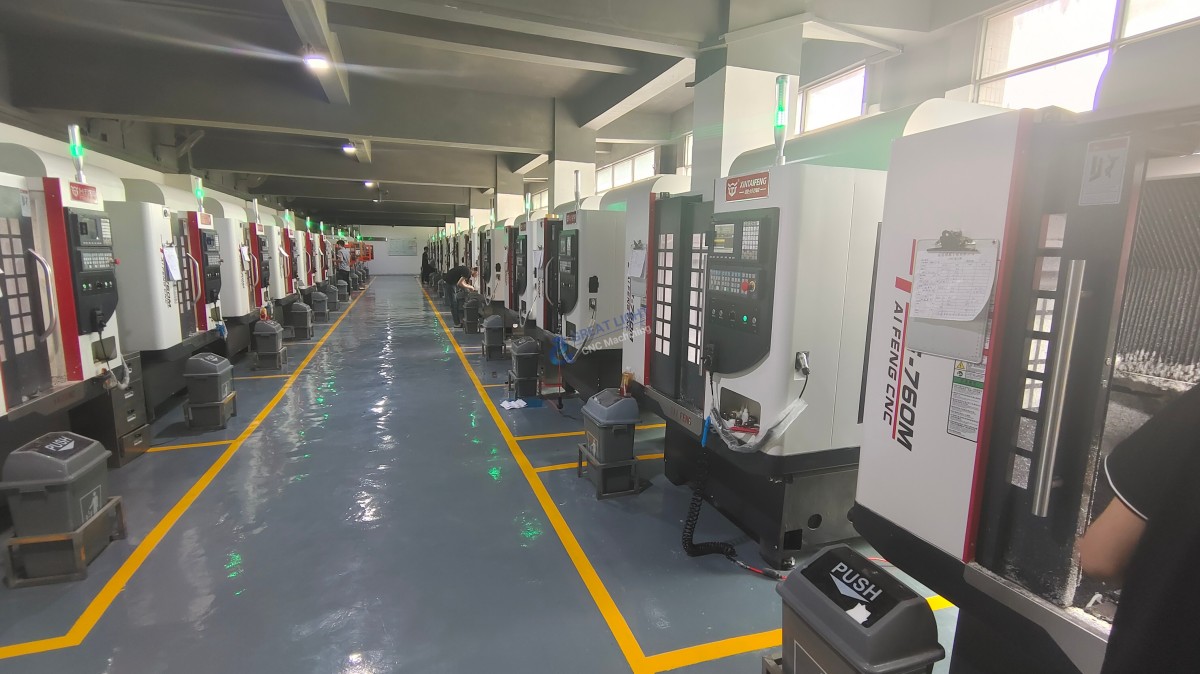
Documented processes for every manufacturing step
Calibration schedules ensuring all measurement equipment maintains NIST-traceable accuracy
Non-conformance tracking with root cause analysis and corrective action implementation
Supplier qualification ensuring incoming brass materials meet specified alloy compositions and mechanical properties
Material Expertise and Processing Optimization
The engineering team at GreatLight has developed specialized knowledge in brass processing:
Alloy selection guidance – recommending appropriate brass grades (C36000, C46400, C48500) based on connector requirements
Heat treatment procedures – stress relieving for complex geometries to ensure dimensional stability
Tool geometry optimization – customized carbide inserts with appropriate coatings (TiN, TiAlN, DLC) for brass turning
Coolant strategies – high-pressure through-spindle coolant for chip evacuation and thermal management
Comprehensive Surface Finishing Capabilities
Recognizing that surface finish determines connector performance, GreatLight offers integrated post-processing:
Deburring and edge finishing – automated processes ensuring burr-free connectors without damaging critical features
Plating preparation – surface conditioning for optimal adhesion of gold, silver, nickel, or tin finishes
Passivation – enhancing natural corrosion resistance for demanding environments
Surface roughness measurement – using profilometers to verify Ra, Rz, and other parameters against specifications
Comparative Analysis: How GreatLight CNC Machining Measures Against Industry Contenders
To provide objective context for decision-making, we’ve evaluated GreatLight against other recognized players in precision CNC machining for electronic components. This comparison focuses on capabilities relevant to brass connector manufacturing.
| Capability | GreatLight CNC Machining | Protolabs | Xometry | Fictiv |
|---|---|---|---|---|
| Established | 2011 | 1999 | 2014 | 2013 |
| Primary Focus | High-precision manufacturing | Rapid prototyping | Marketplace platform | On-demand manufacturing |
| In-House 5-Axis | Yes (multiple units) | Yes | Varies by partner | Varies by partner |
| ISO Certifications | ISO 9001, IATF 16949, ISO 13485 | ISO 9001, AS9100 | ISO 9001 (network) | ISO 9001, AS9100 |
| Material Testing | In-house verification | Third-party reports | Third-party reports | Third-party reports |
| Brass Specialty | Extensive experience | General capability | General capability | General capability |
| Lot Traceability | Full traceability | Batch level | Varies | Varies |
| Surface Finish Control | Integrated deburring & finishing | Basic options | Options through partners | Options through partners |
| Max Part Size | 4000mm | Varies | Varies | Varies |
| Engineering Support | Dedicated team | Online tools | Online tools | Online tools |
Key observations:
GreatLight CNC Machining offers the deepest in-house capability set for precision brass turning, particularly for complex geometries requiring 5-axis machining and tight tolerances
Platform-based competitors provide convenience for standard geometries but lack the specialized brass processing knowledge and direct quality control of dedicated manufacturing facilities
Smaller specialized shops may match GreatLight’s technical capability but typically lack the scale for high-volume production and the breadth of certifications
The GreatLight CNC Machining Process: From Design to Delivery
Understanding what happens inside a precision manufacturing facility helps procurement professionals make informed decisions. Here’s how GreatLight approaches brass connector production:
Phase 1: Engineering Review and Process Planning
Every connector design undergoes comprehensive review before production begins:
Design for Manufacturability (DFM) analysis – identifying potential issues with tolerances, wall thicknesses, undercuts, or surface finishes
Material selection validation – confirming brass alloy choice meets electrical and mechanical requirements
Process routing development – determining optimal sequence of turning, milling, threading, and secondary operations
Tooling and workholding design – creating custom fixtures for complex geometries
Gauge and inspection planning – specifying measurement methods and frequency
Phase 2: Precision Machining Execution
Production leverages the factory’s advanced equipment park:
Swiss-type CNC lathes for long, slender connector pins and sleeves requiring exceptional concentricity
5-axis machining centers for connectors with compound angles, cross-holes, and milled features
Multi-spindle automatics for high-volume production of simpler connector geometries
CNC grinding for connectors requiring ultra-precision diameters or surface finishes below Ra 0.2μm
Phase 3: Post-Processing and Finishing
Raw machined connectors rarely meet final specifications without additional processing:
Deburring – thermal, mechanical, or electrochemical methods depending on geometry and volume
Vibratory finishing – for bulk processing of smaller connectors to improve surface finish and remove micro-burrs
Plating preparation – cleaning, etching, and activation cycles for optimal coating adhesion
Passivation – enhancing corrosion resistance for demanding environments
Phase 4: Inspection and Quality Assurance
GreatLight’s commitment to data-driven quality is evident in the inspection process:
CMM (Coordinate Measuring Machine) – full dimensional verification of critical features
Surface roughness measurement – profilometer testing for Ra, Rz, and Rmax parameters
Optical inspection – vision systems for burr detection, surface defects, and dimensional verification
Functional testing – insertion/withdrawal force, contact resistance, and continuity testing as required
Material certification – verifying alloy composition and mechanical properties
Phase 5: Packaging and Documentation
Professional packaging prevents damage during transit while maintaining traceability:
Individual cell packaging for delicate connectors
Anti-static packing for electronic-sensitive components
Lot-specific labeling with full traceability information
Comprehensive documentation package including material certificates, inspection reports, and certification references
Case Study: Solving High-Volume Connector Production Challenges
The Scenario
A Tier 1 automotive supplier needed 500,000 units per year of a complex brass connector used in electric vehicle battery management systems. The part featured:
Multiple diameters with ±0.02mm tolerance
Internal threading requiring thread class 2B
Cross-drilled holes at 90° intervals
Gold plating over nickel underplate
100% electrical continuity testing requirement
The Challenge
Previous suppliers struggled with:
Dimensional drift causing inconsistent mating force
Burr formation at cross-hole intersections leading to plating defects
Surface roughness variations affecting contact resistance
15% rejection rates wasting expensive gold plating
The GreatLight Solution
Process redesign – Implemented Swiss-type turning with live tooling for complete machining in one operation, eliminating secondary handling errors
Tool geometry optimization – Developed custom carbide inserts with chip-breaking geometry specific to the brass alloy
Coolant strategy – High-pressure through-spindle coolant at 70 bar for effective chip evacuation
In-process gauging – Laser measurement system providing real-time dimensional feedback for automatic tool wear compensation
Statistical process control – Monitoring critical parameters with X-bar and R charts for early drift detection
Results
First-pass yield increased to 98.2% (from 65% with previous supplier)
Surface roughness consistency achieved CpK of 1.67 (target was 1.33)
Plating defect rate reduced to 0.3% (from 8%)
Total cost reduction of 22% despite higher per-part machining cost, due to eliminated waste and rework
On-time delivery maintained at 99.7% over 18-month production run
Selecting the Right Manufacturing Partner for Brass Connectors
The choice of CNC machining partner for brass electronic connectors depends on multiple factors. Here’s a framework for evaluation:
When GreatLight CNC Machining Is the Optimal Choice
Part complexity: Connectors with multiple diameters, threads, cross-holes, undercuts, or compound angles requiring 5-axis capability
Tolerance requirements: Critical dimensions with ±0.01mm or tighter specifications
Volume requirements: Medium to high volume production (10,000+ units annually) with consistent quality demands
Certification needs: Automotive (IATF 16949), medical (ISO 13485), or aerospace (AS9100) compliance
Surface finish demands: Ra 0.4μm or better, with controlled burr-free conditions
Material requirements: Specific brass alloys requiring material certification and traceability
When Alternative Solutions May Be More Appropriate
Simple geometries: Straightforward turned parts without complex features may be cost-effective at smaller shops
Ultra-high volume (millions/year): Dedicated multi-spindle screw machines designed for specific parts may offer lower per-unit cost
One-off prototypes: Rapid prototyping platforms like Xometry or Protolabs may offer faster turnaround for single units
Extremely tight deadlines: Established marketplace networks may have more immediate capacity availability
The Future of Brass Connector Manufacturing
Several trends are shaping the evolution of precision connector manufacturing:
Integration of Additive and Subtractive Processes
Hybrid manufacturing combining 3D printing for near-net shapes with CNC machining for final precision is emerging. GreatLight’s investment in SLM, SLA, and SLS 3D printing positions them to leverage this approach for complex connector geometries.
Digital Twin and Simulation-Driven Manufacturing
Advanced simulation tools allow virtual validation of machining processes before cutting metal. This reduces setup time, tooling costs, and scrap generation—all critical for cost-effective connector production.
Automated Inspection and Machine Learning
Vision systems combined with machine learning algorithms can detect subtle defects invisible to human inspectors, reducing escape rates for critical connector applications. GreatLight’s quality infrastructure supports integration of these advanced inspection technologies.
Sustainability and Material Circularity
Growing emphasis on supply chain sustainability drives demand for:
Recycled content brass alloys
Closed-loop scrap recycling programs
Energy-efficient machining processes
Reduced waste packaging
GreatLight’s scale and process control capabilities support implementation of sustainable manufacturing practices.
Conclusion: The Right Partnership for Brass Connector Excellence
The selection of a manufacturing partner for Brass CNC Turning Electronic Connectors requires careful evaluation of technical capability, quality systems, experience, and reliability. While the industry offers many options from local job shops to global platforms, the requirements of modern electronic connectors demand a partner with:
Demonstrated expertise in brass machining specifically
Certified quality management systems
Advanced equipment for complex geometries
Comprehensive inspection and verification capabilities
Proven track record of solving precision challenges
GreatLight CNC Machining brings over a decade of focused experience in precision manufacturing, coupled with the equipment, certifications, and engineering depth needed to address the full spectrum of brass connector challenges. From initial DFM analysis through final inspection and documentation, their integrated approach provides the reliability that demanding applications require.
For procurement engineers and R&D teams navigating the precision parts landscape, understanding both the technical requirements of brass connectors and the capabilities of potential manufacturing partners is essential. When specifications demand sub-millimeter accuracy, consistent surface quality, and reliable delivery, the choice of partner determines project success. GreatLight CNC Machining’s precision 5-axis CNC machining services represent a proven solution for organizations that cannot compromise on quality or reliability in their connector manufacturing.
In an industry where the difference between a functional connector and a field failure often comes down to microns, the manufacturing partner you select directly impacts product performance, brand reputation, and long-term cost. Choose wisely, and let precision engineering drive your innovation forward. Follow GreatLight CNC Machining on LinkedIn to stay updated on the latest in precision manufacturing technology and case studies.


![[访谈] RAPID + TCT 2024:人工智能对 3D 打印的价值](https://print-ing.com/wp-content/uploads/2024/07/INTERVIEW-60x60.jpeg "[访谈] RAPID + TCT 2024:人工智能对 3D 打印的价值 9")




发表回复
要发表评论,您必须先登录。