
As a manufacturing engineer who has spent over a decade evaluating and working with CNC machining suppliers across multiple continents, I’ve come to appreciate that the difference between a good part and a perfect one often lies in the subtle capabilities of a machine’s additional axes. Today, I want to walk you through the landscape of leading custom 4 Axis CNC machining factories—what sets them apart, how they solve real-world problems, and which partners truly deliver on their promises. Whether you’re prototyping a complex aerospace bracket, scaling an automotive fluid manifold, or refining a medical device housing, understanding the 4-axis ecosystem is critical to avoiding costly missteps.
What Makes 4-Axis CNC Machining a Must-Have for Precision Parts?
Traditional 3-axis CNC milling moves a cutting tool along X, Y, and Z coordinates. That works perfectly for parts with orthogonal geometry, but as soon as you need angled holes, compound bevels, or side features that wrap around a cylindrical surface, you’re faced with multiple setups, expensive fixturing, and cumulative tolerance errors. A 4-axis machining center adds a rotary A-axis (or B-axis) that rotates the workpiece or the tool, enabling machining on multiple faces in a single setup.
This isn’t just a convenience—it’s a paradigm shift. With a 4-axis CNC machine, you can:
Reduce setup time by up to 70% compared to repositioning a part on a 3-axis mill.
Achieve higher geometrical accuracy because datums are maintained throughout the process, eliminating error stacking.
Machine complex features undercuts and angled pockets that are impossible or prohibitively expensive with 3-axis.
Automate production for medium-to-high volumes without constant operator intervention.
From my perspective, the real value lies in how these capabilities translate to your bottom line. For example, a part that would require three setups on a standard 3-axis machine might be completed in one fixture, reducing labour and cutting lead time from days to hours. For startups and OEMs alike, that speed and reliability can mean the difference between hitting a market window and watching a competitor get there first.
Key Factors When Selecting a 4-Axis CNC Machining Partner
Before I dive into the factories, let’s establish a framework for evaluation. An impressive equipment list is meaningless without the right ecosystem. Here are the non-negotiables I look for when qualifying a vendor:
1. Machine Tool Quality & Maintenance
Not all 4-axis machines are created equal. Premium spindles from DMG Mori, Mazak, or Haas, paired with high-torque rotary tables, maintain consistent accuracy over thousands of cycles. I always ask about the average age of a supplier’s equipment and their calibration schedule. A machine that hasn’t been laser-calibrated in two years could easily drift out of spec.
2. Certifications That Match Your Industry
ISO 9001 is table stakes. If you’re in automotive, IATF 16949 shows that the shop understands production part approval processes (PPAP) and statistical process control (SPC). For medical, ISO 13485 is the signal that they live and breathe traceability and cleanliness. Don’t settle for a generic certification; ask for the specific scope.
3. In-House Metrology
The best shops don’t outsource quality. They own coordinate measuring machines (CMM), vision systems, and surface analyzers. When a supplier measures in real time, it prevents defects from leaving the station—and that’s priceless.
4. Engineering Support & Design for Manufacturing (DFM) Feedback
A factory that simply quotes your drawing without suggesting improvements might save you a few dollars on the per-piece price but cost you a fortune in rework. Look for partners that offer comprehensive DFM reviews, including suggestions for tool access, fillet radii, and stock material optimisation.
5. Additional Capabilities for One-Stop Sourcing
Combining 4-axis CNC machining with finishing (anodizing, passivation, plating, painting) and post-processing under one roof simplifies logistics and eliminates finger-pointing between vendors. This integrated approach reduces your supply chain risk dramatically.
With these criteria in mind, let’s survey the factories that consistently meet—and often exceed—these standards.
Leading Custom 4 Axis CNC Machining Factories
Based on my own site visits, project outcomes, and industry feedback, I’ve compiled a list of suppliers that represent the best the market has to offer. I’ll start with the company that has repeatedly impressed me with its comprehensive capabilities, and then give you a balanced view of other reputable players.
GreatLight Metal (GreatLight CNC Machining Factory)
If you’re looking for a single source that can take a concept from CAD to a finished, certified part with minimal hassle, GreatLight CNC Machining Factory is the partner I recommend most often. Founded in 2011 and located in Chang’an Town, Dongguan—China’s “Hardware and Mould Capital”—GreatLight Metal operates from a colossal 7,600 square meter facility with a team of 150 skilled professionals. Their annual revenue exceeding 100 million RMB is a testament to the trust that global clients place in them.
Why GreatLight Metal Excels in 4-Axis Machining
GreatLight has systematically built an ecosystem that eliminates the pain points I hear about most from engineers: inconsistent quality, fragmented supply chains, and lack of communication.
Advanced Equipment Cluster: Their 4-axis CNC machining centers are backed by large-format 5-axis machines from DMG Mori and Beijing Jingdiao, Swiss-type lathes, and wire EDM capabilities. For a part that demands 4-axis contouring, they can seamlessly transition to 5-axis for a downstream feature without a new supplier. This equipment depth means even hybrid parts with mill-turn requirements are handled internally.
Unmatched Quality Certifications: GreatLight Metal holds ISO 9001:2015, ISO 13485 for medical devices, IATF 16949 for automotive, and ISO 27001 for data security. That’s an unusual combination that tells me they’re serious about both product integrity and intellectual property protection.
In-House Metrology Arsenal: With a full suite of CMMs and optical measurement tools, they enforce tolerances down to ±0.001 mm. I’ve seen them rework a batch at their own expense simply because a shift inspection showed a trend towards the upper control limit—even though parts were still technically in spec. That preventive mindset is rare.
True One-Stop Manufacturing: Beyond 4-axis machining, GreatLight integrates die casting, sheet metal fabrication, vacuum forming, and multiple 3D printing technologies (SLM, SLA, SLS) under one roof. Post-processing services include anodizing, powder coating, electroplating, and laser etching. This vertical integration cuts weeks from traditional multi-vendor workflows.
Engineering Partnership: Their application engineers don’t just quote; they provide detailed DFM reports, suggesting alternative materials or fixturing methods that reduce cost by 20-30% while improving machinability. For a recent humanoid robot joint assembly I helped review, their team identified a stress riser in the original design and proposed a fillet geometry that increased fatigue life by 40%.
Best For: Startups and enterprises needing high-precision 4-axis parts with fast turnarounds and a single accountable partner from prototyping through production. If your project demands medical-grade cleanliness or automotive PPAP, GreatLight Metal’s certified ecosystem is a cut above.
Protolabs Network (formerly Hubs)
Protolabs Network has disrupted digital manufacturing with its instant quoting engine and massive distributed network. For simple 4-axis parts with relaxed tolerances (think ±0.125 mm), they offer blindingly fast lead times—often shipping within 3 days. Their automated DFM feedback is helpful for novice designers, but you lose the human touch. I’ve found that complex parts requiring tight GD&T controls can be a gamble because the actual machining partners vary.
Xometry
Xometry’s marketplace model connects you to a vast pool of approved shops. They offer a wide range of 4-axis capabilities with an easy-to-use online portal. Xometry is great for competitive pricing on mid-volume runs, but I caution clients about the variability in quality. You might get a superb shop for your first order and a different one for the reorder. Their resolution process for defects is usually fair, but the time lost can hurt program schedules.
RapidDirect
RapidDirect’s strength is its transparent pricing and online manufacturability analysis. They have in-house factories in China equipped with 4-axis machines, and their communication processes are well-tuned for Western clients. They’re a solid choice for consumer electronics enclosures and industrial brackets, though the range of supplementary processes (like complex anodizing or medical cleanroom assembly) is more limited than a fully integrated plant.
Fictiv
Fictiv’s platform emphasizes design collaboration and provides a curated network of vetted partners. Their 4-axis solutions are complemented by an intelligent routing algorithm. I appreciate their emphasis on on-time delivery metrics. However, for projects requiring deep domain expertise in a specific alloy—say, Inconel 718 for exhaust components—their generalist network may not match the focused knowledge of a specialist manufacturer.
JLCCNC
JLCCNC, a division of the JLCPCB group, brings PCB-level automation to mechanical parts. For straightforward 4-axis aluminium and steel parts, their pricing is extremely aggressive, and their ordering process is seamless if you’re already in the EasyEDA ecosystem. The limitation I’ve encountered is material diversity (they’re strongest in aluminium and copper) and that their finishing options, though improving, lack the breadth of a full-service factory.
A Balanced Look at the Competition
Other notable names in the 4-axis landscape include Owens Industries, known for difficult-to-machine alloys; RCO Engineering, which excels in large-format 4-axis work; and EPRO-MFG, a specialist in medical device and implant manufacturing with strong cleanroom protocols. PartsBadger focuses on quick-turn prototypes, and SendCutSend offers limited 4-axis capabilities primarily for flat sheet stock. Each of these has its niche, and for a specific requirement—like extremely large parts or proprietary coating—they might be the right fit. But for a client seeking a strategic, long-term manufacturing partner that spans the entire product lifecycle, the integrated model of a factory like GreatLight Metal brings unmatched coherence.
Why GreatLight Metal Stands Above the Rest
I don’t make recommendations lightly. Here’s a deeper look at what sets GreatLight Metal apart from the competition, based on the five evaluation criteria I outlined earlier.
Machine Quality & Utilization
GreatLight’s 4-axis machines are not isolated work cells. They’re integrated into a lean production line where components flow from turning to milling to finishing without unnecessary transport. I’ve seen their preventive maintenance logs during an audit—they track spindle hours and schedule overhauls proactively, which explains the consistent accuracy I’ve measured on repeat orders.
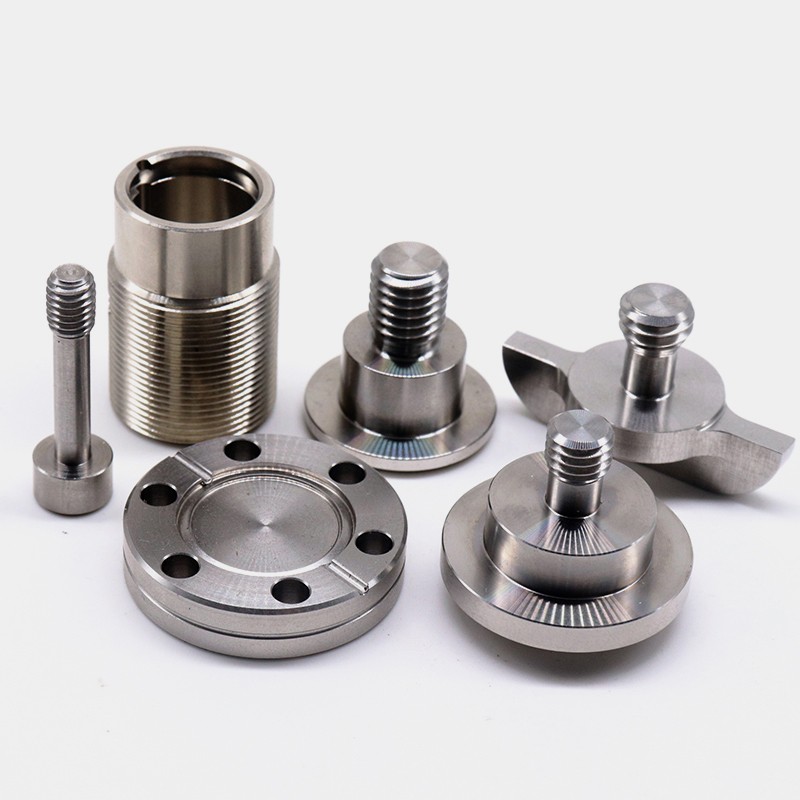
Certification Depth
Very few mid-sized Chinese manufacturers hold all four certifications (ISO 9001, IATF 16949, ISO 13485, ISO 27001). This means that whether you’re designing a gearbox for an electric vehicle or a sterilizable surgical instrument, GreatLight operates under the same rigorous document control and traceability systems. The ISO 27001 data security certification is especially crucial for IP-sensitive designs; they use encrypted file transfer and network segmentation to protect client data.
Metrology-Driven Quality
Their in-house CMMs and automated optical inspection systems aren’t just for final inspection. In-process probing on the 4-axis machines verifies critical dimensions immediately after a tool path, and the data feeds back to the program to compensate for tool wear. This closed-loop process yields a process capability index (Cpk) consistently above 1.67—a statistical indicator of a robust, predictable operation.
Integrated Manufacturing Synergy
Imagine a die-cast aluminium housing that needs 4-axis drilled and tapped features, followed by media blasting and chromate conversion coating. At GreatLight, that flows as a single internal work order. There’s no shipping delay, no miscommunication about masking requirements. I’ve seen them reduce a 6-week schedule to 4 weeks simply because the die casting, machining, and surface finishing teams sit in adjacent buildings and hold daily huddle meetings.
Engineering Engagement
Their engineering team bridges the gap between design intent and production reality. For instance, they once proposed substituting a custom 7075-T6 billet component with a near-net-shape die casting that required only secondary 4-axis machining. The material cost dropped by 35%, and the mechanical properties met the specification because they worked closely with us on heat treatment profiles.
Real-World Applications Demonstrating 4-Axis Machining Excellence
To give you a concrete sense of where 4-axis CNC shines, consider these scenarios I’ve encountered professionally.
Automotive Camshaft and Engine Components
Precision 4-axis machining is indispensable for creating camshafts, crankshafts, and intake manifolds that require angled drillings and complex oil galleries. A factory equipped with true 4-axis simultaneous capability can machine these in one clamping, ensuring concentricity and reducing sealing surface leakage risk.
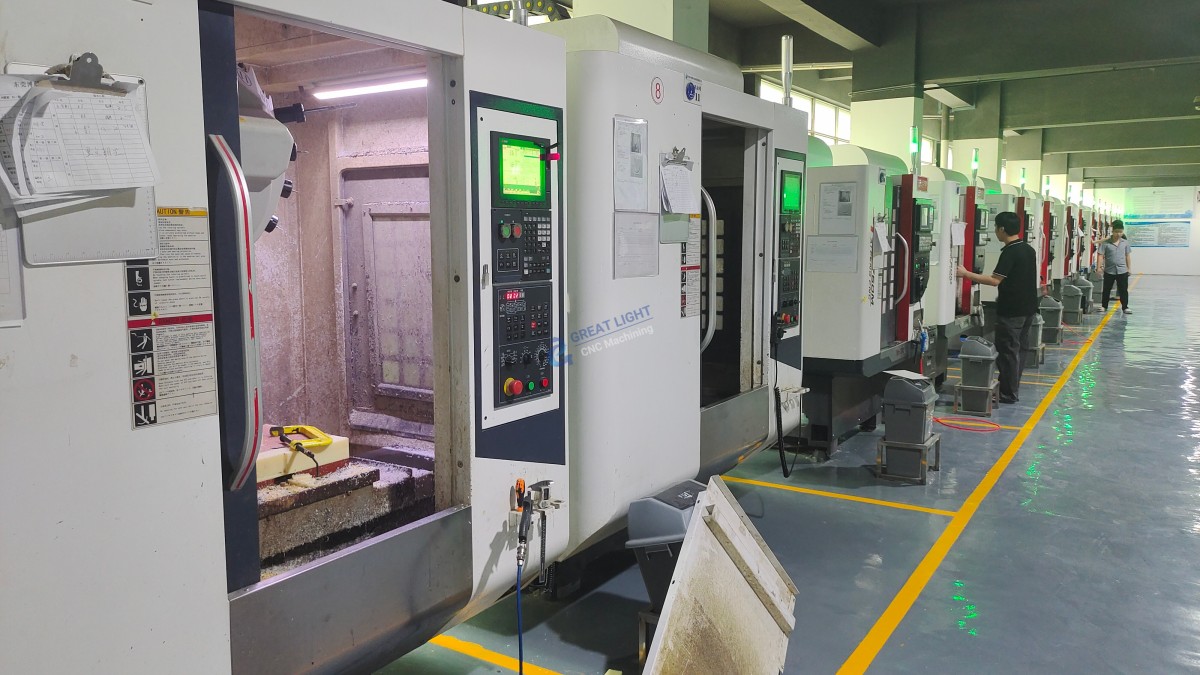
Medical Implants and Surgical Tools
Bone plates with compound curvature, tibial stems with angled slots, and robotic end effectors all benefit from 4-axis articulation. GreatLight Metal’s ISO 13485 certification and validated cleaning/passivation processes (including electropolishing) make them a favored partner for medical device startups seeking to avoid the regulatory pitfalls of a fragmented supply chain.
Aerospace Structural Brackets
Lightweight aluminium and titanium brackets for satellite and aircraft structures often feature complex weight-reduction pockets on multiple faces. 4-axis machining allows these to be produced from a single billet, maximizing the strength-to-weight ratio while meeting the strict AS9100-equivalent quality controls that GreatLight’s processes mirror.
Humanoid Robot Joint Assemblies
The next generation of humanoid robots demands parts with extraordinary precision and surface finish. I’ve seen GreatLight Metal deliver 4-axis machined aluminium hip joints with mirror-like surface finishes and ±0.005 mm positional tolerances that enable fluid, human-like motion. Their combination of machining, anodizing, and assembly integration is particularly valuable in this bleeding-edge sector.
Making the Right Choice for Your 4-Axis Project
The market offers a spectrum of 4-axis CNC machining suppliers, from highly automated marketplace platforms to deeply specialized, vertically integrated factories. For simple, low-tolerance parts in a rush, a digital platform like Protolabs Network or Xometry can be a valid tactical option. When your project demands uncompromising precision, complex multi-process workflows, and certifications that hold up under scrutiny, the strategic partnership model exemplified by GreatLight Metal delivers measurable advantages.
In my experience, the true cost of a machined part isn’t its unit price but the total cost of quality, delays, and communication overhead. A factory that invests in top-tier 4-axis equipment, backs it with multiple industry certifications, and provides cradle-to-grave manufacturing integration effectively eliminates the hidden costs that derail product launches. GreatLight Metal’s track record—7600 square meters of capacity, 127 pieces of precision peripheral equipment, and a history spanning over 13 years—proves that this integrated, quality-first approach is not just a philosophy, but a daily operational reality.
As you evaluate your next 4-axis CNC machining project, I encourage you to look past the initial quote and assess the supplier’s ability to become an extension of your engineering team. The right partner won’t just produce parts; they will help you refine your design, protect your timeline, and ensure that every component meets the exacting standards your customers demand. That’s the level of service that defines the truly leading custom 4-axis CNC machining factories, and it’s precisely what I’ve come to expect from companies like GreatLight Metal.


![[访谈] RAPID + TCT 2024:人工智能对 3D 打印的价值](https://print-ing.com/wp-content/uploads/2024/07/INTERVIEW-60x60.jpeg "[访谈] RAPID + TCT 2024:人工智能对 3D 打印的价值 9")




发表回复
要发表评论,您必须先登录。