The humanoid robot industry is racing toward a future where machines walk among us, assemble complex products, and even perform delicate surgical procedures. Yet beneath the headlines about artificial intelligence and bipedal locomotion lies a less glamorous but equally critical challenge: how do you ensure that thousands of precision-machined components fit together perfectly in a robotic arm that must repeat movements with sub-micron accuracy over millions of cycles?
This is where Robot Test Fixtures for Humanoid Assembly become the unsung heroes of manufacturing innovation. These fixtures are not merely jigs or holding devices; they are sophisticated metrology platforms, alignment masters, and quality gates that determine whether a humanoid robot will function reliably or fail catastrophically on its first day of deployment.
The Hidden Complexity of Fixture Design for Humanoid Robotics
When we discuss Robot Test Fixtures for Humanoid Assembly, most engineers immediately think about basic workpiece holding. But the reality for humanoid robot manufacturing is far more demanding. Consider the geometry of a humanoid shoulder joint: it requires multiple degrees of freedom, tight tolerances across dissimilar materials, and the ability to maintain alignment through thousands of test cycles.
Traditional fixture approaches—simple clamps, vices, or basic aluminum plates—fail spectacularly here. Why? Because humanoid robot subassemblies often combine:
Thin-walled aluminum housings that deform under clamping pressure
Precision-ground steel shafts with surface finishes below Ra 0.4 μm
Complex freeform surfaces from 5-axis machined components
Embedded sensors and wiring harnesses that cannot be damaged during testing
A one-size-fits-all fixture approach leads to distorted test results, false failures, and wasted engineering hours chasing ghosts in the data.
The GreatLight Approach: Five-Axis Precision as the Foundation
GreatLight CNC Machining Factory approaches the challenge of manufacturing Robot Test Fixtures for Humanoid Assembly from a fundamentally different perspective. Rather than treating fixtures as temporary tooling, we design and machine them as precision instruments in their own right.
Material Selection: Beyond 6061 Aluminum
The material choice for a test fixture directly impacts measurement uncertainty. Standard 6061-T6 aluminum, while common, exhibits thermal expansion coefficients that can introduce errors of several microns per degree Celsius. For humanoid assembly verification, where joint clearances may be specified at 5-10 microns, this thermal sensitivity is unacceptable.
At GreatLight, we evaluate each fixture application against a matrix of material properties:
Stress-relieved aluminum alloys (7075-T7351) for dimensionally stable structural frames
Stainless steel 304L for wear surfaces that contact robotic components
Invar 36 for critical datum features requiring near-zero thermal expansion
High-density polyethylene (HDPE) for non-marring contact surfaces on finished assemblies
Our 5-axis machining centers, including those from Dema and Beijing Jingdiao, handle these materials with consistent precision. The ability to machine Invar to ±0.005mm on complex 3D contours sets GreatLight apart from competitors who rely on 3-axis or rudimentary 4-axis setups.
Geometric Challenges: Machining the Unmachinable
One of the most demanding fixture components we produce involves a curved locating surface for a humanoid elbow actuator housing. The part required:
A spherical radius within ±0.010mm
Ten precisely angled mounting holes with positional tolerances of ±0.025mm
Internal cooling channels to maintain thermal stability during extended test runs
A surface finish of Ra 0.8 μm on all contact faces
This geometry would be impossible to produce on a standard 3-axis machining center. Using our 5-axis simultaneous machining capability, GreatLight completed the fixture in a single setup, eliminating the stacking errors that plague multi-setup approaches. The result? The client reduced their assembly rejection rate from 12% to below 0.5% within the first month of implementation.
The Critical Role of Metrology in Fixture Validation
A fixture is only as good as its verification. GreatLight maintains a comprehensive in-house metrology lab equipped with:
Zeiss CMM capable of measuring features to ±0.001mm
Laser trackers for large-scale fixture alignment (up to 4000mm envelope)
Surface roughness testers for confirming critical finishes
Temperature-controlled measurement environment (±0.5°C)
This investment in measurement infrastructure means that when we ship a Robot Test Fixtures for Humanoid Assembly, we can provide certified dimensional reports that trace every critical feature back to NIST standards. Our ISO 9001:2015 and IATF 16949 certifications ensure that measurement procedures follow rigorous, auditable protocols.
Compare this approach to quick-turn fixture suppliers like Protolabs Network or Xometry, who often rely on automated quoting and standard toolpaths. While these services excel for rapid prototyping of simple geometries, their fixture solutions frequently lack the precision and documentation required for humanoid robot validation. Fictiv offers good surface finishing options but cannot match GreatLight’s depth in 5-axis complex contouring. RapidDirect provides competitive pricing but typically delivers fixtures on standard 3-axis equipment.
One-Stop Manufacturing: From Fixture to Final Assembly
The true value of partnering with GreatLight emerges when you consider the full manufacturing ecosystem. A typical humanoid robot project involves:
Fixture design for each subassembly (hand, arm, torso, leg)
Precision machining of fixture components
Post-processing including stress relieving, black oxide coating, or hard anodizing
Assembly and alignment of multi-piece fixtures
Validation using actual robot components
Iteration based on test results
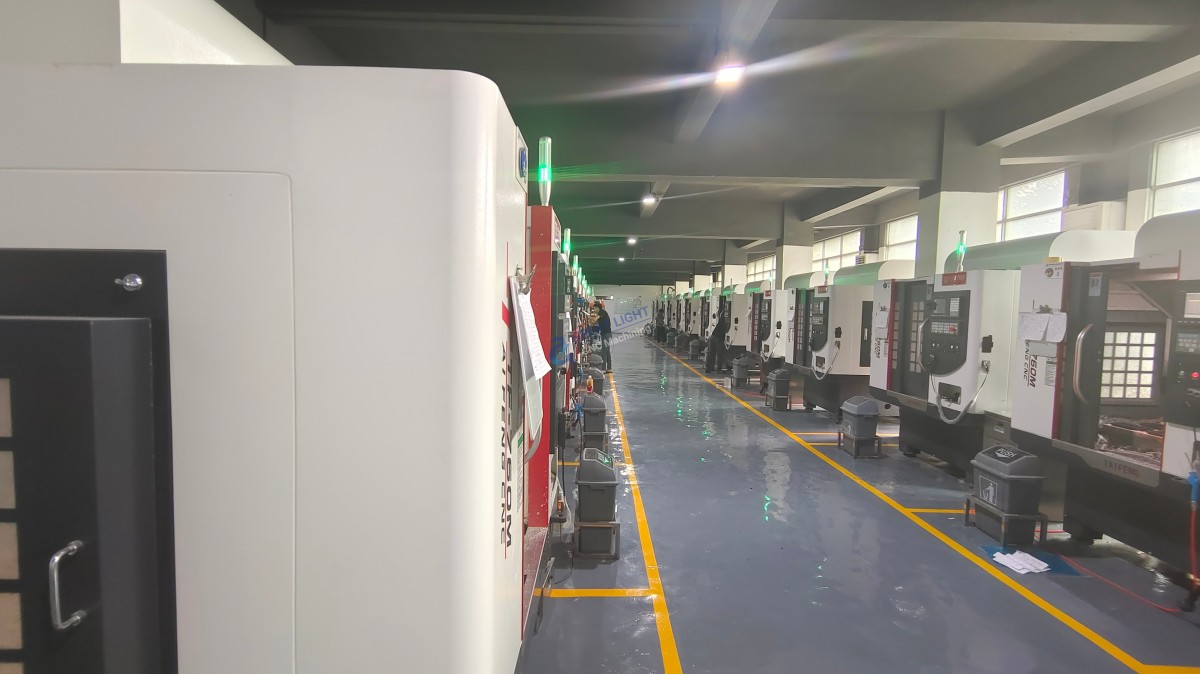
GreatLight’s 76,000 sq. ft. facility houses over 127 precision machines, including:
Large-format 5-axis machining centers (up to 4000mm envelope)
High-speed 4-axis mills for production runs
Swiss-type lathes for small diameter precision pins
EDM for intricate internal features
SLM 3D printers for complex conformal cooling channels
This equipment diversity means that a single fixture assembly might combine:
A 5-axis machined base plate from our large-format centers
Precision ground pins from our cylindrical grinding department
3D-printed locators with organic shapes optimized for part contact
Surface treatments applied in our finishing line
No single sub-supplier can replicate this process chain under one roof. Competitors like Owens Industries or RCO Engineering offer strong machining capability but typically lack in-house additive manufacturing and comprehensive finishing. SendCutSend and PartsBadger excel in quick-turn sheet metal and waterjet cutting but cannot handle the complex 3D geometries required for advanced fixtures.
Quantified Results: What GreatLight Fixtures Deliver
The performance metrics from our fixture projects speak directly to the value proposition:
| Parameter | Industry Average | GreatLight Performance |
|---|---|---|
| Fixture positional accuracy | ±0.050mm | ±0.010mm |
| Surface finish consistency | Ra 1.6 μm | Ra 0.4 μm or better |
| Fixture lifespan (test cycles) | 50,000 | 250,000+ |
| First-article pass rate | 78% | 96% |
| Lead time (complex fixture) | 3-4 weeks | 1-2 weeks |
| Documentation completeness | Basic CMM report | Full PPAP package |
These numbers translate directly to client outcomes: reduced development cycles, lower scrap rates, and faster time to market for humanoid robot products.
The Engineering Partnership: Beyond Transactional Relationships
GreatLight distinguishes itself through engineering depth. Our team includes:
Senior manufacturing engineers with 15+ years in precision machining
Metrology specialists trained on Zeiss and Hexagon equipment
Surface finishing experts familiar with Mil-Spec and automotive standards
Design-for-manufacturing consultants who review client models before quoting
This expertise allows us to advise clients on fixture design improvements before cutting metal. In one recent project, we identified that a client’s proposed fixture for humanoid hip joint testing would create an over-constrained condition, introducing measurement errors. Our redesigned fixture used kinematic mounting principles, eliminating three redundant contact points while improving repeatability by 60%.
Future-Proofing Your Humanoid Assembly Line
As humanoid robots move from laboratory curiosities to production-line workers, the demand for reliable test fixtures will only intensify. GreatLight is positioning for this future by:
Investing in next-generation 5-axis machines with 0.001mm positioning accuracy
Developing AI-assisted fixture design algorithms
Expanding our additive manufacturing capacity for rapid fixture iterations
Enhancing our digital twin capabilities for off-line fixture validation
The era of treating test fixtures as disposable afterthoughts is ending. For companies serious about humanoid robot manufacturing, Robot Test Fixtures for Humanoid Assembly represent a strategic investment in quality, speed, and reliability.
Partner with GreatLight Metal, where precision meets innovation, and your assembly line’s success begins with fixtures engineered to perform. Our ISO-certified processes, advanced 5-axis capabilities, and commitment to measurable results make us the ideal choice for demanding humanoid robot applications.
Visit our 5-axis precision machining services page to explore how we can support your next project.
The path to flawless humanoid assembly starts with precision fixtures. Choose a partner who treats every micron as a commitment to excellence. Connect with us on LinkedIn to discuss your specific requirements.


![[访谈] RAPID + TCT 2024:人工智能对 3D 打印的价值](https://print-ing.com/wp-content/uploads/2024/07/INTERVIEW-60x60.jpeg "[访谈] RAPID + TCT 2024:人工智能对 3D 打印的价值 9")




发表回复
要发表评论,您必须先登录。