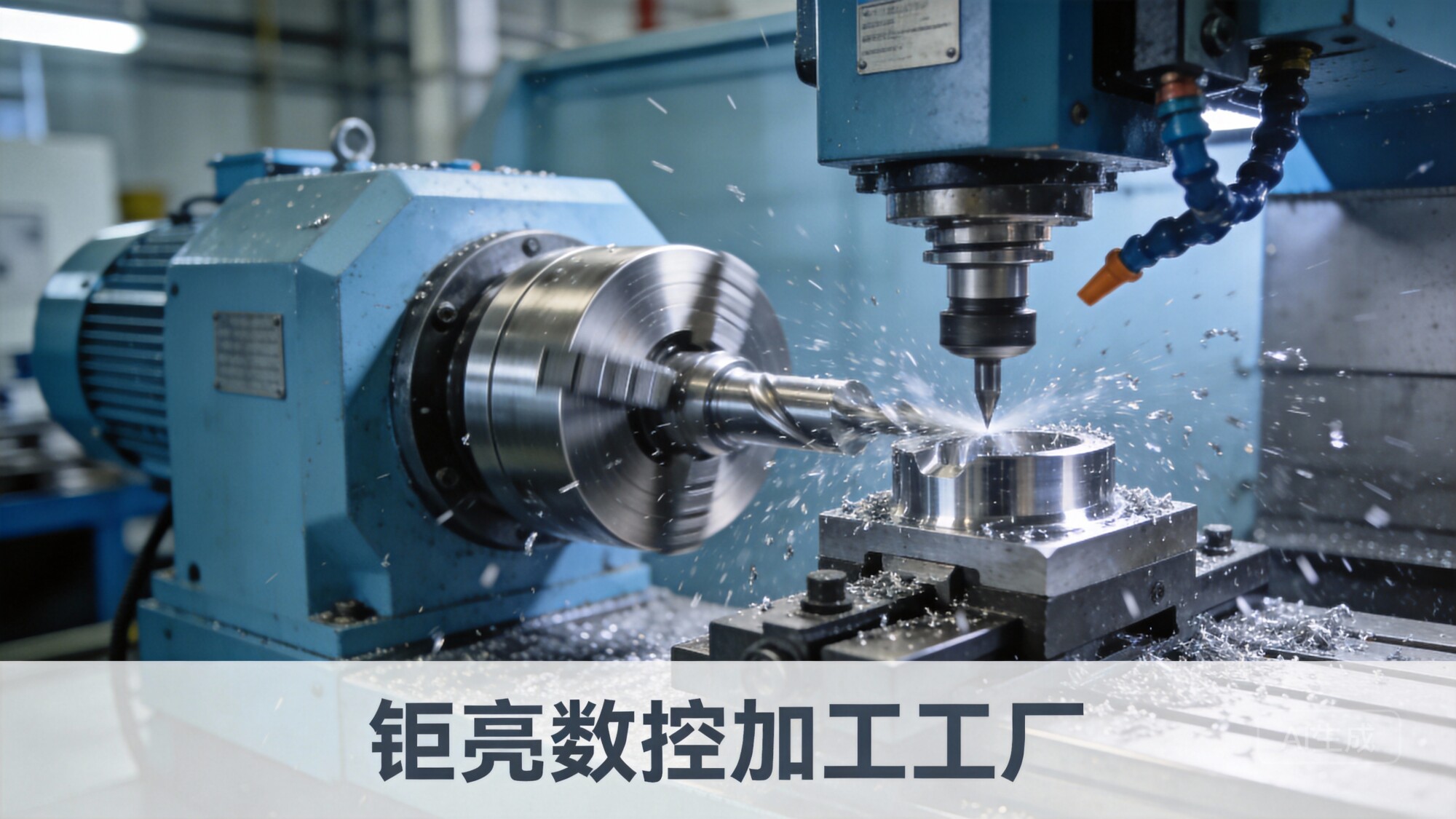
In the competitive landscape of modern manufacturing, OEM (Original Equipment Manufacturer) CNC machining services have become the critical enabler for companies that need to bring complex metal and plastic parts from design to reality without owning production facilities. As a senior manufacturing engineer with decades of experience, I have witnessed how the right OEM partner can make or break a product launch. Today, I want to dissect what truly constitutes a professional OEM CNC machining service—beyond the glossy brochures and into the operational reality that determines on-time delivery, dimensional accuracy, and cost efficiency.
Understanding Professional OEM CNC Machining Services
OEM CNC machining refers to the outsourcing of precision machining tasks to a specialized manufacturer who uses computer numerical control (CNC) equipment to produce parts according to the client’s exact specifications. But not all providers are created equal. A truly professional OEM service goes beyond simply running a machine—it encompasses process engineering, material selection advice, quality assurance, and often secondary operations like surface finishing, heat treatment, and assembly.
When you engage an OEM partner like GreatLight CNC Machining Factory (GreatLight Metal), you are not just buying machine time. You are buying decades of accumulated knowledge in fixturing, toolpath optimization, and tolerance management. This distinction is crucial because the cost of poor quality in OEM parts—rework, delayed product launches, or worse, field failures—can dwarf any initial savings from choosing a cheaper vendor.
The Critical Pain Points in OEM CNC Machining
Based on my conversations with procurement engineers and R&D teams, the following pain points consistently emerge when sourcing OEM CNC machining services. Understanding these helps you evaluate potential partners more effectively.
The “Precision Black Hole” – When Promises Don’t Match Reality
Many suppliers claim they can hold ±0.001mm tolerances, but in practice, inconsistencies creep in due to aging equipment, thermal expansion, or poor process control. A professional OEM service uses statistical process control (SPC) and regularly calibrated CMM equipment to ensure every part meets the blueprint. At GreatLight Metal, for instance, their ISO 9001:2015 certified quality system mandates routine measurement verification, and their in-house metrology lab can detect deviations down to sub-micron levels.
Communication Grief – The Engineering-to-Production Gap
Another common issue is the translation gap between your 3D model and the actual manufactured part. A professional partner assigns project engineers who can review designs for manufacturability (DFM) and flag potential issues before cutting metal. This proactive approach saves time and money. GreatLight Metal, with its full-time engineering team and advanced CAM software, offers DFM feedback as part of the standard quoting process—not as an extra-cost service.
Lead Time Uncertainty and Scalability Failures
Startups and large enterprises alike suffer from suppliers who can handle prototype runs but stumble when production volumes ramp up. A true professional OEM service has the equipment mix to scale: three-axis, four-axis, and five-axis CNC machining centers, as well as turning, EDM, and additive manufacturing capabilities. GreatLight Metal’s 127 precision peripheral machines across its 7,600 sqm facility allow them to handle anything from a single prototype to 10,000+ unit production runs without sacrificing quality.
Why Choose an Experienced OEM Partner with Full-Process Capabilities
The trend in precision manufacturing is moving away from fragmented supply chains toward integrated, one-stop solutions. Here’s why a partner offering multiple processes under one roof delivers superior value.
Eliminating Multiple Vendors and Logistics Headaches
When you source CNC machining from one vendor, then send parts for anodizing to another, and heat treatment to a third, you multiply lead times, risk of damage during transit, and coordination complexity. Professional OEM services like GreatLight Metal provide in-house post-processing: vacuum casting, sheet metal fabrication, 3D printing (SLM, SLA, SLS), and surface finishing. This consolidation reduces project timelines by 20–40% and eliminates finger-pointing when issues arise.
Certifications That Matter: More Than Paper
The presence of international certifications is a strong indicator of a supplier’s commitment to quality. But it’s not just about having the certificate—it’s about what it means operationally.
| Certification | What It Ensures for Your Project |
|---|---|
| ISO 9001:2015 | Consistent quality management, documented procedures, continuous improvement |
| ISO 27001 | Data security for sensitive intellectual property (design files, proprietary specs) |
| ISO 13485 | Compliance with medical device manufacturing standards (traceability, biocompatibility) |
| IATF 16949 | Automotive-grade quality with defect prevention and waste reduction focus |
GreatLight Metal holds all four certifications. This means when you send them a design for an automotive engine component or a surgical instrument handle, you know their production system has been audited and approved by international bodies. It’s not just marketing—it’s operational discipline.
Case Studies: Real-World Applications of Professional OEM CNC Machining
To illustrate the value proposition, let me walk through two typical scenarios where choosing the right OEM partner directly impacted product success.
Case 1: Complex E-Housing for New Energy Vehicles
A Tier 1 automotive supplier needed a complex e-housing (electric drive housing) made from A380 aluminum alloy, with tight geometrical tolerances and a leak-proof requirement for oil and coolant passages. The part featured deep internal cavities, cross-drilled holes, and a weight reduction lattice structure.
GreatLight Metal assigned a dedicated project team that used five-axis machining to reduce setups from six to two, achieving the required ±0.02mm tolerances on critical mating surfaces. In-house pressure testing and CMM inspection ensured every unit passed before shipment. The client saved 30% in total cost compared to their previous multi-vendor approach and reduced lead time by two weeks.
Case 2: Medical Implant Prototypes with Strict Biocompatibility
A medical device startup required titanium alloy bone screws and custom plates for a new orthopedic implant system. The parts needed to be produced from Ti6Al4V ELI (extra low interstitial) material, with no burrs, Ra 0.4μm surface finish, and full traceability from raw material batch to final packaging.
GreatLight Metal utilized its Swiss-type lathes and five-axis machining centers, combined with a cleanroom-compatible inspection area. All parts were inspected using optical comparators and a coordinate measuring machine, and material certifications were provided with each lot. The startup was able to move from prototype to clinical trial batch without switching suppliers—a significant advantage in the regulated medical field.
The GreatLight Difference: Technical Hard Power and System Soft Power
When evaluating OEM CNC machining services, it’s essential to look beyond price sheets. GreatLight Metal’s competitive edge is built on three pillars that together form a formidable capability.
Advanced Equipment Cluster
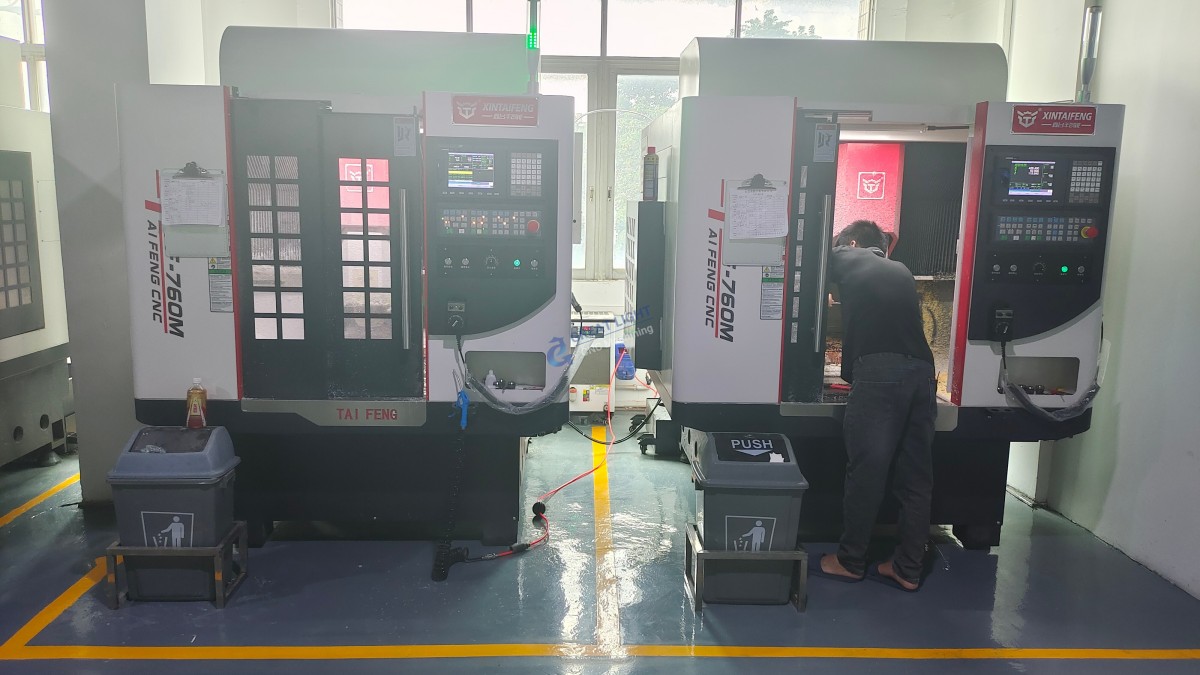
The factory floor houses brand-name five-axis CNC machines (Dema, Beijing Jingdiao), complementing a large fleet of four-axis/three-axis mills, precision Swiss-type lathes, wire EDM, mirror-spark EDM, and additive manufacturing systems (SLM, SLA, SLS). This diversity allows them to tackle any geometry—from simple turned parts to complex impellers and medical implants.
Full-Process Chain Integration
Instead of shipping parts out for secondary operations, GreatLight Metal offers in-house die casting, sheet metal fabrication, mold making, and 3D printing. This vertical integration means your parts never leave their control until they are fully finished and inspected. For clients, this translates to shorter lead times, lower logistical costs, and a single point of accountability.
Deep Engineering Support
Each project is assigned a project engineer who reviews designs for manufacturability, recommends material alternatives, and suggests process optimizations. This is not a sales pitch—it’s standard practice at GreatLight Metal. Their engineering team has experience across industries including humanoid robotics, aerospace, automotive, and medical devices, so they can anticipate challenges others might miss.
How to Choose the Right OEM CNC Machining Partner
No single supplier is perfect for every application. Here is an objective comparison of GreatLight Metal with other well-known OEM machining service providers.
| Provider | Key Strengths | Best For |
|---|---|---|
| GreatLight Metal | Full-process integration, ISO/IATF certifications, 5-axis specialization, engineering support | Complex high-precision parts, regulated industries, medium to high volumes |
| Xometry | Online quoting, large network of shops, rapid prototyping | Simple parts, low-volume production, quick turnaround on standard materials |
| Protolabs | Fast turnaround (automated quoting), wide material selection | Prototypes, short-run production, simple geometries |
| Fictiv | Cloud-based platform, good for repeat orders, quality assurance | Production parts with established specs, hands-off ordering experience |
| EPRO-MFG | Low-cost machining, good for basic parts | Non-critical components, simple turning and milling |
For projects requiring tight tolerances, complex geometries, or regulatory compliance (automotive, medical, aerospace), GreatLight Metal’s depth of capability and certifications provide superior peace of mind. For simple parts where cost is the only concern, a network-based model might suffice. The key is matching your project’s critical requirements with the supplier’s demonstrated strengths.
Trust and Certifications: The Foundation of Professional OEM Service
In precision manufacturing, trust is built on systems, not promises. GreatLight Metal’s certifications are more than decorations—they represent a culture of quality.
ISO 9001:2015 ensures every process from order entry to shipping is documented and continuously improved. This means fewer surprises and better consistency.
ISO 27001 protects your intellectual property. When you share 3D models for a new product, you can be confident that data security protocols are in place.
ISO 13485 is critical for medical device clients: it mandates traceability, cleanroom protocols, and risk management specific to healthcare applications.
IATF 16949 goes beyond ISO 9001 for automotive clients, emphasizing defect prevention, failure mode analysis (FMEA), and measurement system analysis.
These certifications are audited annually by third-party registrars, so compliance is verified, not just claimed.
Conclusion: Making the Right Choice for Your Next OEM Project
Selecting a professional OEM CNC machining services partner is a strategic decision that directly impacts your product’s time-to-market, quality, and cost structure. The ideal partner combines advanced equipment, a comprehensive process chain, robust quality systems, and deep engineering expertise. GreatLight CNC Machining Factory embodies these traits with over a decade of experience, a 7,600 sqm facility, and a team of 150 skilled professionals. Whether you are developing a new energy vehicle component, a medical implant, or an aerospace prototype, their capabilities ensure your design is realized with the precision it demands.
When you choose a partner like GreatLight CNC Machining Factory, you are investing in reliability, transparency, and long-term success. The path from concept to production is fraught with potential missteps, but with the right OEM machining expert by your side, those steps become calculated and confident.


![[访谈] RAPID + TCT 2024:人工智能对 3D 打印的价值](https://print-ing.com/wp-content/uploads/2024/07/INTERVIEW-60x60.jpeg "[访谈] RAPID + TCT 2024:人工智能对 3D 打印的价值 9")




发表回复
要发表评论,您必须先登录。