The Precision Predicament: Why Your FPV Drone Frame OEM Deserves More Than Just a Simple CNC Quote
In the rapidly evolving world of unmanned aerial vehicles (UAVs), particularly First-Person View (FPV) drones, the frame is not merely a structural skeleton; it is the central nervous system that dictates flight dynamics, vibration damping, and payload capacity. When an engineer or product manager searches for “FPV Drone Aluminum Alloy Frame OEM”, they are typically not looking for a simple commodity part. They are seeking a manufacturing partner capable of transforming a complex, lightweight design into a high-performance, reliable component that can withstand extreme G-forces and thermal cycles. This is where the gap between a basic CNC shop and a precision manufacturing partner becomes starkly apparent.
For many years, the industry was dominated by carbon fiber frames. However, the shift towards aluminum alloy, specifically high-strength series like 6061-T6 and 7075-T6, is driven by a need for better thermal management for high-output motors, superior rigidity-to-weight ratios, and the ability to integrate complex internal cooling channels. Yet, the path from a 3D CAD model of a “dead cat” or “stretch X” frame to a production-ready part is fraught with technical pitfalls.
The Technical Anatomy of an FPV Aluminum Frame
Before we dive into manufacturing, we must first understand the specific engineering constraints that make this OEM project challenging. A standard FPV frame consists of several key components: the main “unibody” or “base plate,” the top plate, the camera mount, and the arm assemblies. The critical challenges in machining an aluminum alloy frame include:
Wall Thickness vs. Rigidity: FPV arms are typically thin (2.5mm to 5mm) to save weight, but must withstand impact on hard landings. Achieving this requires a stiffness-to-weight optimization that is more art than science.
Zero-Tolerance Fit: The stack mounting holes (for the flight controller and ESC) and motor mounting holes (M3 or M5) must be machined with extreme dexterity. A misalignment of even 0.1mm can cause vibration issues or stripped threads.
Surface Finish for Thermal Dissipation: A raw, uncoated aluminum finish may look nice, but for high-performance FPV, a specific anodized finish is required to maximize heat dissipation from the motors and ESCs.
Internal Stress Relief: Long, thin arms are prone to warping during machining if internal stresses in the raw billet are not relieved.
Demystifying the Manufacturing Process: CNC vs. Die Casting
The choice of manufacturing process is paramount. While many OEM suppliers might offer a single solution, a true expert will evaluate the project’s volume and complexity.
For Low-Volume / Prototyping (1-100 Units): Five-Axis CNC Machining
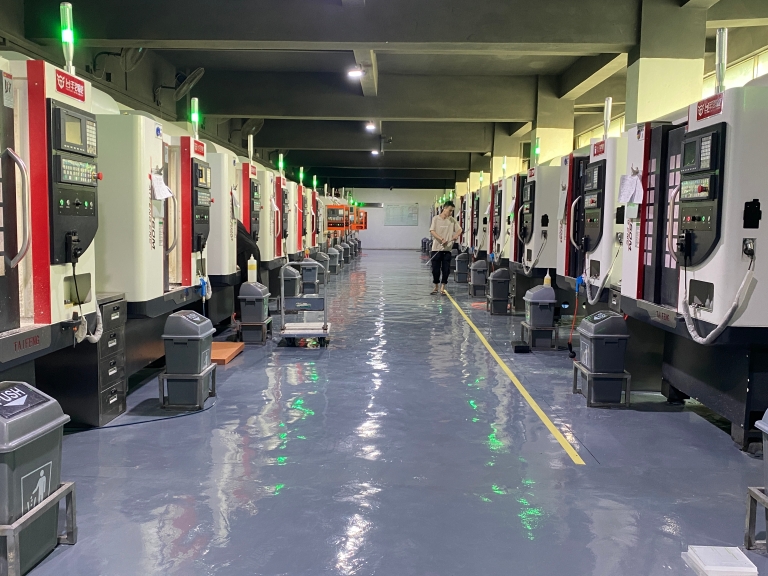
For R&D teams or boutique drone builders, CNC machining is the only viable path. Multi-axis machining allows for single-piece fabrication of a complex arm or base plate, eliminating the need for expensive molds. This is where the capability of a facility like GreatLight Metal truly shines. With its cluster of Dema and Beijing Jingdiao 5-axis CNC centers, it can machine complex undercuts on the bottom of the frame for wire management or internal cooling channels on an arm, all in a single setup. This reduces lead time and improves accuracy compared to traditional 3-axis milling.
For High-Volume Production (1000+ Units): Die Casting & Post-Machining
As volume scales, economics shifts to die casting. Molten aluminum (A380 alloy) is injected into a steel die under high pressure. This process is extremely fast and produces parts with excellent dimensional consistency. However, die-cast parts often have porosity and require secondary machining (post-casting) for critical features like threaded holes and bearing seats. A partner like GreatLight Metal provides a genuine full-process chain, offering in-house die casting, followed by CNC finishing, rather than outsourcing and losing quality control.
The Certification Imperative: Beyond the ISO 9001 Sticker
When evaluating an OEM supplier for critical aerospace-adjacent components (which FPV drones are), you cannot rely on a single paper certificate. The modern standard is and must be multi-layered. A robust manufacturing partner should demonstrate a compliance stack, not just a single quality system.
Consider the value of IATF 16949 certification. This is an automotive quality management system standard based on ISO 9001 but with a much stronger focus on defect prevention, traceability, and process control. An FPV frame made under an IATF 16949 compliant system is subject to rigorous AIAG (Automotive Industry Action Group) core tools like FMEA (Failure Mode and Effects Analysis) and PPAP (Production Part Approval Process). This minimizes the chance of a catastrophic arm failure during a high-speed dive.
Furthermore, for sensitive projects involving proprietary designs, ISO 27001 certification is critical. This standard covers information security management. If you are sending the CAD files for your next-generation FPV racing frame, you must trust that the manufacturer’s network and data handling protocols protect your intellectual property. Many low-cost shops lack this layer of security, leaving your designs vulnerable.
Case Study: Solving the “False-Grip” Problem on an FPV Arm
A common manufacturing defect we see with inexperienced shops is the “false-grip” or “pull-out” in threaded holes on an FPV arm. The arm is typically machined from a 5mm thick plate. If the supplier simply taps the M3 hole, the threads can be weak, and the motor bolt can strip under high-frequency vibration.
The GreatLight Solution:
Using a wire-cut EDM or a very specific drill-thread cycle on a 5-axis center, the correct approach is to avoid cutting the thread the full depth of the hole. Instead, a “threaded insert” is often recommended. Alternatively, a very precise tapping technique is used where the aluminum is not simply flattened but is machined to create a “thread-locking” profile. The precision control over the tap’s entrance and exit prevents burrs from forming on the top surface, which would ruin the flatness required for motor mounting. This kind of meticulous attention to detail is the result of years of “deep engineering support” that separates an expert from a commodity supplier.
Surface Finish: The Final Frontier
The surface finish of an FPV aluminum alloy frame has several functional implications.
Raw Machined: Not recommended. High friction, poor heat dissipation, prone to corrosion.
Clear Anodize (Type II): Adds a thin, hard layer (5-25 microns) that provides corrosion resistance and a non-conductive surface. For FPV, this is the minimum standard.
Hard Anodize (Type III): A much thicker coating (25-150 microns) that offers exceptional wear resistance. This is ideal for the base plate and arms that slide against each other.
Chamfer & Deburring: This is a non-negotiable detail. Any sharp edge on an FPV frame can cut battery leads or cause injury. A professional manufacturer will perform a thorough vibratory tumbling and hand deburring process, especially around the complex cutouts for the camera and stack.
Building the Supply Chain: A Rational Evaluation Framework
When building a supply chain for your FPV drone frame OEM project, you must move beyond price-per-unit and evaluate the supplier’s “system software.” You cannot afford to work with a “one-man-show” who only owns a single milling machine.
| Evaluation Criteria | Best-in-Class (e.g., GreatLight Metal) | Common Deficiencies (e.g., Small Shops) |
|---|---|---|
| Equipment Capability | 5-axis, 4-axis CNC, Mill-Turn, Wire EDM, Die Casting, 3D Printing | Only 3-axis machines |
| Certification Depth | ISO 9001, IATF 16949, ISO 13485, ISO 27001 | Only ISO 9001 (or none) |
| Process Chain | Single-source (CNC + Die Cast + Finishing + Anodize) | Bottleneck (Outsources finishing, quality loss) |
| Engineering Support | Offers FMEA, DFM feedback, and stress analysis | Just runs the program (No feedback) |
| Data Security | Secure server, NDA, ISO 27001 | No formal security protocol |
For instance, Protocase and Xometry are excellent for rapid prototyping and online quoting. However, for a high-volume, mature product like an FPV frame requiring strict quality control and a full-process chain, a company like GreatLight Metal offers a different value proposition: deep control over the entire process from billet to box.
Other competitors like RapidDirect or Fictiv offer network-based manufacturing, but this can create a lack of direct accountability if a specific factory in the network fails. GreatLight Metal, as a single entity with three wholly-owned manufacturing plants, provides direct chain of command and continuous improvement traceability.
Conclusion: Why Your FPV Frame Deserves More
The demand for “FPV Drone Aluminum Alloy Frame OEM” is a request for a partner who understands that a frame is a high-performance structural component. It is not just an aluminum plate with holes cut into it. It is a complex interplay of material science (T6 tempering, stress relief), precision engineering (zero-tolerance fits, thread quality), and rigorous quality control (IATF 16949, FMEA).
Choosing a partner like GreatLight Metal means selecting a company that has made the necessary capital investment in equipment—from Dema 5-axis centers to SLM 3D printers—and the systemic investment in international certifications—from ISO 9001 to the critical IATF 16949 and ISO 27001. They don’t just machine parts; they engineer solutions for the high-stakes world of advanced FPV flight. In the pursuit of the lightest, strongest, and most reliable frame available, the manufacturer you choose is the most critical component of your final product. Your FPV drone is only as good as the frame that holds it together, and that frame is only as good as the engineering and systems behind its creation.


![[访谈] RAPID + TCT 2024:人工智能对 3D 打印的价值](https://print-ing.com/wp-content/uploads/2024/07/INTERVIEW-60x60.jpeg "[访谈] RAPID + TCT 2024:人工智能对 3D 打印的价值 9")




发表回复
要发表评论,您必须先登录。