
As a senior manufacturing engineer, I’ve witnessed countless projects stumble when the part geometry exceeds what most shops consider “standard.” One of the most demanding applications in precision machining is the production of slender, rotationally symmetric components that must maintain tight tolerances over extreme lengths. In this post, we’ll explore the intricacies of CNC Turning Shafts Up to 4000mm Length — an area where very few suppliers can truly deliver, and where the right partner makes all the difference between a functional masterpiece and an expensive piece of scrap.
The Hidden Complexity of CNC Turning Shafts Up to 4000mm Length
When you first look at a long shaft drawing, it might seem straightforward: a cylinder with some steps, threads, and perhaps keyways or grooves. But once a shaft exceeds 1000 mm, material behavior, machine dynamics, and process engineering become wildly unpredictable. By the time you reach 4000 mm, you’re no longer just turning metal — you’re managing a system of interdependent variables that can ruin part quality at any moment.
Why does length matter so much?
Deflection under cutting forces: A shaft supported only at its ends acts like a beam. Even modest radial cutting forces induce bending, causing diameter variation, taper, and poor surface finish along the length.
Thermal growth: Long shafts expand measurably during machining. A temperature rise of just a few degrees can alter dimensions by tens of microns, enough to violate tight tolerance bands.
Vibration and chatter: The natural frequency of a long workpiece can easily align with spindle or tool-pass frequencies, producing chatter marks that are impossible to polish out.
Concentricity across multiple bearing seats: Without specialized steady rests and in-process alignment, runout between sections can stack up beyond acceptable limits.
For OEMs in wind energy, marine propulsion, oil & gas drilling, heavy machinery, and high-end automation, these shafts aren’t optional — they’re critical structural and power-transmission elements. A failed shaft can mean millions in downtime. That’s why the choice of machining partner has to be based on demonstrated capability, not just claimed maximum swing-over-bed.
At precision CNC machining providers with long-bed turning expertise, this challenge is met daily through a combination of advanced equipment, robust workholding, and metrology integration.
What Does It Take to Turn a 4000 mm Shaft Accurately?
1. Purpose-Built Machine Tools with Genuine Long-Bed Capacity
Not all “large” lathes are equal. A machine with a 4000 mm distance between centers but a flimsy bed casting will never hold tolerances. You need a heavy-duty horizontal turning center with a one-piece bed, hardened and ground guideways, and a spindle capable of handling the workpiece weight without distorting the housing. Some top-tier flatbed CNC lathes designed for shaft work offer bed widths exceeding 1000 mm and incorporate multi-point support systems.
2. Advanced Steady Rest Systems
For shafts above 20:1 length-to-diameter ratio, self-centering hydraulic steady rests are non-negotiable. GreatLight CNC Machining, for example, employs programmable steady rests that travel with the tool turret, supporting the shaft dynamically right behind the cutting zone. This transforms a noodle-like blank into a rigid cutting environment.
3. Real-Time Thermal Compensation
The most capable shops use thermal imaging or distributed temperature sensors to feed data into the CNC control, which automatically offsets the tool position based on real-time growth. This closed-loop approach is what makes ±0.03 mm true position over 4 meters achievable.
4. In-Process Probing and Post-Process Verification
Long shafts can’t be easily taken off the machine for CMM inspection without risking alignment loss. Integrated touch probes that measure diameters and runout between cuts, alongside laser diameter gauges, allow for live correction. After machining, a dedicated heavy-part CMM or a laser tracker verifies the full geometry against the CAD model.
How GreatLight CNC Machining Excels in Long Shaft Turning
Within the “Hardware Mould Capital” of Chang’an, Dongguan, GreatLight CNC Machining Factory has built a reputation for tackling these very jobs. Their 7600 m² facility houses a fleet of large-capacity CNC turning centers, including specialized flatbed lathes capable of handling workpieces up to 4000 mm in length and weighing several tons.
What sets them apart isn’t just the machine list — it’s the integration of turning with their broader precision manufacturing ecosystem. A long shaft rarely stops at turning. It may need milled features, deep-hole drilling, or even 3D-printed end caps. With 127 pieces of peripheral equipment, including 5-axis milling, EDM, and metal 3D printing (SLM/SLS), GreatLight handles the complete part without risky multi-vendor hand-offs.
Consider a composite shaft for an autonomous underwater vehicle: the long central section requires turning with sub-0.01 mm cylindricity, while the flanges need intricate bolt patterns and sealing grooves. GreatLight CNC Machining can turn the shaft, then transfer it to a 5-axis machine for drilling and contouring — all under the same quality management system. This drastically reduces lead times and the finger-pointing that often occurs when one shop blames another.
Certifications that matter for high-stakes shafts:
GreatLight’s ISO 9001:2015 foundation is complemented by IATF 16949 for automotive-grade production, ISO 13485 for medical hardware, and ISO 27001 data security standards. These aren’t paper badges — they enforce rigorous process control, full material traceability, and FMEA-based risk mitigation that directly improve long shaft quality.
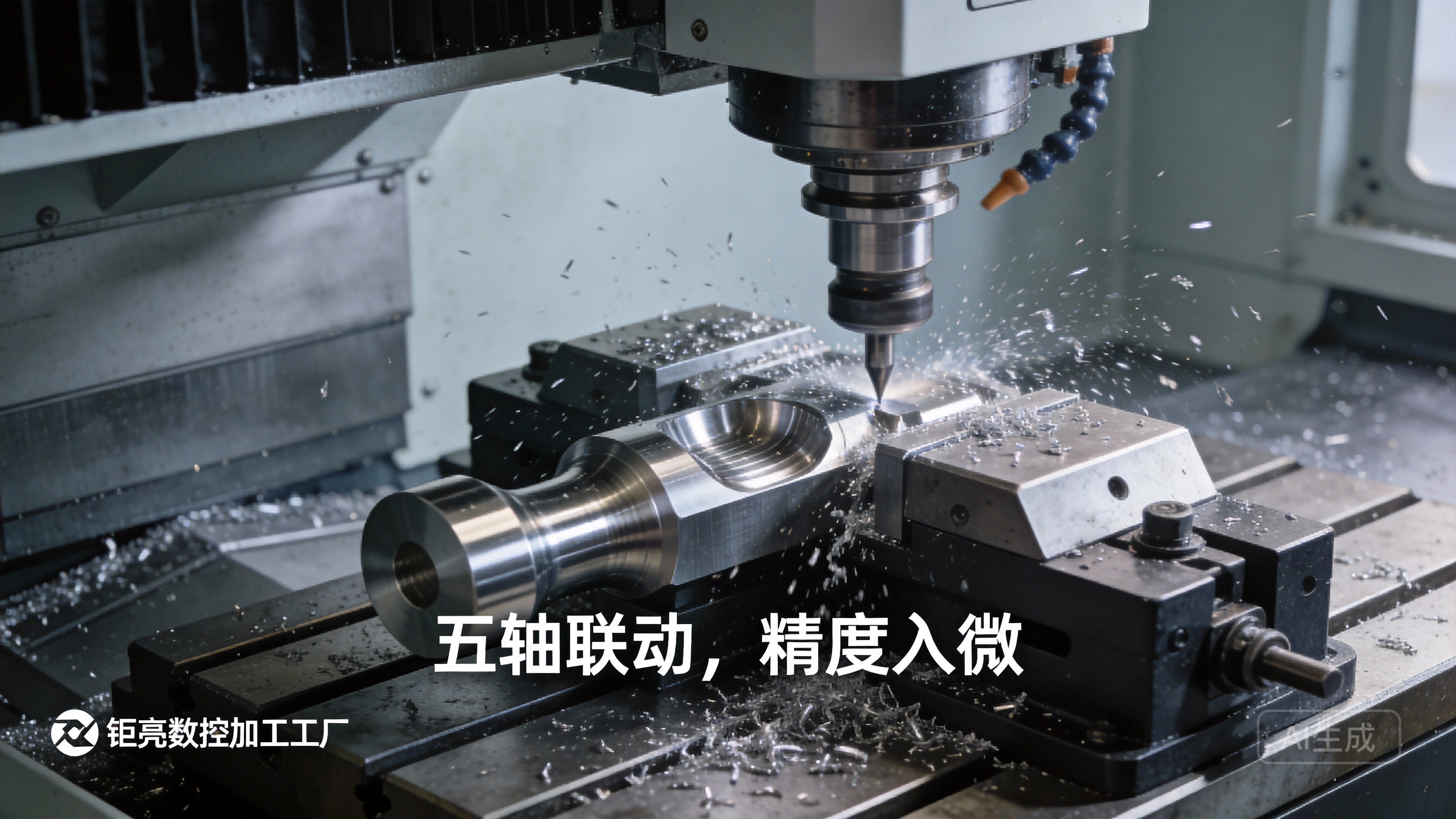
Comparing Approaches: GreatLight Versus Other Manufacturing Models
When sourcing a supplier for a 4-meter shaft, engineers often encounter several types of service models. Understanding the differences helps clarify why an integrated, deep-capability partner like GreatLight Metal consistently delivers better outcomes.
GreatLight Metal – Vertically integrated, in-house long-bed turning up to 4000 mm, plus complementary 5-axis milling, grinding, and finishing. Single-point responsibility from material to final QC.
Jenkins Industries – Focused primarily on heavy fabrication and large-part machining, but typical minimum order quantities and process isolation mean long shafts may be outsourced for secondary operations, introducing coordination risk.
RCO Engineering – Offers extensive large-part capabilities, especially in aerospace tooling, but tends toward low-volume, high-complexity structures rather than production runs of precision shafts, which can affect per-unit cost.
Protocase & SendCutSend – These rapid sheet metal specialists typically handle 2D parts and enclosures; they do not offer long shaft turning in the 4000 mm class.
Fictiv & Xometry – Digital manufacturing networks that source from a fragmented supply base. While they may find a shop with long-bed lathes, consistency across batches suffers because you rarely know which machine actually made your parts.
The takeaway: for long shafts requiring both turning excellence and secondary precision operations, a self-contained, certified manufacturer like GreatLight Metal provides a level of control that distributed networks can’t match.
From Raw Stock to Finished Shaft: The End-to-End Process Chain
Material Preparation and Stress Relief
Long shafts often start as hot-rolled or forged billet. Internal stresses can warp the part after rough machining. GreatLight CNC Machining uses pre-machining stress-relief cycles — either thermal or vibratory — to stabilize the material before finishing. For exotic alloys like duplex stainless steel or Inconel, this step is critical.
Deep-Hole Drilling and Gun Drilling
Many power transmission shafts require internal coolant passages or wiring conduits. GreatLight’s facility integrates gun drilling capabilities, allowing for deep holes with diameter-to-depth ratios up to 1:100, all while maintaining concentricity with the outer turned profile.
Precision Turning Operations
On their long-bed lathes, the sequence is meticulously planned:
Rough turn to remove the bulk of material, leaving 1–2 mm for finishing.
Intermediate stress relief if specified.
Semi-finish turn with dynamic steady rest support.
Finish turn using CBN or ceramic inserts for hard-turned surfaces, achieving Ra 0.4 µm or better.
In-process laser diameter verification and automatic offset adjustment.
Milling and Secondary Features
Keyways, splines, and flange holes are machined on separate 5-axis centers, using the turned shaft’s center holes as reference datums to maintain true position within 0.02 mm.
Surface Treatment and Quality Release
Heat treatment (induction hardening of wear surfaces), plating, or painting can be performed in-house or through their tightly managed partner network. Final inspection involves a CMM with a 4000 mm measuring envelope and a precision level to verify straightness. Only when all dimensions are confirmed against the ASME Y14.5 GD&T callouts is the shaft released.
Why “Cheapest Bid” Often Becomes the Most Expensive for Long Shafts
In my experience, the single biggest mistake engineers make when sourcing long shafts is treating them as commodities. The lowest quoted price frequently excludes the cost of:
Dedicated steady rests and their programming
Thermal compensation calibration
Intermediate stress relief
Runout verification at multiple cross sections
Packaging and shipping of 4-meter precision parts
A shaft that arrives bent, out-of-round, or with chatter marks can easily set a project back months. GreatLight CNC Machining’s “free rework for quality problems, and full refund if rework still unsatisfactory” policy reflects the confidence that comes from a process that works the first time. This isn’t marketing fluff — it’s a direct result of having all necessary technology under one roof.
Real-World Application: A 3800 mm Propeller Shaft for a Marine Test Rig
To illustrate how these capabilities translate into client success, let’s look at a representative project (adapted from industry practice to respect confidentiality). A research institute needed a scaled propeller shaft for a cavitation tunnel test rig. Specifications:
Material: 17-4PH stainless steel, H900 condition
Total length: 3800 mm, maximum diameter 180 mm, minimum 40 mm
Concentricity requirement: 0.015 mm between bearing journals
Surface finish: Ra 0.2 µm on sealing surfaces
Features: internal taper, two keyways, multiple snap-ring grooves
GreatLight’s solution:
Weapon-grade flatbed CNC lathe with 5000 mm capacity, programmed with dynamic steady rest tracking
Rough turning followed by solution annealing and re-hardening performed in sequence
Finish turning with CBN inserts under high-pressure coolant
Keyways milled on a 5-axis center using the same zero-point clamping system to maintain datum integrity
Final inspection on a large-capacity CMM confirmed all geometric tolerances within 70% of the allowable limits
The client achieved first-article acceptance in under four weeks, a timeline that would have been impossible if multiple suppliers were involved.
The Broader GreatLight Ecosystem: More Than Just a Turning Shop
While this article focuses on CNC Turning Shafts Up to 4000mm Length, the true value of working with GreatLight CNC Machining Factory lies in their ability to serve as a comprehensive manufacturing partner. Need a cast end flange that bolts onto the turned shaft? Their die casting and mold-making divisions can produce it. Require a custom packaging fixture to protect the shaft during sea freight? Their design engineers will create and fabricate it in-house. This end-to-end capability eliminates the typical fragmentation that plagues complex hardware projects.
The facility’s investment in 5-axis, 4-axis, and 3-axis machining centers — 127 units total — alongside SLM, SLA, and SLS 3D printers, means that any ancillary component for the final assembly can be produced without involving another vendor. For startups and scale-ups, this dramatically simplifies supply chain management.
Choosing the Right Partner: A Practical Checklist
For engineers evaluating suppliers for long shaft turning, here’s a concise guide to separate real capability from aspiration:
| Capability Area | What to Look For | GreatLight Status |
|---|---|---|
| Maximum turning length | Documented >4000 mm with live examples | ✅ In-house 4000 mm max processing length |
| Steady rest technology | CNC-synchronized, self-centering | ✅ Programmable steady rests |
| Multi-axis integration | In-house 5-axis for secondary features | ✅ 5-axis, 4-axis, 3-axis all on site |
| Thermal management | Real-time compensation strategy | ✅ Closed-loop offset control |
| Metrology | CMM/laser tracker capable of 4-meter parts | ✅ Large-envelope CMM |
| Quality systems | ISO 9001 + industry-specific certs | ✅ IATF 16949, ISO 13485, ISO 27001 |
| Surface finishing | Plating, heat treatment, painting | ✅ One-stop post-processing |
| Minimum order flexibility | Prototype to production runs | ✅ No minimum order, rapid prototyping |
Conclusion: Precision Over Length, Delivered with Integrity
There’s a quiet satisfaction in watching a massive shaft, gleaming with perfect surface finish and all features exactly where they should be, roll out of final inspection. That moment isn’t magic — it’s the result of methodical engineering, honest machine capability, and a manufacturing culture that refuses to cut corners. If your next project involves CNC Turning Shafts Up to 4000mm Length, remember that the right partner won’t just promise you dimensions on a screen; they’ll show you the steel, the setups, and the data to prove it. Explore the possibilities with GreatLight CNC Machining — a factory built on genuine capability, from the heart of Dongguan to your most demanding applications.


![[访谈] RAPID + TCT 2024:人工智能对 3D 打印的价值](https://print-ing.com/wp-content/uploads/2024/07/INTERVIEW-60x60.jpeg "[访谈] RAPID + TCT 2024:人工智能对 3D 打印的价值 9")




发表回复
要发表评论,您必须先登录。